Showing posts with label background knowledge. Show all posts

Wednesday, November 26, 2014

Give your students the two minute challenge

If you've been following me for a while, you may have picked up on a few of my philosophies.  First off, I am a firm believer in the idea that motivation must come from within rather than externally.  Second, in order to be motivated to do something, you must feel like there is a chance that you will find success in whatever it is.

This is the big hangup with a lot of our kiddos.  Success seems so distant to them that refusal is a much better option.  These are the failure accepters.  

During her Friday pre-conference presentation for the Secondary Reading League's Day of Reading, Dr. Janet Allen mentioned a simple way to build some confidence in those who are somewhat resistant when it comes to learning.  The two minute challenge works really well as a background knowledge builder, and as long as you can find a few paragraphs pertaining to your topic, you should be good to go!  Here's how she explained it.
  • Give your students a small passage full of facts on whatever topic you are going to study.
  • Allow your students to read it in whatever format you choose.  You can read it aloud to them, have them read silently (if you have a class full of independent readers), or pair them up and partner read.
  • Set the timer for two minutes and have students write down a set number (she suggested ten) of facts derived from the text.
  • Choose a way to wrap up the exercise.  Sharing in a group of 2-3 is great because they can add to their lists during the group time.  Having them all share one thing from their list with the class may give a few a boost just because it's not often that they have anything academic to say.  This will help them to feel competent, and a feeling of competence breeds intrinsic motivation.  
Doing an activity in the classroom like this one will hit several targets at once.  Many of our students come to us with very little background knowledge, and this is a brilliant way to begin building that for the big learning.  But even more importantly, it allows our strugglers an opportunity to feel successful by participating in writing and discussing the topic in a non-threatening way.

Can you turn around Monday and use this strategy?  Many of you can!  Let us know what your plan is or what you have done in the past to make a strategy like this work for you.  

Happy Thanksgiving!

Friday, November 14, 2014

Admit Slip: 3-2-1

Exit slips are common practice in many classrooms and so are daily "bell ringer" activities.  I never thought to put the two together, however, until I got to hear Dr. Janet Allen talk about this practice this morning at the Secondary Reading League's Day of Reading Pre-Conference.

Last February I blogged on building background knowledge using a really cool activity called Observe, Infer, and Question.  In this activity, students looked at a visual and made observations.  From the observations, they recorded inferences based upon their background knowledge, and then finally the asked questions based upon those observations and inferences. The entire process spanned over an entire class period.

Dr. Allen's strategy is this exact activity, but in the form of an exit slip and at the beginning of a lesson rather than the end.  Here's how it works.

  • As students walk in the door, give them their Admit Slip: 3-2-1 sheets or index cards (one per student).  
  • If you copied a sheet for your students, you can put the picture(s) and/or graphic(s) on it.  For even easier implementation, project the image on the front screen so you don't have to make copies of it and just give your students index cards on which to write.
  • Students first task is the 3.  Write down three details about the image (observe).
  • Their second task is the 2.  Finish this sentence:  I think . . . Then finish this sentence: I also .think . . .  Both sentences should be based from the details they recorded in the first task (infer).
  • Finally, the third task is to write one question based from the details they recorded and/or the inferences in the second (question).  
Once students complete the Admit Slip, you can do a variety of different things with them.  You can collect them to see how much background knowledge each student has on the topic if it's new.  You can begin small group discussions with this information.  You can have an entire class discussion.  Students can share in small groups or with the entire class.  They can also keep their admit slips in an interactive notebook (see my amazing colleague's blog on those right here) or someplace safe so that they can return at a later date to see how much their initial reactions have changed.

Whatever you decide, know that in all content areas, students see visuals and graphics, which means that every content area should be able to use something similar to this strategy.  It would work especially well in geometry, science, and art where content is linked so heavily with visuals.  Think of the possibilities!  How could you use something simple like this?  Share with us in the comments below.  

Friday, September 12, 2014

A-B-C. Easy as 1-2-3.

Sometimes you just need something easy to engage your learners in conversation and get them thinking right away.  The A-B-C brainstorm is such an easy and versatile strategy, and yet it gets little credit for being amazing.  Not only does this strategy engage your aural and social learners in conversation, but it also engages those who are linguistic and read/write learners due to the alphabetizing and writing.  It can be used as a background knowledge retrieving activity , an informal formative assessment, or a note taking strategy.  Here's how simple it is:


  • Give students a copy of the organizer
    click the link for the source
    at the beginning of class or as they walk in (good for visual learners, as there are boxes for drawing pictures and  organized visually). 
  • Direct them to work with a partner or group of three on filling in the organizer with words and/or pictures that directly relate to the topic and begin with the letter in the box (or have that letter in the word - your choice).
  • Students can use their resources or not - it's completely up to you.  
  • Walk around, monitor, and ask questions to engage students in deeper conversations, pointing out other words that can be written in the boxes.  
You can time the activity or not.  I could even see it used as a homework assignment so that your students review learned material from that day.  Making students go into a text book to skim and look for relevant words that are directly related to the topic might make a good preview activity for a selection of text.  For our kinesthetics, make them do it on big paper.  Tape it to a wall if you want to get crazy!  

Keep in mind that a quick reflection should always be used after any strategy.  Start out by saying something like this, "Okay, so what did we do to start out learning today?"  [Students answer with A-B-C Brainstorm]  "How did using this help you to review/learn/dig out background knowledge?" At this, your students should be able to tell you that they talked about it, reviewed the text, wrote about it, etc.  Finally, ask them what part worked best for them and how it relates to them as learners.  Making your kiddos talk about their specific learning preferences is beneficial here because they will begin to relate these preferences with their individual learning, ultimately creating more metacognitive and independent learners.

Sunday, May 4, 2014

Background knowledge and purpose setting - Part 2

This blog is a continuation from last week's blog.  It is an ongoing narrative of a large project in which I am currently involved.  To get the scoop on what has happened previously, go back and read last week's blog.

On Friday I asked my colleague’s fourth period class for a show of hands of students who were more than half way through the biography that they had chosen last week.  Over half the class raised their hands, and some expressed that they had already finished!  Stepping out on a limb, I asked for a show of hands of students who are actually sort-of enjoying the biography (Never ask a middle schooler if they enjoy something about their education.  You’re likely to get crickets.).  What amazed me is the positive response we got when posing this question.  The room was filled with hands in the air.  They were admitting to enjoying  - not just reading – but reading a biography!  And, friends, I am not working with a class full of self-motivated or gifted students!  I’m working with a very diverse group of readers ranging from below average to above average in their reading levels. 

The big question from my former colleague (and tireless volunteer in this adventure) Pam is – WHY?  Why are these kiddos reading?  Why are they enjoying it?  What have we done that would cause a twelve or thirteen year old to find a biography on Helen Keller, Einstein, or Abraham Lincoln so satisfying that they’d want to finish it?  I’ll let you decide that answer for yourself after you read about the steps that we took  last week. 

We left off last blog with a final, class-derived list of the top ten characteristics that made a person highly influential.  Each class (fourth and sixth period) voted on the top ten, and, if you remember from last week, six of those ten characteristics were the same in both classes.  We felt like this was wildly successful.  If almost sixty students could conclude that the same six traits made a highly influential individual, then all sixty of those kiddos read, comprehended, and concluded at relatively the same level! 

Here they are.  The entire collection of pics just waiting to be picked.
The next step in this project was to have students choose their project topic.  Instead of giving the students a list of individuals from which to choose, Pam suggested going to the Library of Congress and printing photographs that represented the different choices we were offering.  She had even gone to the trouble of choosing only people who matched a biography of 100 or more pages in our library collection!  The pictures we printed and put into plastic sleeves before we laid out about 200 of them in the classroom.  The choosing process we conducted just like we normally do Steven Layne  Book Shopping activity (sadly, I can't find a good link for this activity).  With music playing softly in the background, we allowed students about twenty minutes to circulate the room and study the pictures.  Students carried sticky notes with their names on them so that they could mark their final choice when we gave the okay to do so.  Their instruction was to choose a picture that spoke to them.  What we didn't tell them was that the picture would be their choice for the biography project, and the next day we took a trip across the hall to the library where the students each checked out at least one biography that matched their picture from our collection.  Some students were intrigued by their choices, many knew at least the field form which their biography would likely come, and only a small number of students were outwardly upset by their choices.  We dealt with these students individually.
We couldn't get them out of their books!

What happened next was nothing short of miraculous for a group of seventh graders.  Our idea was to come back to the classroom the next day and have the students put themselves into groups according to field (artists, inventors, scientists, etc), which we did.  But we wanted the students to talk amongst their groups and share what spoke to them about the picture, why they chose it, and if they were surprised with the choice.  The picture to the left is what happened instead.  I walked into the classroom in the middle of the period to join the activity, and I was bowled over by what I saw!  These kids were READING.  Now, for those of you who know anything about most middle schoolers, its tough enough to get an entire class to sit still for independent reading when you ask them to, but to give them a social activity and have them choose to read (a biography) instead???  We couldn't believe it, and we finally gave up and let them read.

Working on the flip book
The following day we insisted on moving forward because we wanted our kiddos to read with a purpose before they got too far into their books, so we had the groups create flip books.  On each page of the book, they wrote one of the class-chosen characteristics of an influential person (ie. confident, good public speaker, etc.).  Then they had to go back and think about how that trait applied to their field.  We gave this question frame as an option if the group was struggling: What would it look like if a person in the field of _______________ was _____________?  So some students asked themselves something like What would it look like if an inventor was self-motivated?  They really struggled with this, and we found that, even though they could identify these characteristics as being important for a person of influence, they had a difficult time describing what the trait would actually look like.  This will be an ongoing vocabulary lesson with them as we move through the different stages of research, but there was no way we were going to be able to address all groups with all ten characteristics in one period.  The decision was made that we would clear up misconceptions on a small-group basis rather than with the whole group because each group had different needs.  The final product for this day was the flip book that we kept in a binder for future reference when it came to remembering the purpose for reading.

Pam's big job was to present the Question Formulation Technique (QFT) to the students.  We spent a day with the kids having them, as a group, write down all of their questions about their topic on a piece of poster paper.  Before they began, we reflected back on the essential question:  What makes (their topic) an influential person in (the field)? There were only four rules to the questioning activity:

  1. Ask as many questions as you can.
  2. Do not stop to discuss whether a question is good or bad.  Just write down every question.
  3. Write down questions exactly as they are stated.
  4. Change any statement into a question.

Once students spent time doing this, we then showed our kiddos how to change questions from In the Book questions (a Project CRISS QAR term) to Author and Me questions.  The idea was to show students that purpose changes when you change the questions.  We wanted students to think about questions before they really dove into their reading.  And that was that.  We let them read for two days.

Sticky notes by an average student
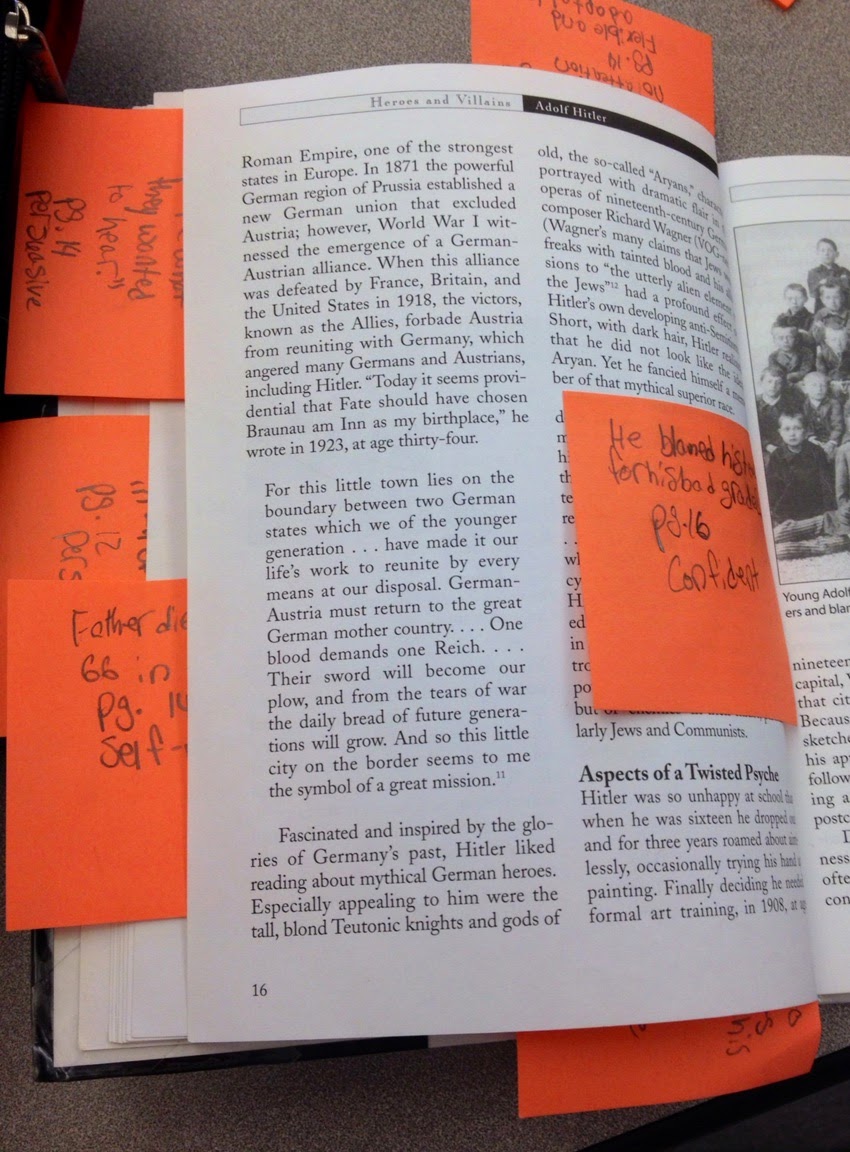
We really couldn't get the kiddos into their books fast enough.  Some of them had already gotten through half of their books because they'd been reading outside of school, and we wanted to arm them with some hard-core purposes before they got any further.  With sticky notes in hand, they attacked their books - looking for examples of the ten characteristics of influential people and answers to some of their preliminary questions.  At this point in the game, we didn't even really want them stopping to jot down notes other than on the sticky notes, and I have to say, it was an effective decision!  Some of them went sticky-note mad, marking spots on every page where they identified examples of how their person demonstrated confidence or public speaking, or the art of persuasion.

As you can see, the heavily-hit background information and purpose setting has made all the difference in the world to these kiddos.  And we still haven't told them what their final product will be!  Because the final product is not our real purpose, we didn't feel like we needed to focus too much on it, and honestly, we are having entirely too much fun to focus on ruining it with a final product.  We do have projects and rubrics ready to go, and the plan is to introduce them this week, but the kiddos are much more interested in the process than the product.  When more than half of them raised their hands when I asked who was enjoying their biographies - I knew we had them hooked.

Saturday, April 26, 2014

Background knowledge and purpose setting - without them you could face epic fail

This topic never gets old for me.  I think it is because I've walked into dozens of classrooms over the years and have heard students ask over and over and over again, "Why are we doing this?"  When those words come out of their mouths, immediately I understand that the relevance of the activity and information has left the building, and the kids are instantly disengaged.  Posting standards and target goals in one's classroom gives a purpose, but the relevance is still not there.  Thus, continued disengagement.  Well, the last two weeks I have been working with two educators who are always willing to step out on the highest cliff with me and peer over just to see what possibilities lie over the edge, and I have to say, its been so wildly successful that we have rallied two more teachers to join us on this adventure!

Its tough to let go of things we have loved from years past.  There is currently a joke running in our department about a dramatic version of The Diary of Anne Frank and how this has been one of the toughest pieces for some teachers to "let go".  My risky colleague is no different.  Last year she and I collaborated on her long-loved biography project.  It's one of those projects that she has been teaching for years, and we needed to revamp it to cover the correct standards.  I'm a firm believer that if you really love something that much, you'll teach it with passion, so I knew that we needed to fix it up and make it work for her.  

Well, she approached me again about this same unit three weeks ago, but this year we were both ready to amp it up.  In the past she has had students choose biographies, read them, and then do some sort of project on the person.  As with so many other long-standing projects across the curriculum, it was a basic research report where kids choose a topic and become the expert on this topic, and we pray that they have found enough relevance and interest in the topic to complete it. This year we wanted to tie in some argumentative tone to the project, so we met and decided to focus on the essential topic Most Influential People.  We decided that students would be required to research a person and then provide evidence that proves that the person is, indeed, one of the most influential people in their field.  

Our first meeting consisted of pinpointing standards that we wanted to be certain to cover in-depth and then outlining our expectations.  We knew we wanted to focus on the research process, and we knew that we wanted to leave the final project open to student choice. After that planning meeting, we met off and on to start the process of front-loading important information, and we decided that we needed to get everybody on the same page in terms of defining what an influential person was.  I was also able to interest my retired former-colleague (and Project CRISS partner in crime) Pam, who loves to come back and share her wealth of knowledge with middle schoolers.  

Because the project has turned out to be one of the most interesting collaborative adventures I have ever had, I wanted to outline, in depth, what we did - partly to share what we have done and partly to remember the beauty of how it all came together.

Our first few days with the students focused on the phrase influential person.  We did a few background knowledge activating activities which ended up being as telling for us as they were for our students.

  • We had students draw a target on a piece of poster paper and fill in people they considered to be influential in their families, school, neighborhood/city, state/nation, and the world.  This was an immediate bust.  It was clear, after only a few minutes, that some of our kiddos could identify the word influential, but few could apply it and identify people they would consider influential because their definitions of the word were so wishy washy.
  • We then went back and had students discuss, in groups, their definitions of the word before they looked it up in the dictionary to clarify their misconceptions.  A whole group discussion took place, and we pointed out misconceptions over several days.  My biggest fear is always that students will go back to their former thinking because its easier and has been ingrained in them for so long.
  • Finally, we had groups discuss and identify a list of ten characteristics they thought a person of influence might have.
Students took purposeful notes
I knew I wanted to hit this idea of influential people really hard, and I also knew that if we didn't clean up all misconceptions on the word that our project would fall apart during the early stages - an epic fail I was not willing to watch, considering we actually had the time to clear things up.  We decided to work this idea for a week.  My colleague and I googled "characteristics of influential people" for kicks, and we found some pretty amazing articles on the web that outlined what these organizations believed it meant to be influential.  We chose 4 different ones (two from Forbes  and the other two from different websites that focused on self-help).  One was so long that we split it into two.  From there we performed the same twisted jigsaw that I had done with a group of kids in science earlier in the year.  
Discussions began
  • Print enough articles for every student to have one (be sure to even out the articles so that each one is read by the same number of students).  Have students choose what article they want to read and get into groups after they've chosen.
  • Give students their purpose for reading the article.  Their purpose is to decide which of the characteristics they feel are most important and to be prepared to explain why by arguing the case for the chosen characteristics.
  • Once everybody in the group finishes, the group must somehow agree on the most important characteristics.  If one person feels strongly about their second choice, he must argue his case, but he cannot choose it unless the entire group agrees.  By the end of this group work, all students in each group should have identical lists of characteristics and be prepared to provide reasons why they were chosen.  Here is where it gets fun.
  • Count each group off again.  In one group, each person gets a different number.  Then put the new groups together by number.  Now each new group should have at least one person in it that has read a different article.  In a normal jigsaw, the job of the group would be to "teach" the information to the rest of the group, but not in this one!
  • Every student in the group will, undoubtedly, have come armed with three to five characteristics of an influential person - all from different perspectives.  The group's job is to whittle down those into a list of their top ten.  What our kiddos found was that one characteristic may have shown up several times, and all they had to do is put some of them together!  Some, however, had to be debated.
  • Their final list then got submitted to us before they left for their next class.
Once we got those lists, we took the time to cut them apart and put like-characteristics together until we came up with a long class list of every trait mentioned.  The next day, we made the class discuss and vote on the final top ten.  What we found beautiful is that six of the ten characteristics chosen for the top ten were the same in both classes!  I'd call that success!

Our kiddos were finally ready to move forward to previewing topics and choosing their biographies.  Reflectively speaking, a few beautiful things happened during this entire pre-learning stage.  
Final lists derived from jigsaw activity
  • In the time that it took us to complete this entire process (about a week), only one student got "schooly" on us and asked what the final project was going to have to be.
  • Misconceptions were cleared up, and we now had an easily accessible list of ten characteristics that students could use while they played detective in their reading of their biographies that they didn't even HAVE yet.
  • Interest was piqued.  I say this with hindsight because we are several days ahead as I write this, and the behavior of the students after they received their biographies blew us away.  More details to follow on this.
  • A good discussion was had in both classes about negative influences and how they would align to the top ten characteristics. Without even doing it, students had developed a top ten list that would easily include the negative influences as well as the positive.
The next steps in this process are just as exciting, but this is a great place for me to stop for now.  What I can say is that every day I cannot wait to step into this classroom to see what is going to happen next.  Even though our plans are secure, the implementation is entertaining.  Watching our students remain engaged excites me.  But what really is interesting is that they all know they will be expected to produce something at the end, but they're so involved in what they're doing right now that none of it seems to matter.  Next weekend, I should be able to report to you the process of choosing topics and beginning the prep for research.  Stay tuned!

Saturday, February 22, 2014

Building background knowledge to create a foundation before reading

One of the key Principles of Project CRISS is Background Knowledge - be it accessing it or building it.  It is not an original thought that if you have background knowledge on a topic, new information is more likely to stick.  We call this schema.  Students who struggle with information and reading in school suffer partly because, more likely than not, they lack background knowledge, or schema, (and this includes the basic vocabulary) on the academic subject.  As I perform reading inventories individually, part of the assessment is to determine the level of familiarity the student has with the text by asking basic questions about the main topic, vocabulary, or theme.  If a student scores less than fifty-percent on the pre-assessment, the passage is considered unfamiliar.  My problem is that no matter what passage I have pulled this year, all the way down to a grade three passage, very few of the passages had friendly text with which any one of my strugglers was familiar!  Imagine trying to read one hundred percent of your required material in school with little to no familiarity of the text.  What a daunting task, and one that would cause immediate stress and anxiety.

So in my last blog I mentioned that I would be working on a social studies activity this week in a U.S. History class.  It was wildly successful, in my opinion, so I thought I would share exactly what we did and give you some ideas as to how you can adapt this type of activity to your own curriculum.  

My lovely example of the organizer
We used the visuals from the text book in Chapter 16.1 to start.  I had the students create an adapted form of the organizer that a respected former-colleague showed me from the Library of Congress teacher-resources website.  I'm kicking myself now because I have a copy of the organizer that I created for them as a model, but I didn't take any pictures of completed student organizers!  So unlike me!  I'm of the mindset where the fewer organizers you give your students, the better prepared they will be.  Creating their own gives them a sense that they can do it on their own rather than waiting to be handed ways to think.  

In the organizer set up by the Library of Congress, students are asked to observe, reflect, and question.  I made mine a little  more user-friendly for our struggling readers, and we asked the kids to write "What I see (observations)", "What I think (inferences)", and "What I wonder (questions)".  I demonstrated using a map of Fort Sumter, talking my way through it and explaining how challenging it was for me because I generally skip the visuals in a select piece of text and dramatically overreacting when I found things I would have missed had I not looked at the visual.  I'm certain the kids think I'm crazy.  

One of the biggest struggles we have in this class is differentiation. We have a comparable population of gifted students and students with IEPs, and most of the rest of the class is composed of struggling readers.  Keeping the gifted students engaged is a tough line of business, and we were delighted to see that they maintained engagement through the entire activity!  When it was their turn to try their hand at the observation of the next visual (a color coded map of the United States during the Civil War), our strugglers took more time to read the visual.  We walked around, pointing out captions and helping them interpret what some of the images might be.  The gifted kids took the ram by the horns and wrote detailed descriptions. Inferences?  Even better!  We supported some of our struggling readers by giving them sentence starters if they needed them (This makes me think . . . ) while the gifted students and some others were able to infer more deeply and support those inferences with details.  Even the level of questioning varied, which was really fantastic!  My colleague and I agreed that we needed to do more activities like this one to keep all engaged (our strugglers were forced to participate because we put them into pre-determined groups where they were equally matched, skill-wise, so they couldn't really depend on their partners to do all the work).  Finally, after performing a third observation on a graph of the resources of the Union and the Confederacy during the Civil War, we asked students to write a prediction of what they would learn in the section.  This helped to bring the information together and set us up to read the summary the following day.

As a bell-ringer activity the next day, my colleague had her students read an adapted version of the section (two brief pages) with some directed reading questions thrown in for kicks.  Before they read it, I suggested that they circle or underline things that they remembered from the section preview the day before.  Words such as Fort Sumter, border states, and West Virginia were great reminders of the visuals we had seen in the section during the preview.  Students read the two pages, we went over some of the directed questions, and we were ready for their note-taking activity.  

After the two background knowledge builders, the actual note-taking went relatively quickly.  All students created another organizer and got right to work (we had them work in pre-determined groups again).  I also will point out that we did not ask students to read the entire selection of text, but we created a purpose for reading and took the five page section down to three for easier manageability.  All-in-all, I was very pleased with how things went this week, and I'm looking forward to more hands-on work in this class.  The idea of using visuals to preview the material made it easy to differentiate and allowed both our visual students and our students who were read/writers to use those skills.  It also allowed those of us with a weakness for visual learning to sharpen that skill.  

The skill of observation can be applied to just about anything:
  • artwork in history, geography, art, foreign language, language arts, or music classes
  • album covers in music, art, language arts, or history classes
  • photographs in any subject
  • 3 dimensional art in social studies, language arts, or art
  • science demonstration setup, art setup, or a demonstration itself in art, PE, science or technical studies
  • graphs, charts, or tables in science, math, social studies, PE, health etc.
  • equations in math or science
  • grammar in sentences in language arts
  • plants or animals in science, health, language arts, or social studies
  • rocks or fossils in science, language arts, or social studies
  • human beings in social studies, language arts, art, PE, health, etc.
The possibilities are so endless!  You could really require this type of studying of anything for a pre-determined purpose.  Take a look at a lesson for next week.  Can you take five minutes and ask students to notice something, write it down, and then make an inference (start out their thinking by saying, "What do you think about it?")?  The more practice our kiddos have in doing this type of exercise, the more observant they will learn to be.  By using this skill, our students are more likely to access or build their own background knowledge, which ultimately leads to more independent learners with a higher academic self-esteem.

Monday, December 30, 2013

The Importance of Building Background Knowledge

Last week I finally got to sit down with our reading professional development coordinator to show her some of the vocabulary and QRI testing results I had been getting on my eighth grade target students.  She confirmed my fear, after looking at all of the scores.  These kiddos needed support in their oral vocabulary in order for them to build reading skills.  This was the first time I had really gotten a chance to approach this dilemma from a reading specialist standpoint, and I was anxious to hear what she had to say.

She introduced me to the idea of multi-level text sets (different texts on the same topic that require students to determine importance and extract information - all part of our new Common Core Standards), which is not a new concept for me in any respect, but for the sole purpose of building vocabulary it was. This conversation started me thinking about some things I then wanted to develop.

She also introduced me to newsela.com, a news website where teachers can find one article on a topic and download it in four different lexile levels! Her thought was to start with the article in a 730 lexile, do a vocabulary building activity, and then read the exact same article in an 850.  The idea is to read the same article four times, each time building more and more background knowledge, more and more vocabulary, until we got to the article at the 1130 lexile.  She also suggested that I try to use an article that connects somehow with content area material that our kiddos might be studying by the end so that the knowledge and vocabulary might support these students in their content-area classrooms!  Genius!

From this, we started to formulate some thoughts that have been brewing over the last month or so - the idea of building background knowledge.  I was talking to a sixth grader who struggles with reading.  He insisted that he wanted to read the Twilight series.  Now, if you're familiar with the read at all, you might know that the lexile level is in the 600s - a nice easy read for an adult, but it is LONG and rather mature for an eleven-year-old struggling reader.  Many of my adult friends found the book annoying and repetitive, and yet I was captivated by the love story.  Still, this boy was insistent and went on to tell me that he had watched the movie several times AND he had read the graphic novel and he LOVED them.  It was at this point when the conversation I had with our reading professional development coordinator started ringing with me again.  This was a perfect opportunity for this kiddo to challenge himself with a lengthy book on which he already had a TON of background knowledge and maybe build some reading stamina.  So we found the novel for him, and he checked it out for winter break.

After these two incidents last week, a few ideas developed.  Aside from my more solidified plan to go to our Tier 3 team with the pull out idea for vocabulary groups, I'm also going to work to target background knowledge building activities with our struggling readers in their content area classes.  Meeting with some of the content area teachers and coming up with lists of specific students to target is next on my list, and then I'd like to somehow target these students specifically.  One big challenge is finding the time during the day for pull out groups.  For now, however, I'm making a list of ideas (many of which come from the CRISS manual) that will help in building background knowledge.

Keep in mind that building background knowledge and activating background knowledge are very different. When activating background knowledge, you assume that the learners have some background knowledge.  Building it means that there is nothing filed away in your students' schema for them to build upon, and now, not only are you responsible for the new knowledge, but you have to give your kiddos some background in order for the new knowledge to stick as well.

Let me give you an example.  I worked in December with a few colleagues who had their sixth graders writing a RAFT assignment.  The idea was that students would use multiple texts to research something specific about the Olympics and then write a perspective piece based upon that research.  During the time students were supposed to be writing, I noticed that critical pieces of information were being left out or wrongly assumed.  Then it hit me - when one student began to write about a skiing event, and her first paragraph mentioned traveling to an arena for the event.  I finally asked her if she had ever seen an Olympic skiing event before, and she shook her head.  Another one struggled to write about her ice skating event until I realized she had never seen an Olympic ice skating competition or ANY ice skating competition, for that matter.  After that, I spent the entire day looking up Youtube videos of the different events and watching them with the kids.  Two things could have been done to prevent this - and I don't know why we didn't think of it before beginning the project.  Hindsight is always 20/20, I suppose.  We could have spent a day watching videos of the different events together OR we could have left a few more days for research and insisted that each student watch several videos of the events.  However it was, we have noted it and I would like to see us include the extended time for next year's project.

So for this blog, I've made a list of background activation activities and background building activities so that you can begin to think about how to use these effectively with your students.  Keep in mind that many of your students who struggle with reading may need background knowledge building activities because they lack much of the vocabulary necessary to function at grade level.  I think our biggest problem here is differentiation.  You will, undoubtedly, have students in your class who have access to background information.  How you will use some of these ideas in your classrooms most effectively is the next step.  I realize that you may not have these strategies in your pocket, and if you don't, please don't hesitate to ask about them.

Background activation activities

  • Preview the reading by looking at text features (titles, subtitles, illustrations, vocabulary, etc.) and making connections/predictions in partners or groups of three.  Give specific guidelines for group work and set strict time limits.
  • Use an easy organizer (such as a word map or Venn diagram) and have students work individually or in pairs to fill it out before previewing the information.  
  • Easy word sorts or pattern puzzles (both strategies require words cut up ahead of time and are basically matching activities - ironically interesting for our older students) in partners or groups of three.  These usually work, themselves, as classroom managers so you won't have to do much work in terms of management unless you find that your students have no background knowledge on the topic.  In which case, you'll want to skip down to the next section.
  • Discussion strategies such as the ABC Brainstorming (literally a list from A-Z where students have to think of an on-topic word that begins with each letter of the alphabet), mind streaming (partners each have to spend one minute blurting out any information that comes to mind on the topic without interruption or stopping), Discussion Webs, Carousel Brainstorming, and previewing using questioning techniques
  • K-W-L plus (categorize information gathered on the K-W-L)
  • Anticipation Guides (agree/disagree questions for students to consider that are directly related to the topic) and Double Entry Reflective Journals (Questions or statements to be answered before learning and then again after learning.  It's my personal favorite.)
  • One sentence summaries and/or paragraph frames before learning
Background building ideas
  • Youtube, United Streaming or another video websites
  • Articles and/or other text-selections well-below grade-level on the same topic
  • Preview vocabulary necessary for learning (use an engaging activity such as word sorts and pattern puzzles that are more guided)
  • Web quests or website exploration
  • Photos, pictures, artwork, primary source documents (with active learning strategy attached - you could consider having students work through a Double Entry Reflective Journal with these.)
  • Easier non-fiction text to build knowledge for fiction and visa versa
  • Picture books (another favorite of mine!)
  • Musical recordings (with an active learning strategy attached. - for example, have students journal how the music makes them feel when listening.)
  • Cartoons (for some reason the Simpsons seem to have an episode for everything!)
  • Poetry or lyrics to songs
  • Field trips (if your students are lucky enough to be in a district that funds them)

And the list goes on and on . . .

Friends, I implore you to really look hard at your clientele.  Our students need us to understand that we can't take for granted that any of them have the background knowledge or the vocabulary to tackle even the easiest knowledge, skills, or information in our classrooms.  Don't leave your kiddos behind because they lack the background necessary to easily pick up on what others can manage without much thought.  Observe. Evaluate. React. Give them success that they might not have otherwise.

Happy New Year.

Friday, September 13, 2013

September 13 Crumble - Purpose Setting - the key to engaging our students

I have a ten-year-old who doesn't like to read.  But every once in a great while I can't get her head out of a book.  It's at those times when I look at her and ask myself, "What is different about this time, and why is she making the choice to read?"  In her case, eighty-percent of the time it is a non-fiction book that has captured her with a picture that made her go, "What's that!"  And at her age she knows that she will find the answer inside. 

So how can we transfer this type of behavior to our classrooms?  One of Project CRISS's Principles and Philosophies is Purpose Setting - but we're not just talking about telling kiddos why they're doing what they're doing.  Purpose setting comes in all sizes and shapes - including the "sneaky-teacher" ways of getting kids interested.  Here are some ideas to get your students motivated to read, learn, and participate.
  • Play a video related to your content (YouTube, United Streaming, DVD clip) that is not too long (6-8 minutes max) - something that is edgy or entertaining, and maybe evokes emotion.  After the video, ask students to write observations and reactions.  Give them a sentence frame if you think it will help.  Expect them to give details about their observations and reactions. Have students discuss and share their thoughts and then have them ask questions about it. You now have the beginnings of purpose (their questions).
  • Use music.  Kids love music.  Many of them write, and if you approach their lessons in a way that breaks down their own music or allows them to understand what goes INTO writing it, those with a musical inclination are more likely to participate.  Is there music that relates to the topic at hand?  I'm not talking a song about the scientific method or the fifty states, but music that somehow connects to the topic at hand.  You make the connections for them initially.  Have them observe and ask questions. 
  • Google Images is, hands down, one of the most fun places to go when you're curious about something.  Why not use it to gather some attention and show images that related to something in the lesson before giving the lesson and see if you can get kids to react to it.  So how does your topic of study connect to students' lives TODAY?  Find some images.  Have students write and discuss their observations and reactions and . . . you guessed it - ask questions!
In the three general ideas listed above, there are some commonalities that I'd like to point out, and then I'll let you take it from there. 
  • Get the kids thinking about the topic before they learn.
  • Engage them in something other than reading or talking (viewing, listening, or playing).
  • Require them to observe, write, and react.
  • From those observations, require them to ask thoughtful questions.  The questions asked can be used to drive your instruction or not - but a good educator can easily find the balance between what the kids want to know and the stuff that we're being told is important. 
It's not tough - in fact, I find that our purpose setting activities can be the most fun part of the lesson because it requires students to express themselves.  This is the beauty of middle school!  They're just learning to express themselves - their viewpoints and opinions, and yet we don't have to reel them in too much.  You can learn so much from just talking to your kiddos, and who knows?  Maybe what you learn from them is a new way to look at the topic!