Showing posts with label Project CRISS. Show all posts

Saturday, November 1, 2014

You Ought to Be in Pictures – Using the Visual to Strengthen the Linguistic

I had a wonderful conversation with a colleague a few days ago about student strengths, and since this conversation, I’ve been hypothesizing all sorts of things about the way our kiddos behave in the classroom.  I don’t have to tell many people this, but according to the Birmingham Multiple Intelligence Test, one of my highest intelligences is musical/rhythmic. I don’t get to use this intelligence much in the classroom, however.  This year, I’ve been illustrating the use of our intelligences to my students by bringing up my lack of kinesthetic intelligence.  To clarify, I hate exercise and anything associated with it.  I don’t learn by doing, and I hate moving around.

But I’m forty.  And if I plan to live a long time, I need to get moving.  So in January I started running.  The only way I can get myself moving – be it outside or on a treadmill – is to blast music at just the right BPM into my ears for the entire run.  And so I did.  It’s been ten months since I started, and I ran over two miles this morning.

My point is – I used my musical intelligence to pull me through my weakness in my kinesthetic, which is strengthening every day.  This made me start thinking about the number of kiddos we have who can’t do their homework unless they’re listening to music.  It’s not all of them, but many of our students have a musical/rhythmic strength that may pull them through the trials of not being linguistic or mathematical/logical

Today’s strategy uses visual to strengthen linguistic.  So many of our kiddos are visual learners, that if we don’t use that to our advantage, we miss out on a huge opportunity to strengthen other areas!  This particular strategy is one outlined in the Project CRISS manual as You Ought to Be In Pictures and can be used in any content area.  Here’s how it works.

Choose a picture or cartoon for the students to view either on the projector or photocopied.  Depending on your objective of the lesson, give your students instructions as to how to use the picture.  You could choose to have them:
  •  Answer questions based upon what they see.  If you are using the picture at the end of a unit, perhaps they need to use what they’ve learned to help them answer those questions.
  • Caption the picture using information they’ve learned.
  • Caption the picture using specific words that they’ve been studying during the unit.
  • Describe what might be happening in the picture based upon what they’re learning.
  • Notice specific things in the picture and write about it.
  • Write a narrative about what is happening in the picture.  

Some examples of how this could be used are below.
  •  Language arts – Caption the photograph using specific words or a part of speech correctly.
  • Social studies – Caption the photograph knowing what you know about life in a specific time period.  Use three of the vocabulary words we have studied.
  • Science – Write a narrative about what is happening in the photograph, now that you’ve conducted an experiment that looks similar to it.  Use these three vocabulary words in your narrative: ___, ___, and ___.
  • Health – Look at the graphic and write a narrative about the way that the respiratory system works using your vocabulary correctly.  Be sure to include all parts of the system.
  • PE – Use the photograph to help you write a narrative about a person teaching a seven year old to play this game for the first time.  Be sure to include the rules that the person would have to learn in order to not get hurt.
  • Math – use the photograph to write a word problem based upon what you see.  Solve the problem and explain what you did and why.
  • Music – Use the photograph and the piece of music we just learned to write a short story.  Bring them together using what we learned about the meaning of the piece.
  • Art – Use the photograph of this artist to write a story about what is going through this artists mind as she is creating.  Use three of the words we have learned in this unit to explain the process of her creation.
  • Woodshop/Life Skills - Use this photograph to explain why this person got hurt.  Include safety tips that we learned this week and how you know the person in the photograph didn't follow the rules.
It takes a little creative thinking on your part, but you can tie photographs in anywhere for your visul/spacials and use them to help your students strengthen their other areas of intelligence.  Keep in mind that the writing is going to be really hard for some of them - especially if they're not accustom to writing in your content area.  Stick with it, though.  Make them write once a week, and they'll start expecting it.  They know when it's "pacers" day in PE - whether they like it or dislike it - they come to expect it.  They can come to expect to write weekly, as well, in any content.  It just takes practice and determination on your part.  I know that it's not just your kiddos whose boxes are being shaken up a bit - its yours too, but you'll get used to it, and some of you may actually enjoy the change of pace!  

How can you use this type of activity in your content?  Share your ideas with us in the comments.

Friday, October 17, 2014

Make information stick with magnet summaries

It's amazing how much useful information one can retrieve from one session at a conference!  This week's blog stems from the same session from the IRC 2014 Conference as the last two I have written.  The strategy is magnet summaries, which also happens to be a CRISS strategy. Double score!

Magnet summaries can be used in a variety of contexts, which is what I love about the strategies in the Project CRISS manual.  They're all very adaptable.  Here's how this one works:

  •  Give each student an index card or half sheet of paper.  On the "front" have the students write the topic you want them to summarize.  For example, if you're teaching students about variables in math, write variables on the front of the card.  
  • After the initial lesson, have students go back to their notes (maybe do this in partners to keep your interpersonals happy) and find four words that stick out as being key words connecting to the word in the middle (one or more will probably be another vocabulary word, which should help with information transfer).  When talking about variables in math, you might have words like constant, coefficient, operator, and equation.  


    http://hs-englishliteracy.wikispaces.com/file/view/
    strategy8.JPG/250740026/703x521/strategy8.JPG
  • On the back of the card, students can expand their words into sentences.  Depending on the writers, you may choose to let them freely write their summary based upon the five words on the front of it, OR you may want to give your students a frame.  The frame might look something like this:
Today's lesson explains [topic] by talking about ______, ______, ______, and ______.  [Write one sentence explaining each of the four magnet words or combine them into a few sentences if they easily connect.] It is important to know this because ___________________. 

The picture to the right is one way a student could write a magnet summary if you were allowing them some freedom in their writing or if you have very comfortable writers.  One thing that I liked about the session I attended at the IRC Conference is their attention to reflection, which is not included in the example above.  The last sentence in the frame above in red addresses the reflection.  Students need to justify why the information is important.  This does two things - it validates why the information is being taught and creates a reason to connect the information to either new information, past information, or student's lives.  

So think about the next lesson you plan to share with your students.  How can this strategy be adapted?  Could you add it easily?  Could you use it as a formative assessment?  Share your ideas with us in the comments below.  


Sunday, October 12, 2014

Applying vocabulary - More than just writing sentences

Teaching vocabulary is tricky and can sometimes become monotonous if you don't change it up.  Often, we want to present vocabulary to students before reading, but then what?  Well, when I was at the IRC Conference a few weeks ago, I was reminded of this really simple, yet super effective activity.  It is called Interact with Vocabulary. Here's how it works.

After you've introduced vocabulary and have established definitions and examples using a technique like the Frayer model, it's time to apply the information.  Pre-write questions to ask.  Try to connect the vocabulary to your students' lives.  For example:

  1. Name one thing that happens unintentionally in the hallways at school. [general Tier 2 vocabulary]
  2. Why is the system of checks and balances important for you as a citizen of the United States? [social studies]
  3. What is one reason you would measure perimeter of something? [geometry]
  4. Why would one need quick reaction time? [health]
  5. Name one popular song that would sound better piano rather than forte. [music]
  6. What is an example of a network that teenagers may use every day? [computer tech]
  7. Give an example from school of convection. [science]
Not every vocabulary term has practical life application, so you could also write your questions in perspective.  For example:

  1. If you were a constructivist artist, which medium would you prefer and why? [art]
  2. As a tyrant of a Greek city-state, what is one job that you would do well and why? [ancient history]
  3. You are planning to build a bookshelf.  What tools should you plan to use, and why? [woodshop]
The next decision you'll have to make is how to have your students interact with their vocabulary.  If you're a teacher who needs proof of accountability, try the following ideas.  I'm an advocate for the interpersonal (social) student, so you'll see that these all include discussion:
  • Type up the questions in a worksheet and have them record the answers from their discussion so that all of the group members has a copy.  Everybody's answers should match.  Share out as a class or conference with each group as discussions progress.
  • Give each group a copy of the questions and have them discuss and record on a large piece of poster paper (more for your visual and kinesthetic students).  Share out with the class or conference with each group as discussions progress.  Post answers around the room after discussions.  
  • Put up poster paper around the room and have the students carousel each of the prompts.  Give students forty-five seconds to a minute at each station.  
  • For my digital-teachers, use Google docs and have all groups contribute to the same document in different colors.  Monitor what students are writing and conference with groups as misconceptions emerge.  Print a copy for each student.  
The title Interact with Vocabulary immediately indicates that more will be happening than just reading definitions.  Using student schema to learn, is a sure-fire way to ensure longer retention, but its also a great way to assess whether a student truly understands that meaning of the words.  But just as important is the idea that we should be choosing applicable vocabulary.  Educating our students is not just about taking words from a text book, it's about applying them.  It's our job to be sure that the words apply.  

What challenges do you see in using a strategy like this one?  Share those with us in a comment below. 

Friday, October 3, 2014

A Cornell Notes Comeback!

On Thursday I attended a session at the Illinois Reading Conference in Springfield entitled Success in Science Through Literacy Strategies.  The four presenters Katie Giambeluca, Jamie Moderhack, Melissa Sethna, and Alyssa Wiltjer were all from Mundelein High School.  After spending some time with them both in the session and with some Mundelein teachers later on that evening - and after attending a subsequent session the next day with another set of amazing teachers from Mundelein (blog to follow in the future), I am convinced that Mundelein really has it going on out there, and I want to see and hear more!
http://caren-iannelli.blogspot.com/

One thing I found interesting in the few days I've been here in Springfield is the number of times that Cornell Notes have been referenced (or Two-Column Notes for my Project CRISS friends).  I find this amusing because Cornell Notes never seem to really go away!  After doing some research, I discovered that they got their beginning in the 1950s - obviously an oldie but a goodie, and they have withstood the test of time!  Even more interesting is that I have heard about this strategy three times in three different sessions in reference to science instruction.

Regardless of the content, Cornell Notes can be used effectively as a note taking and study strategy.  Your read/writers would use this most effectively because there are no limitations on how lengthy your notes can be.  Those of us who are linguistic tend to like limitless possibilities for writing.  BUT, they're also a really great setup to keep students organized AND a very useful tool for studying.

Here's how they work.

  1. Have students split their paper into four sections as shown above to the right (kind of like a capital I but off center).
  2. Give students a purpose for reading (or watching a video or participating in a discussion or activity - however you plan to deliver information), and have them write the purpose on the top of the paper.  For example, watch the video to gather information on how climate patterns have changed over the last one hundred years.
  3. Instruct students to jot down notes or draw pictures/diagrams (for our visual students) in the big right hand column.  The notes/pictures should connect to the purpose (skip a line between notes).  Notes should not be in full sentences and should/could be abbreviated as much as possible.
  4. After note-taking is completed, students should go back and read their notes, pulling out key ideas, names, dates, and vocabulary. These can be listed on the left in the skinny column.  Also, any questions students may still have about the material can be written in this column for future inquiry. This entire step can easily be done in small groups so that our interpersonal students get their chat release and so that all of our kiddos can process and grapple with what the key points really are.
  5. Finally, as a group or individually, on the bottom of the page, have students write a few sentences, summarizing those key points listed in the right column.  Again, this could easily be done in small groups.
Once the note taking process has happened, students now have beautifully constructed notes that can be a fantastic study tool for something like a twelve minute study.  Students can approach studying their Cornell Notes like this.
  1. Reread your notes in the bigger right hand column, looking for specific examples or details that might be important.
  2. Look at your key ideas on the left, and ask yourself if you really understand them.  If not, how can you help yourself understand them?
  3. Reread the summary.  
  4. Do this for a set amount of time (eight minutes for eighth grade, six minutes for sixth grade, etc.) every day up until the test or quiz.
No matter if you know them as Cornell Notes or Two Column notes - the premise is the same - this type of note taking strategy is useful in any area that a student would need to record information to be used for studying at a later time.  Once your students have gone through the process, have them reflect on themselves as learners and how the practice of organizing their notes in this manner has benefited them.  Be prepared to hear how much students found them to be seriously beneficial.  But also be prepared to hear how difficult they were for some.  Remember that no strategy works for everybody, and our job is to shine a spotlight on what might work for each of our students as individuals so that they can begin to feel control over how they organize and take their own notes.  Our job is to create independent learners, and this is a perfect tool to put into their hands.

What kinds of successes have you had with Cornell Notes?  Share those below.

Friday, September 12, 2014

A-B-C. Easy as 1-2-3.

Sometimes you just need something easy to engage your learners in conversation and get them thinking right away.  The A-B-C brainstorm is such an easy and versatile strategy, and yet it gets little credit for being amazing.  Not only does this strategy engage your aural and social learners in conversation, but it also engages those who are linguistic and read/write learners due to the alphabetizing and writing.  It can be used as a background knowledge retrieving activity , an informal formative assessment, or a note taking strategy.  Here's how simple it is:


  • Give students a copy of the organizer
    click the link for the source
    at the beginning of class or as they walk in (good for visual learners, as there are boxes for drawing pictures and  organized visually). 
  • Direct them to work with a partner or group of three on filling in the organizer with words and/or pictures that directly relate to the topic and begin with the letter in the box (or have that letter in the word - your choice).
  • Students can use their resources or not - it's completely up to you.  
  • Walk around, monitor, and ask questions to engage students in deeper conversations, pointing out other words that can be written in the boxes.  
You can time the activity or not.  I could even see it used as a homework assignment so that your students review learned material from that day.  Making students go into a text book to skim and look for relevant words that are directly related to the topic might make a good preview activity for a selection of text.  For our kinesthetics, make them do it on big paper.  Tape it to a wall if you want to get crazy!  

Keep in mind that a quick reflection should always be used after any strategy.  Start out by saying something like this, "Okay, so what did we do to start out learning today?"  [Students answer with A-B-C Brainstorm]  "How did using this help you to review/learn/dig out background knowledge?" At this, your students should be able to tell you that they talked about it, reviewed the text, wrote about it, etc.  Finally, ask them what part worked best for them and how it relates to them as learners.  Making your kiddos talk about their specific learning preferences is beneficial here because they will begin to relate these preferences with their individual learning, ultimately creating more metacognitive and independent learners.

Wednesday, September 3, 2014

Using a three-minute-pause to break things up

I rarely walk into a classroom anymore where a teacher starts a video at the beginning and lets it just run all period.  Those days are long gone, thanks to United Streaming and YouTube where we can pull a seven minute clip rather than a forty-five minute documentary.  Last year I blogged about studying for tests, and I mentioned that I usually consider a minute per grade level the maximum a student can do the same thing before zoning out.  So for the average eighth grader, we're looking at about eight minutes of note taking, video gazing, worksheet doing, or even group discussion before they get sidetracked and lose focus.

Enter: the three minute pause.

I love this strategy because it is a quick and easy way for a student to regain focus and for the teacher to gauge what is happening inside the student's head.  Here's how it works.

  • Decide ahead of time if you want students to discuss while pausing or work independently.  I tend to lean toward discussion if the lesson has been a sit-and-get with note taking or independent if the students have been actively involved in discussion or activity.  
  • Also decide ahead of time how you want your students to be held accountable for the pause.  Should they write out their answers on a page?  On a large piece of poster paper?  Sticky notes?  Record it?  
  • After eight minutes of a video or note-taking, find a logical stopping point and pause.
  • Ask students to summarize key points so far, make connections and react to what they've learned, and ask questions or predict what they will learn next.
  • Resume the activity.
  • At the end of the activity, take a few minutes to have a group discussion about how the Three-Minute-Pause worked for them as learners, and get a feel for who seemed to benefit more than others.
And that, my friends, is it.  So go ahead.  Use it, and use it often.  Watch that forty-five minute video.  Make those kiddos take notes for the period.  But pause, pause, pause.  Don't forget who you have sitting in front you, and understand that they're all going to need to get refocused - even if you are shoveling the information in by means of the correct learning style.  

Friday, August 22, 2014

Digging into the Frayer Model for word understanding

Word knowledge happens in layers.  We are first introduced to a word, learn the meaning, how it might be used - but then over time we begin to place that word on a continuum where we can relate it to others that may have slightly different connotations.  Our ultimate goal should be to add the word to our word bank so that we might communicate more effectively over time.  Studies show that the word-exposure gaps between children in poverty and children of affluent families are staggering - millions of words!  What does that tell you about the communication skills of some of those kiddos who come to us everyday from low-income families?  It tells me that I need to work double hard to ensure that these children have a competitive chance!

One of my go-to strategies is the Frayer Model.  Now I've seen this strategy morphed into dozens of different organizers - all with the same outline but different prompts.  The ultimate goal here is to add the word to a continuum of words so that we can pick from a variety of words that might mean similar things.

The Frayer is a great tool for our visual /  spatial students who like to see relationships and information organized spatially.  You can have them draw pictures or write in the boxes.  Make the boxes big enough and your linguistic kiddos will enjoy this one also because there is potential for lots of room to write (although may of them like lines on which to write).  Put it on the sidewalk in chalk and now your kinesthetic students will have to bend down and crawl around to write on it.  Make them move!

Here's how it works:

  • Place the word to be studied in the middle oval.  
  • I prefer to write "What it is" instead of definition because it leaves for some wiggle room on a definition.  Definition, to many students, means open up a dictionary and copy the first definition for the word.  Before any of my students write down what it is, we discuss, and then they write down what it is.
  • When using characteristics, be sure that the word has some distinct characteristics.  This could take some grappling, but it's not supposed to be easy, either.  Characteristics can be replaced with "What it is not".  I LOVE asking kids to identify what it is not because it makes them think in a way that requires more distinct lines drawn between words.  This will also require some discussion and grappling as well.
  • Examples requires students to take it a step further.  Now they can't just define it, but now they have to apply the information, which is, again, a visual strategy.  Don't forget you can have them draw. They don't have to write.
  • Finally, non-examples, again, requires students to stop, back up, and think backwards.  I've also used the prompt connection here to make my students connect the word somehow to their own background knowledge.  Research clearly shows that linking new knowledge gives the information a better chance of sticking.  
Keep in mind that once all is said and done, having students reflect on what the strategy did for them as a learner is always beneficial.  It'll be painful at first, but drawing attention to them, as learners, keeps them thinking that these strategies are not just gimmicks but true learning tools.  

And that is it.  A quick (yet not-so-quick) vocabulary acquisition strategy that can be used over and over and over again and in every content area.  You can use it on paper, make it miniature and put four on a piece of paper, or create gigantic ones on sidewalk with chalk.  What are some ways you can see adapting this simple strategy to your teaching?  Have you used a Frayer before?  What are some of the ways you have used it, and how have you had your students reflect on their learning afterward?

Sunday, May 4, 2014

Background knowledge and purpose setting - Part 2

This blog is a continuation from last week's blog.  It is an ongoing narrative of a large project in which I am currently involved.  To get the scoop on what has happened previously, go back and read last week's blog.

On Friday I asked my colleague’s fourth period class for a show of hands of students who were more than half way through the biography that they had chosen last week.  Over half the class raised their hands, and some expressed that they had already finished!  Stepping out on a limb, I asked for a show of hands of students who are actually sort-of enjoying the biography (Never ask a middle schooler if they enjoy something about their education.  You’re likely to get crickets.).  What amazed me is the positive response we got when posing this question.  The room was filled with hands in the air.  They were admitting to enjoying  - not just reading – but reading a biography!  And, friends, I am not working with a class full of self-motivated or gifted students!  I’m working with a very diverse group of readers ranging from below average to above average in their reading levels. 

The big question from my former colleague (and tireless volunteer in this adventure) Pam is – WHY?  Why are these kiddos reading?  Why are they enjoying it?  What have we done that would cause a twelve or thirteen year old to find a biography on Helen Keller, Einstein, or Abraham Lincoln so satisfying that they’d want to finish it?  I’ll let you decide that answer for yourself after you read about the steps that we took  last week. 

We left off last blog with a final, class-derived list of the top ten characteristics that made a person highly influential.  Each class (fourth and sixth period) voted on the top ten, and, if you remember from last week, six of those ten characteristics were the same in both classes.  We felt like this was wildly successful.  If almost sixty students could conclude that the same six traits made a highly influential individual, then all sixty of those kiddos read, comprehended, and concluded at relatively the same level! 

Here they are.  The entire collection of pics just waiting to be picked.
The next step in this project was to have students choose their project topic.  Instead of giving the students a list of individuals from which to choose, Pam suggested going to the Library of Congress and printing photographs that represented the different choices we were offering.  She had even gone to the trouble of choosing only people who matched a biography of 100 or more pages in our library collection!  The pictures we printed and put into plastic sleeves before we laid out about 200 of them in the classroom.  The choosing process we conducted just like we normally do Steven Layne  Book Shopping activity (sadly, I can't find a good link for this activity).  With music playing softly in the background, we allowed students about twenty minutes to circulate the room and study the pictures.  Students carried sticky notes with their names on them so that they could mark their final choice when we gave the okay to do so.  Their instruction was to choose a picture that spoke to them.  What we didn't tell them was that the picture would be their choice for the biography project, and the next day we took a trip across the hall to the library where the students each checked out at least one biography that matched their picture from our collection.  Some students were intrigued by their choices, many knew at least the field form which their biography would likely come, and only a small number of students were outwardly upset by their choices.  We dealt with these students individually.
We couldn't get them out of their books!

What happened next was nothing short of miraculous for a group of seventh graders.  Our idea was to come back to the classroom the next day and have the students put themselves into groups according to field (artists, inventors, scientists, etc), which we did.  But we wanted the students to talk amongst their groups and share what spoke to them about the picture, why they chose it, and if they were surprised with the choice.  The picture to the left is what happened instead.  I walked into the classroom in the middle of the period to join the activity, and I was bowled over by what I saw!  These kids were READING.  Now, for those of you who know anything about most middle schoolers, its tough enough to get an entire class to sit still for independent reading when you ask them to, but to give them a social activity and have them choose to read (a biography) instead???  We couldn't believe it, and we finally gave up and let them read.

Working on the flip book
The following day we insisted on moving forward because we wanted our kiddos to read with a purpose before they got too far into their books, so we had the groups create flip books.  On each page of the book, they wrote one of the class-chosen characteristics of an influential person (ie. confident, good public speaker, etc.).  Then they had to go back and think about how that trait applied to their field.  We gave this question frame as an option if the group was struggling: What would it look like if a person in the field of _______________ was _____________?  So some students asked themselves something like What would it look like if an inventor was self-motivated?  They really struggled with this, and we found that, even though they could identify these characteristics as being important for a person of influence, they had a difficult time describing what the trait would actually look like.  This will be an ongoing vocabulary lesson with them as we move through the different stages of research, but there was no way we were going to be able to address all groups with all ten characteristics in one period.  The decision was made that we would clear up misconceptions on a small-group basis rather than with the whole group because each group had different needs.  The final product for this day was the flip book that we kept in a binder for future reference when it came to remembering the purpose for reading.

Pam's big job was to present the Question Formulation Technique (QFT) to the students.  We spent a day with the kids having them, as a group, write down all of their questions about their topic on a piece of poster paper.  Before they began, we reflected back on the essential question:  What makes (their topic) an influential person in (the field)? There were only four rules to the questioning activity:

  1. Ask as many questions as you can.
  2. Do not stop to discuss whether a question is good or bad.  Just write down every question.
  3. Write down questions exactly as they are stated.
  4. Change any statement into a question.

Once students spent time doing this, we then showed our kiddos how to change questions from In the Book questions (a Project CRISS QAR term) to Author and Me questions.  The idea was to show students that purpose changes when you change the questions.  We wanted students to think about questions before they really dove into their reading.  And that was that.  We let them read for two days.

Sticky notes by an average student
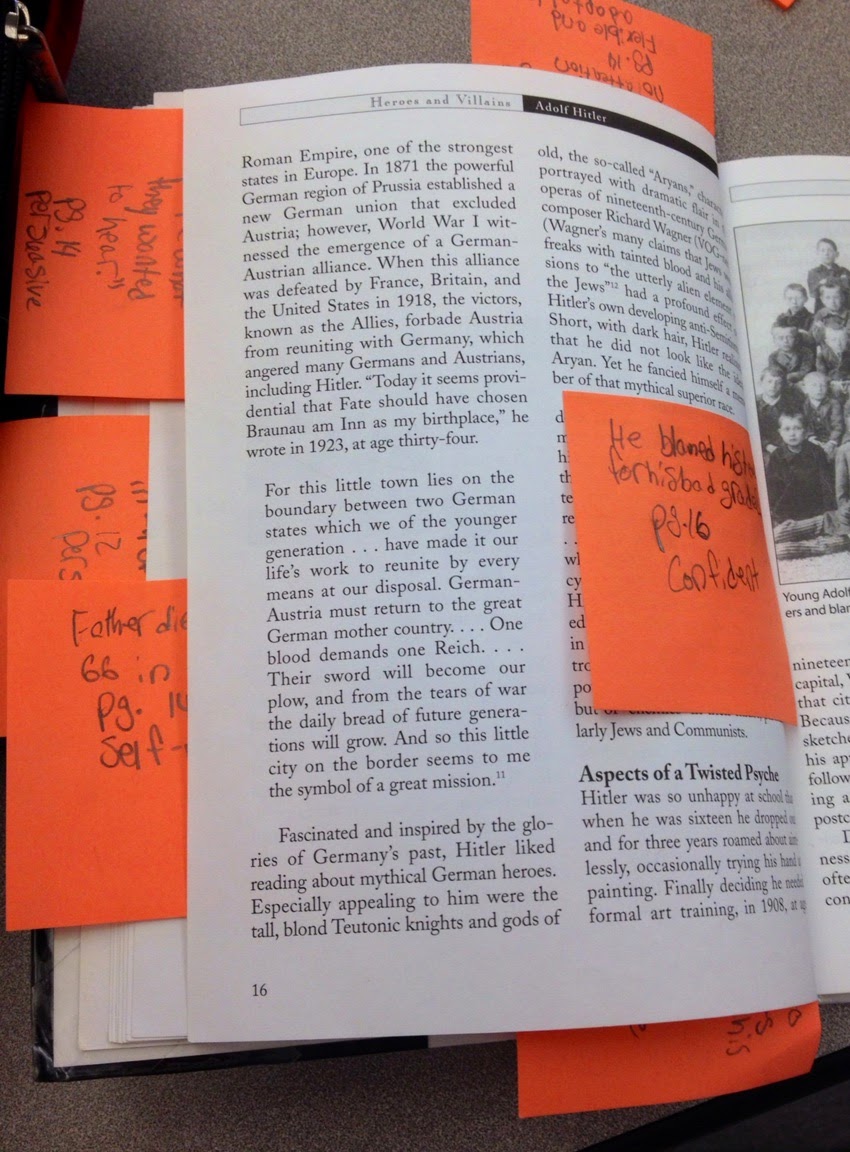
We really couldn't get the kiddos into their books fast enough.  Some of them had already gotten through half of their books because they'd been reading outside of school, and we wanted to arm them with some hard-core purposes before they got any further.  With sticky notes in hand, they attacked their books - looking for examples of the ten characteristics of influential people and answers to some of their preliminary questions.  At this point in the game, we didn't even really want them stopping to jot down notes other than on the sticky notes, and I have to say, it was an effective decision!  Some of them went sticky-note mad, marking spots on every page where they identified examples of how their person demonstrated confidence or public speaking, or the art of persuasion.

As you can see, the heavily-hit background information and purpose setting has made all the difference in the world to these kiddos.  And we still haven't told them what their final product will be!  Because the final product is not our real purpose, we didn't feel like we needed to focus too much on it, and honestly, we are having entirely too much fun to focus on ruining it with a final product.  We do have projects and rubrics ready to go, and the plan is to introduce them this week, but the kiddos are much more interested in the process than the product.  When more than half of them raised their hands when I asked who was enjoying their biographies - I knew we had them hooked.

Saturday, April 26, 2014

Background knowledge and purpose setting - without them you could face epic fail

This topic never gets old for me.  I think it is because I've walked into dozens of classrooms over the years and have heard students ask over and over and over again, "Why are we doing this?"  When those words come out of their mouths, immediately I understand that the relevance of the activity and information has left the building, and the kids are instantly disengaged.  Posting standards and target goals in one's classroom gives a purpose, but the relevance is still not there.  Thus, continued disengagement.  Well, the last two weeks I have been working with two educators who are always willing to step out on the highest cliff with me and peer over just to see what possibilities lie over the edge, and I have to say, its been so wildly successful that we have rallied two more teachers to join us on this adventure!

Its tough to let go of things we have loved from years past.  There is currently a joke running in our department about a dramatic version of The Diary of Anne Frank and how this has been one of the toughest pieces for some teachers to "let go".  My risky colleague is no different.  Last year she and I collaborated on her long-loved biography project.  It's one of those projects that she has been teaching for years, and we needed to revamp it to cover the correct standards.  I'm a firm believer that if you really love something that much, you'll teach it with passion, so I knew that we needed to fix it up and make it work for her.  

Well, she approached me again about this same unit three weeks ago, but this year we were both ready to amp it up.  In the past she has had students choose biographies, read them, and then do some sort of project on the person.  As with so many other long-standing projects across the curriculum, it was a basic research report where kids choose a topic and become the expert on this topic, and we pray that they have found enough relevance and interest in the topic to complete it. This year we wanted to tie in some argumentative tone to the project, so we met and decided to focus on the essential topic Most Influential People.  We decided that students would be required to research a person and then provide evidence that proves that the person is, indeed, one of the most influential people in their field.  

Our first meeting consisted of pinpointing standards that we wanted to be certain to cover in-depth and then outlining our expectations.  We knew we wanted to focus on the research process, and we knew that we wanted to leave the final project open to student choice. After that planning meeting, we met off and on to start the process of front-loading important information, and we decided that we needed to get everybody on the same page in terms of defining what an influential person was.  I was also able to interest my retired former-colleague (and Project CRISS partner in crime) Pam, who loves to come back and share her wealth of knowledge with middle schoolers.  

Because the project has turned out to be one of the most interesting collaborative adventures I have ever had, I wanted to outline, in depth, what we did - partly to share what we have done and partly to remember the beauty of how it all came together.

Our first few days with the students focused on the phrase influential person.  We did a few background knowledge activating activities which ended up being as telling for us as they were for our students.

  • We had students draw a target on a piece of poster paper and fill in people they considered to be influential in their families, school, neighborhood/city, state/nation, and the world.  This was an immediate bust.  It was clear, after only a few minutes, that some of our kiddos could identify the word influential, but few could apply it and identify people they would consider influential because their definitions of the word were so wishy washy.
  • We then went back and had students discuss, in groups, their definitions of the word before they looked it up in the dictionary to clarify their misconceptions.  A whole group discussion took place, and we pointed out misconceptions over several days.  My biggest fear is always that students will go back to their former thinking because its easier and has been ingrained in them for so long.
  • Finally, we had groups discuss and identify a list of ten characteristics they thought a person of influence might have.
Students took purposeful notes
I knew I wanted to hit this idea of influential people really hard, and I also knew that if we didn't clean up all misconceptions on the word that our project would fall apart during the early stages - an epic fail I was not willing to watch, considering we actually had the time to clear things up.  We decided to work this idea for a week.  My colleague and I googled "characteristics of influential people" for kicks, and we found some pretty amazing articles on the web that outlined what these organizations believed it meant to be influential.  We chose 4 different ones (two from Forbes  and the other two from different websites that focused on self-help).  One was so long that we split it into two.  From there we performed the same twisted jigsaw that I had done with a group of kids in science earlier in the year.  
Discussions began
  • Print enough articles for every student to have one (be sure to even out the articles so that each one is read by the same number of students).  Have students choose what article they want to read and get into groups after they've chosen.
  • Give students their purpose for reading the article.  Their purpose is to decide which of the characteristics they feel are most important and to be prepared to explain why by arguing the case for the chosen characteristics.
  • Once everybody in the group finishes, the group must somehow agree on the most important characteristics.  If one person feels strongly about their second choice, he must argue his case, but he cannot choose it unless the entire group agrees.  By the end of this group work, all students in each group should have identical lists of characteristics and be prepared to provide reasons why they were chosen.  Here is where it gets fun.
  • Count each group off again.  In one group, each person gets a different number.  Then put the new groups together by number.  Now each new group should have at least one person in it that has read a different article.  In a normal jigsaw, the job of the group would be to "teach" the information to the rest of the group, but not in this one!
  • Every student in the group will, undoubtedly, have come armed with three to five characteristics of an influential person - all from different perspectives.  The group's job is to whittle down those into a list of their top ten.  What our kiddos found was that one characteristic may have shown up several times, and all they had to do is put some of them together!  Some, however, had to be debated.
  • Their final list then got submitted to us before they left for their next class.
Once we got those lists, we took the time to cut them apart and put like-characteristics together until we came up with a long class list of every trait mentioned.  The next day, we made the class discuss and vote on the final top ten.  What we found beautiful is that six of the ten characteristics chosen for the top ten were the same in both classes!  I'd call that success!

Our kiddos were finally ready to move forward to previewing topics and choosing their biographies.  Reflectively speaking, a few beautiful things happened during this entire pre-learning stage.  
Final lists derived from jigsaw activity
  • In the time that it took us to complete this entire process (about a week), only one student got "schooly" on us and asked what the final project was going to have to be.
  • Misconceptions were cleared up, and we now had an easily accessible list of ten characteristics that students could use while they played detective in their reading of their biographies that they didn't even HAVE yet.
  • Interest was piqued.  I say this with hindsight because we are several days ahead as I write this, and the behavior of the students after they received their biographies blew us away.  More details to follow on this.
  • A good discussion was had in both classes about negative influences and how they would align to the top ten characteristics. Without even doing it, students had developed a top ten list that would easily include the negative influences as well as the positive.
The next steps in this process are just as exciting, but this is a great place for me to stop for now.  What I can say is that every day I cannot wait to step into this classroom to see what is going to happen next.  Even though our plans are secure, the implementation is entertaining.  Watching our students remain engaged excites me.  But what really is interesting is that they all know they will be expected to produce something at the end, but they're so involved in what they're doing right now that none of it seems to matter.  Next weekend, I should be able to report to you the process of choosing topics and beginning the prep for research.  Stay tuned!

Friday, April 18, 2014

Feeding curiosity and writing questions to guide research

I had the pleasure of working with eighth graders this week on an activity that had two clear and important goals.  When I met with my colleague several days before, she showed me examples of final products from years past and explained that she was trying to build much-needed background knowledge on the Holocaust and WWII before beginning a novel study unit on the Holocaust novel Night.  She also planned to hit target standards that focus on research skills.

My role as a reading specialist is generally one of reading support for struggling readers, but another part of my job is to support teachers with best practice instruction, support for implementation of the Common Core standards in English Language Arts, and to give our achieving readers strategies to become more independent learners.  Collaborating on this research project was an exciting prospect, and I couldn't wait to get started!

After establishing our goals, we decided that I would come in to do a mini lesson on creating good questions for research.  Research instruction has changed significantly over the years.  Because our kiddos are inundated with information from all angles, our job is to teach them how to retrieve the information and then process it.  When I was a kid, we researched one way - encyclopedias and books, card catalogs, and index cards.  Today we have brain research to thank for the dozens of organization and note taking techniques that we can teach along with millions of cyber-resources, making teaching research more challenging than it has ever been!  Stephanie Harvey discussed this same idea in March when I attended her session at the IRC Conference.  Kids think they can just hop onto Google and type in a question, click on the first link, and voila! Question answered!  Next!  To avoid this, teachers make lengthy lists of previewed websites so that students can use them like books - scanning the documents for information and reporting their findings.  Why are we not teaching them how to scan the web to find the information for themselves?  Time is always of the essence, and teaching web searches is a time-consuming process.

I opened my lesson with the Observe, Infer, Question activity that has had me smitten this last few months.  Clearly, students were engaged, as we saw them write and discuss, ultimately beginning the process of asking good questions.  We used the photograph to the left to get the students thinking about our topic for the day - Adolf Hitler.  Next, we moved into the real purpose for the day, which was to write research questions that would help us to understand Hitler - my colleague called it biographical information, which it is, but with a spin.  Gone should be the days of writing reports where we simply talk about something.  Hitler was born on April 20, 1889, in Austria might seem like important information if we were gathering biographical information on Hitler, but for this particular assignment there is no purpose for it.  Project CRISS would call these questions right there questions.  They're quick to ask and quick to answer, and they take about as much thought as 1+1.  We wanted to push our kiddos to do more "thinking and searching" in their research.

In order to do research like this, we had to look at the purpose.  My colleague's purpose for research was to build students' background knowledge on the Holocaust so that they can better pick apart the themes and literary elements of the novel Night.  That being said, the Holocaust is where we needed to head, so anything that she wanted students to research ultimately had to connect to that.  Once that was established, she asked the students how they could connect World War I with the Holocaust.  After some discussion, the class was able to come up with How did the events during and after World War I effect what later happened, causing World War II and the Holocaust?  This is exactly what we did with Hitler, then, the next day.

I posed the big question How did Hitler effect what happened during World War II and the Holocaust?  From that I demonstrated how I would write more questions that led us to a better and clearer understanding of Hitler and what his part was in the Holocaust.  I wrote questions like What was Hitler's path to power? What events in Hitler's life may have impacted his decisions while in power? and How did the citizens of Germany view Hitler and why?  We organized them in a two-column note and started reading the synopsis of the article on Adolf Hitler from biography.com.  Instead of skimming the article looking for the answer to the first question and then the second question and so on (which is so often what I see students doing), I encouraged students to just start reading, and what they found was that we could begin to answer three questions in the first paragraph, but those answers made us ask more questions, so we wrote the new ones as well!  In that short twenty minute period we had written eight pretty good research questions that would easily give us a handle on who Adolf Hitler was and what his role was during the Holocaust.

In hindsight there are a few things I would have done differently during this lesson, but I was pleased with much of what we had done.  A few things to consider when taking a stab at a research activity are below.

  • Be absolutely clear on what your purpose(s) is(are).  Be certain your final product will align with the purpose.  It is always refreshing when a teacher takes a look at his original vision of a final product and realizes he has made it way more complicated than it needs to be.  If the goal is the research process, why go on and waste time with publication?  If the goal is a final published work for some purpose, then, by all means forge ahead!  My colleague wanted the students to organize their notes in a booklet-form for easy reference and connection during the novel study, which was a meaningful and purposeful final product.  If you are a content area teacher, you will probably have a two-fold purpose - one skill-based purpose (ie. - asking good research questions) and one content-based (ie - What was Hitler's role in WWII?)
  • Once your purposes are clear, establish a "big question" that can be answered by all students.  I'm working with another colleague right now on a biography unit, and, after lengthy discussion, we  finally decided to ask students to prove that the person they chose to research was a major influence in whatever industry he/she was in.  This is a great way to introduce informative writing with the argumentative purpose.  Our big umbrella question was What makes people influential? So the big question became, for the students, What made so-and-so a major influence in the such-and-such industry?  Once the big question is established, everything leads back to that question.  It's like a foundation.
  • Require students to ask loads of questions before allowing them into the resources.  I make this mistake over and over and over again - I let my kiddos into the resources, and the first thing they do is abandon the questioning.  Then it's days of clean-up as I watch them start randomly writing down unimportant information, and the entire process crumbles before my eyes.  Once your kiddos stop asking questions, their purpose is blurred and they lose focus.  Make questions mandatory, and do not give up!  If these kiddos get into the habit of asking questions, their entire educational career becomes more focused.  Imagine if your students opened a science book to chapter 12 and started immediately asking questions before they began reading!  How much more focused their learning would be!
  • Teach note taking strategies and allow students to give input on strategies that have worked for them in the past.  Pick one.  Ask the teachers in grades below what they use and the grades above what they use, and build a bridge.  Wouldn't it be fabulous if a sixth grade student used one type of note taking for research in sixth grade and repeated it in seventh grade and then eighth grade? Or even better - what if sixth grade teachers taught multiple note-taking strategies and allowed students to choose which one fit their learning style better?  And then seventh grade teachers built on those same strategies, and then eighth grade teachers did the same??? Kids are adaptable, but jumping from strategy to strategy every year never allows them the spiral effect where they can build upon acquired skills.  
  • Pique curiosity.  Allow students to choose.  Appeal to their emotions.  Get visual.  Use their five senses.  Nobody dreads a research project more than a person who researches something that has no interest or connection to their lives whatsoever.  Brain research tells us negative feelings impede learning. Some of our kiddos go through their entire day with a negative outlook on school.  No wonder these kids make so little progress!
Really, I could go on and on about the research process, but I will quit now while I am ahead.  The chances of me discussing this same topic next week are pretty high, as I have begun an exciting research project with two seventh grade teachers and a retired library media specialist this week, and we are all pretty psyched so far with what we have done!  Research has never been more challenging for students, so our job as educators is to help them to use their current reading and writing skills to make the task easier.  This is a daunting challenge, but one that can be conquered with the proper planning.  


Friday, April 4, 2014

IRC Conference: Scaffolding for mastery of the Common Core by Deb Franciosi of Project CRISS

It was my pleasure to connect with Deb Franciosi and Anna Deese of Project CRISS at the IRC Conference for dinner Thursday night.  I've been conducting trainings for and embracing the Principles and Philosophies of Project CRISS since 2005, and although the emphasis on CRISS at the middle level seems to have waned in my district, my faith in the philosophy has not.  

The next morning I had to choose between Anna and Deb's sessions because they both had presentations planned at the exact same time on Friday.  I had seen Anna present the year before, so she encouraged me to attend Deb's session this year, and I'm very glad I did!

Franciosi's session focused on the idea of scaffolding.  According to the Glossary of Educational Reform by the Great Schools Partnership, scaffolding is "a variety of instructional techniques used to move students progressively toward stronger understanding and, ultimately, greater independence in the learning process. The term itself offers the relevant descriptive metaphor: teachers provide successive levels of temporary support that help students reach higher levels of comprehension and skill acquisition that they would not be able to achieve without assistance."

To start out her session, Franciosi went through the CRISS frameworks for teaching and learning, which is really a fancy name for a plan for instruction.  She called the framework "PPER" (pronounced peeper).  The acronym stands for Plan, Prepare, Engage/Transform, and Reflect.  Nothing earth-shattering here, but the focus of the scaffolding happens during the planning and preparation stage.

One target of my coaching this year has been the area of planning.  I never begin a collaborative project without first discussing the goals of the project and what outcomes are expected.  It's a tricky situation when I begin work with a teacher, only to discover that he/she is unclear on the final assessment for the unit.  What scares me even more is when the final assessment is created by somebody else and the teacher with whom I'm working has never seen it.  To me, its not enough to know what the objectives are for the unit.  The assessment is written with the idea that the skills tested are expected to be mastered.  If the assessment is based upon anything other than those goals and the teacher hasn't seen the assessment, the students are immediately set up to fail.  Period.  Franciosi's first P in PPER is Plan.  Plan beginning with your goals, how you will assess, and what materials you will need to begin and engage your students.

Prepare is the second P in PPER.  To prepare oneself to engage students in content means to consider the learner and the content to be presented.  We have already determined the end-product and the goals of the lesson, but without properly assessing our learners, we cripple ourselves as educators.  What kind of background knowledge will our kiddos need for us to scaffold properly?  Who are our learners?  What are their strengths and learning preferences?  Are we standing in front of an entire class of struggling readers or a group of gifted kiddos?  Does our audience speak English?  All of them?  How much do they already know about the topic?  Do they know anything that I can easily connect to the topic?  What about the content?  What resources are readily available to me?  Are the resources easily accessible for my kiddos?  In other words, can they easily glean information from the resources or will they need support to do so?  Without asking every single one of the questions above, and possibly more, we leave out part of the preparation process and therefore risk losing our audience before we even begin.

Scaffolding happens as a result of preparation.  Once you know your learners and your content, you prepare to engage them, which may require some pre-teaching before actually teaching.  Earlier this year I worked with a science teacher on a close reading activity on global warming.  Although we chose to introduce the strategy and practice it with easily accessible text, in hindsight, we could have (and probably should have) used sections from the actual text book to work through the strategy.  

One idea that Cris Tovani describes in her book Do I Really Have to Teach Reading? is the idea of text-sets.  The reason we chose the easily accessible text was because we weren't certain students would have enough background knowledge to pull-off a good close read of the text book itself.  If we had considered the piece of text that we did use as more of a part of a text-set, we could have had the students read it first with the essential question in mind and then dive into the science text book to conduct a close read on sections of the text.  We could have given students time in class to explore several different texts, in fact, so that we could build up their current knowledge before we hit them with the really tough stuff.  This would have given the students an opportunity to build some background knowledge and maybe allow them to formulate some questions before tackling the more challenging text from the book.  It would have allowed them to feel challenged but successful.  Hindsight is always 20/20.

Another point that Franciosi made during her presentation was that the initial material that should be presented to students should not only be accessible but relevant.  In other words, find material that relates somehow to students' lives.  I read this recently, and I wish I could remember where . . . wherever it was, I recall the speaker adamantly telling the audience that no matter what the content, make it relevant!  Somehow find a way to connect it to students' lives.  If it is history, start with how the outcome impacts us today or parallel the situation with a current day situation.  Science? Health?  Music?  Get creative and make it fit.  Without relevance, you immediately lose a large percentage of your students without even beginning.  

The second part of Franciosi's session was filled with an example lesson, using the framework that she introduced at the beginning.  She went into much detail about all steps in the framework, but what I brought from the session was the emphasis on scaffolding, the research behind it, the implications for using it, and how it applies to good planning.  

Good, solid planning equals a well-managed classroom where students know the goals and the plan to get there.  Knowing your goals, your plan, your students, and your resources creates an environment where students may be less self-conscious about trying new things and stepping out of their comfort zone.  Once the ice is broken, students begin to feel more independent in their learning, and that is the whole premise of the Principles and Philosophy of Project CRISS.  CReating Independence through Student-owned Strategies.

Monday, March 17, 2014

IRC Convention – Using Writing and Speaking to Close Read Complex Text with Jennifer Lippert, Stacie Noisey, and Erin Metaxas

At 10:30 we made our way over to the next room at the Hilton to collect information on close reading.  I figure it’s not a reading conference without a session on close reading, right?  And I have a knack for coming to a revelation, even if I have exhausted all ways of looking at things.  This session was no different.

Although Jennifer Lippert, Stacie Noisey, and Erin Metaxas had to move quickly through their information, three main pieces of their presentation jumped out as things I should share with my colleagues.  To avoid rewriting something I have already written, I will simply link my September blog on close reading and move on.  If you're interested in learning more about the nuts and bolts of it, you can read it or one written by Jen White, my co-department chair of the language arts department.  Either blog will give you some basic information on the close reading strategy.

Jennifer Lippert, who did most of the talking during the presentation, drew our attention to a fantastic pyramid, about midway through, of text-dependent questions.  Why everything in education has to be pyramid-shaped, I have no idea, but it did make sense.  At the bottom of the pyramid lies general understanding of the media being "read".  As you move your way up the pyramid, your understanding of the media grows deeper.  By the time you reach the top of the pyramid, you have used what the author (or creator, if using media other than written text) has given the "readers" to analyze and deeply understand it, along with other media that is closely related.

I found this pyramid enlightening for a number of reasons.  First off, although I am not a visual learner in any respect, it gives us a clear picture of the vast use of low-level questions that are asked versus the higher level ones.  It also gives the viewer an idea of where one might look in a piece of media to find the answer to the question.  For example, if a question asks how many brothers the main character has, one may have to look into the text in various places to find the answer or maybe even in just one place (these are like Project CRISS's right there questions).  The answer would be short and quick, right or wrong.  However, if a question asks the reader to draw conclusions based upon a photograph and a primary source document, our kiddos are now being asked to analyze each, draw conclusions, provide evidence to support those conclusions, and justify them, based upon their own background knowledge.  Lines are blurred.  Answers are lengthy, and more than one answer is acceptable.  These questions are few and far between.  Project CRISS might call them author-and-you questions.  I call them tough.

After giving the audience some basic information about close reading, Lippert, Noisey and Metaxas clarified that close reading encompassed more than just reading text from a page.  They clearly explained that close reading has expanded what we could consider "text" to include a variety of medias, including visual art, three-dimensional art, written music, audio recordings, videos and other electronic media, etc.  My memory jogged as I remembered a presentation done by Mal Keenan at the Secondary Reading League's 37th Day of Reading Conference last November where she had said the exact same thing!

Giddy with excitement, I began planning an entire lesson in my head for my choral director husband, who would undoubtedly sit politely and listen to me as I explain what I want him to try.  Whether his intent was to use the idea is another story, but he at least feigns his attention.  It also made sense for me to use music to start with my new non-traditional close reading activity, as I am a former music-ed major .  I envisioned a piece of music being distributed for the first time to a group of eighth grade students.  Although I am confident that my husband does a superb job of prepping his students for a first sing-through, I suggested that he have the students close read the piece first.  Here's how it could work (obviously with some guidance and to start them out):
  • After distribution of copies of the piece of music (because the kids are going to mark them up like crazy), ask students to look on the first page and follow along as you "think aloud" the close read.
  • Point out things on the first page, such as the title, arranger, writer, tempo, dynamic markings, time signature, key signature, etc.  "Remember" a lesson where you learned what it was and what it means, and jot down some notes right on the copy.  For example, for time signature, you might say something like, "The time signature is 4/4 time.  I remember that we just sang another song in 4/4 and that it means there are four beats to a measure, but I can't remember what the other four means."  Some of your students may be able to help you out.  Get them involved early on.  Don't forget to read the lyrics out loud and make some comments about them as well.  
  • After the first page, ask students to partner up and do the same things with the second page.  Monitor them and have them share out as a group after they have worked a little bit together.  Continue on  until you think the groups have a handle on it.  You might just do the rest of the music in partners.
  • If you feel like they can handle it independently, give it a shot.  Otherwise, stick with partners, and keep on them about it.  They may start to say that a lot of it is repetitive.  That, in itself, is good close reading.  
Ask them what things mean or why the arranger made that choice.  There are so many GREAT ways to use this strategy!  And it can work with any piece of information-producing media!

Finally, about forty minutes into the session, we got a chance to try out a few of the strategies, and my group was assigned an activity entitled Pass the Annotation.  Here's how it worked:

  • Each participant in our group of four was given a piece of text to read (in this case, we had actual text rather than a different piece of media).  We set a timer for three minutes, and we all began reading the text and annotating, keeping a purpose in mind.
  • At the end of the three minutes, we passed our papers one person to the left and set the timer for another three minutes where we then read the annotations by the previous reader and then continued to read and annotate.
  • We read in this manner until we got our papers back, and by this time we had each read the annotations made by the other members and probably reread the text a few times as well.
I found myself loving this activity because, on the third pass, I was still learning things that I hadn't picked up my first two times.  I had a few "A-ha!" moments even after we got our papers back, and that never would have happened with just one read-through, even with a close read.  What a great activity where all participants are expected to contribute and learn.

At the end of this third session, my brain was full, and my idea-bin was overflowing!  I was pleasantly surprised with the information and ideas I gleaned from this session.  Close reading is such a hot-topic right now, and everybody claims to have the right way to do it.  This group of ladies helped me to think of new ways to adapt the strategy and apply it to a wider range of medias.

Friday, March 14, 2014

IRC presentation: Essential Middle School Strategies for English Language Learners (ELLs) in the Content Areas

Eight a.m. came pretty early this morning, but I started out my day with a Dr. Pepper Ten and a hope that I would increase my knowledge about reaching our high population of former-bilingual students.  Even though most of our kiddos receive no bilingual or ELL services, I knew that attending a session dedicated to ELLs would arm me with even more strategies and philosophies to take back to the staff and use immediately with our kiddos.  Boy, was I right!

We attended our first session by Amanda Schacht & Gabriela Carbajal from Crystal Lake School District 47.  The ladies started out their session by explaining that their strategies would be presented in three main categories, headed up with an essential question - which seems to be a hot topic the last few years in the education world.  Their three stages were the preview stage, focused literacy stage, and the application stage.  Unfortunately, most of the sessions here are sixty-minute sessions, so we ran out of time before we could go through each stage thoroughly, but the handouts contained explanations of every strategy.  This made it worth attending, in itself, because I could go back to my room and collect more information afterwards (which is what I am doing currently).

We spent most of our time on the preview stage, trying out out some of the strategies and learning about different language frames.  One point that these ladies made was that working with students who are still developing English language, the preview stage should probably be done orally rather than weighing down activities with written language.  The term language frames was new to me, but when I took a look in the packet, I realized that they were similar to Project CRISS's sentence frames.  Over the last few weeks I've been working in an eighth grade US History class.  While supporting students or delivering instruction, I try to interject sentence frames whenever I can.  We have so many students who still grapple with the English language, that sometimes they struggle with the act of even starting out sentences.  By giving students a frame into which to place ideas, they can use the English language properly and focus more in their ideas than formulating language.  Here's how it works.

When you are asking students who are still developing English language to perform a specific task that requires language (ie. answering a question or responding to media), supply them with several choices in language frames.  
  • To make a prediction, start out your sentences with phrases such as "I predict that . . . " "I bet that . . . " or "I wonder if . . . "
  • To ask a question, think about using starters such as "What would happen if . . . " "Why did . . . " or "Do you think that . . . "
  • To clarify something, supply your students with phrases such as "At first I thought _____, but now I think . . . " "Oh, I get it . . . " or "This part is really saying . . . "
  • To encourage students to make a connection, supply them with a things like "This reminds me of . . . " "This part is like . . . " or "This  makes me think of . . . "
  • If students are expected to answer a question, support them by giving them the beginning of what you would expect them to supply as the answer, and then let them continue on with their answer.
The above examples are just a small sampling of what Schacht and Carbajal included in their packet of resources, but I'm guessing you get the idea.  One question that a colleague asked me just today was, "At what point do you stop supplying students with these frames?"  I had to really put some thought into that question because at first glance, I can see how a student would use the frames as a crutch, but then I went back to the presentation that I gave later in the day today.  If our kiddos are armed with one hundred percent of the tools they need to perform a task, they will.  If they rely on what we give them as a crutch, there are still skills that they lack.  It is our job to figure out what those skills are, and one of them may very well be dealing with the fear of failure - a skill that many of our reluctant learners have (making them look unmotivated because they refuse to even try).  Perhaps if we made our efforts two-fold and provided students with academic as well as social-emotional support, we might find them moving forward at a much quicker pace and we might see them taking healthy academic risks more often.

The remainder of the presentation included a whole slew of previewfocused literacy, and application strategies such as Word Sorts, Think-Pair-Share (which they termed Think-Partner-Share), TPR (Total Physical Response), Video Jigsaw (see graphic to the right), Pane It / Retain It, Connect 2, THIEVES, Anticipation Guides, Say Something /Write Something, Narrow Reading, Numbered Brains (like Numbered Heads), Jigsaw, Combination Notes, Question / It Says / I Say / And So, GIST, Magnet Summaries (another CRISS strategy), Sketch to Stretch, LEA (Language Experience Approach), Side-By-Side Translations, and Metalinguistic Focus. So you can see that they supplied their participants with a wide variety of strategies to take back to their buildings and use immediately.  

THIEVES example
Late in the presentation, Schacht and Carbajal discussed the THIEVES strategy, which is an in-depth previewing strategy.  During this part of the talk, the ladies showed us a beautiful bookmark that was color coded, and then they unfolded a color coded copy of a chapter from a text book to demonstrate to students which parts of the bookmark coincided with the parts of the chapter.  It was beautifully done, and I could see this being something that could be adapted to a content area to support our students who are still developing English or for any of our students struggling to grapple with the complicated text in their text books.  

All in all, this presentation was a great way to begin my conference, and I am thrilled to bring back some of this information to start using in supporting our content area teachers and students.  With over forty percent of our student population being native Spanish speakers, each content area classroom contains groups of students who might benefit from any number of the strategies presented today during this first session.