Tuesday, July 1, 2014

Finding your students' inspiration to write through interest inventories

I’ve been wandering around my house for days thinking it should probably be blog time, but as I went into my brain, looking for a good topic, I kept coming up blank.  That’s a bad feeling for a writer.  Summer is tough.  I don’t have teachers around me asking questions or wanting to upgrade their instruction with some more engaging strategies.  It’s all me.  A perfect example of why I could never just blog and why I surround myself with inspiring people. 

Last summer I had colleagues, friends, and family feeding me articles to ponder, and I was taking classes that gave me more reading to process.  I had blog ideas all summer long last year, and they took me right up through Christmas break. This summer my friends have been quiet (I’m not sure this is a good thing), and I’m not taking classes – so I’m back to relying on myself to come up with stuff my readers will appreciate!  As I started thinking about this, though, I realized that one of my favorite places to get blog topics is from learning I do myself - things that hook me and give me inspiration to do what I love to do.

It was then that an idea struck me.  If my favorite writing topics are things that hit me emotionally and inspire me, shouldn't it be the same for our kiddos?  I know what you’re thinking.  “Duh,” right?  Well, it’s kind of willy-nilly to get up in front of thirty eighth graders and say, “Ok, all!  Write about what inspires you.”  Most of them haven’t got a clue what inspires them.  That’s when I started formulating a fantastic idea for getting resistant writers to write!


  • Start with interest inventories.  Many of you might use them for reading, but why not use them for writing also?  If you look at an inventory and find that a student loves to watch scary movies, then you have a place to start.  What kind?  Ghost stories?  Slasher movies?  A quiet kid in the back of the room bleeds football, plays for the school team, and spends the entire weekend watching college and NFL games with his uncle.  What can you do with this information?
  • Go to Google.  Type in “effects of watching horror films on teenagers” and watch what happens.  Dozens of websites and articles pop up.   Now google “teenager playing football”.  Again, dozens of websites and articles that somehow relate to teenagers playing football – all with different angles.  These websites don’t even have to be “evidence based”.  All we are looking for is something to inspire writing and get our kiddos writing passionately.  This type of activity is a great start to finding a good writing topic.  Grab the laptop cart or go to the lab and have your students do some searches with one goal in mind - to find something that really grabs their attention and sucks them in.  You could even have them work in pairs to help each other come up with good search topics.  And we all know they LOVE using Google.  This, in itself, could be a great collaborative lesson with the school library media specialist!
  • Once your students have their articles (hard copies might be a better choice), you can have them read and react.  A mini lesson on close reading or annotating might be good here.  The idea is to get some meat and potatoes from the article and get the kids thinking, feeling, and eventually writing. 
  • Free-writing is the next step.  If the topic is truly inspiring, these kiddos will now have lots to say. Give them as long as they need to write about what they read and their reactions.  Model this process.  Start a free-write by talking and writing in front of them.  Then let them go and keep writing in front of them.  The more you write, the more they will write.  I’m a firm believer in creating on the spot so they can see me struggle with it like they might.

From here, it really depends on your goal.  If you want some material for grammar lessons, try using some of Jeff Anderson’s approaches.  They’d fit perfectly here.  If you’re looking to move into a specific type of writing, ask students to go back into their writing and start pulling out information that applies.  In my opinion, once you have the inspiration – the possibilities are endless.  For a kiddo who reads an article on negative effects of horror films on teenagers, he could write a piece that argues the other side or a narrative about a kid who started hurting people after going on a horror film watching spree.  He could compare types of horror films and their effects or do his own study on how middle schoolers view them. He could compare horror books to horror films to see what the differences are in their effects on kids. 

The keys here are to begin with a goal in mind and to get your students writing about relevant topics.  If you know that your idea is to get some good free-writing down for grammar instruction, you may want to give free reign on what they load up from the internet.  If you have a specific writing goal in mind, then when you conference with your students while they’re searching for material, let them start by reading anything from the internet, but you’ll need to teach them how to find credible sources once they’ve picked a topic.  It all depends on where you want to go with the instruction, and don’t forget to tap into your resources yourself.  Use your media specialist to help you out from the get-go!

As I have found over and over and over again, once I find a topic that inspires me, the 833 words I crank out in 30 minutes seems like nothing.  This is what we want for our kiddos.  Writing should not be work.  Revising and editing?  That will and should be work.  But writing itself should flow from their fingertips like words do from their mouths.  If it does, they will create inspired works for you.  Guaranteed.

Monday, June 23, 2014

Motivation - the overlooked sixth component of reading

Trina is an eighth grader trapped in her own prison.  She's the one whose seat you've had to move a dozen times in the last semester.  The one who pokes four different kids on her way to sharpen her pencil for the fifth time before you've gotten through the daily warm-up.  Yep, she's that kid.  That's the kid who, on the rare chance that she's absent (more likely suspended or in the dean's office), the class seems more . . . well . . . manageable.  And that kid is what prompted me to start really looking into what makes our "unmotivated" adolescents  . . . well . . . not tick.
 In a Stamford Advocate article entitled "The Disturbing Transformation of Kindergarten", columnist Wendy Lecker reports that kindergarten has changed drastically in the last fifteen years, shifting to reading instruction rather than discovery and creativity.   Anybody who knows a five-year-old is well aware that they have a natural curiosity that, if fostered, becomes a full-blown desire to learn.  In her March, 2014 IRC session, Stephanie Harvey said that when kindergartners come in to school, they are wide-eyed with curiosity and a desire to learn, but by fifth grade, our focus has become answers and not questions.  She quoted Albert Einstein who said, even in his time, “It is, in fact, nothing short of a miracle that the modern methods of instruction have not yet entirely strangled the holy curiosity of inquiry.”  Enter: the “unmotivated” adolescent. 

Reading instruction is commonly broken into five components: phonemic awareness (knowledge of sounds), phonics (the idea that sounds equal letters and those letters make words), fluency (pace and accuracy of reading), vocabulary, and comprehension.  When our kiddos are first learning to read, everything is new and exciting to them.  To some (probably our linguistic ones), reading comes naturally.  To others, not so much.  Well-meaninged educators identify those who struggle and give them more support, taking time away from other areas, and then during the process we begin to try to boost their confidence by showering them with praise and incentives when small successes are made.  Thus, the sixth component of reading – motivation.

But what of those kiddos who are now ten, eleven, twelve or older?  These are the ones who have heard the words of praise hundreds of times.  The ones who feel dumb because they have to miss art for reading.  They’re the ones who deflect their inability to function at the same level their peers are by throwing a pencil when the teacher isn’t looking or bullying others. Dr. Ross Greene, psychology professor at Harvard University, writes in his 2007 article, “Kids Do Well if they Can,” that all children would perform if each possessed the necessary skills to complete the task.
Kids are motivated to learn by three different factors: desire to learn, incentives, or fear of failure.  As they get older, desire to learn decreases, external and internal obstacles increase, and we find that they rely on incentives and/or fear of failure as their major motivating factor.  Most of the curiosity has been tested right out of them, and school becomes work.  JackCanfield, self-esteem expert and author of the Chicken Soup series, reports that in a self-esteem survey eighty percent of first graders reported high self-esteem, but by graduation this number had dropped to five percent.  Five percent of high school graduates reported high self-esteem.  That's staggering. 

But can this be reversed?  Can the motivation blockade be torn down?  The external factors such as family and neighborhood distractions sometimes cause internal factors to arise.  What starts as a hostile environment may cause a struggling eleven-year-old to develop low academic self-concept, and the downward spiral begins.  Often this happens much earlier than age eleven.  When the external factor of standardized testing provides feedback that spells intervention, our kids know, and their fragile sense-of-self takes a nose-dive.  

Certainly you aren't reading this blog for that bleak truth.  Your real question is Now what? 

Martha Farrell Erickson, PhD. (2003) of the University of Minnesota describes the Three C's as "critical ingredients for healthy child and youth development."   In my opinion, they are critical for educating any child, and most importantly, for reversing the earlier damage done to self-esteem, which can cause blocks in motivation.

Connection

Erickson says, "as children move into the school years, connections to teachers and other caring adults, and also to peers, become increasingly important, allowing children to feel a sense of belonging not only in the family, but in the larger community as well."  Shortly after I read this, I began to take inventory of the different ways teachers can make connections with their students, use the information to their advantage, and begin building back that battered self-esteem.  The idea is to get to know your kiddos so that you can best educate the entire child.  Brain research tells us that if negative emotions are present, internalization of information is unlikely.  When students feel happy, protected, and comfortable, they are more apt to take in and retain information.  Dr. Ross Greene (2007) says that if we can pinpoint and support students with skills they lack, they will begin to feel successful and want to succeed.  It is our job to get to know these kiddos inside and out.  Here's how.
·         Reader Self-Perception ScaleSome of our kiddos are completely disengaged with the reading process and have no reason to re-engage.  Others struggle, even though they want to do well.  With this information, you could determine which students need more encouragement and how to approach each one individually, which makes a huge difference in differentiating your instruction. 
·         Learning Styles Assessments - I use the VARK.  It can be done paper/pencil or online, and it comes in an adult and student version.  I ALWAYS take these assessments first because the epiphany that comes after learning something new about myself is mind-blowing.  Once you find out what YOUR learning style is, reflect on your teaching to see if your teaching style matches.  If it does (and it inevitably will), start to realize you will have to make some changes because teaching to one style leaves out three others.  And learning your students' styles and making them aware of them gives them power to learn and produce.  It's pretty amazing.
·         Multiple Intelligences Assessments - I can tell you that I've taken close to half a dozen from different websites, and they've all come out the same.  It doesn't matter which one you take or give.  But take one first, realize that there are reasons you do certain things in your teaching and life, and then give them to your students.  Allow them to reflect, gain power, and proceed carefully with this new knowledge of self.
·         Skill Deficit Inventories - Kids will perform if they possess the skills necessary, according to Dr. Ross Greene.  What better way to help these kiddos than to teach them those skills.  The problem usually lies in the fact that we never seem to dig deep enough.  My favorite question to ask about a student is, "Why?"  If, in a conversation with another teacher, the teacher mentions a student's misbehavior or refusal to participate, I always ask myself, "Why?"  What's missing?  The only way to find out is to assess (formally or informally) and observe, draw conclusions, and collaborate.  What skills are missing?
·         Interest Inventories - These are especially useful when looking for reading material for a resistant reader.  Here's my favorite, created by two of my colleagues (one whose blog you should definitely read!). Getting to know your students' interests allows you to match them up with good-fit reading material.  Pair this with a skill inventory, and you could quite possibly find a book that not only matches what a student is capable of managing but on a topic he enjoys!  You can't get any closer to getting a resistant reader to read.  I've done it dozens of times.  Lexile.com is great for choosing great-fit books.  Simply type in an approximate lexile score from a reading inventory and check the boxes of interests.  Lexile.com will narrow the millions of books available to adolescents to a much less intimidating list.  "There's nothing good to read in this library," may just become, "I never knew there were this many good books here!"
·         Types of Learners questionnaire – Dr. Valerie Rice and the US Army did a study on types of learners.  The gist of the study breaks learners into four different types, depending on their approach (or non-approach) to learning new material.  Imagine the power our students would have if they knew what type of learner they were and how his information could benefit them!

Contribution
In the book Bridging Cultures Between Home and Schoolthe author team discusses collectivist cultures and what educators can do to honor this growing number of students.  Adolescents of immigrant families from all over the world grow up with a sense of collectivity, and parents emphasize working together and community instead of bringing attention to individual successes.  As educators, it is our job to support each student individually while maintaining that we have a large number of students who also need to feel like they are contributing.  

This is just as much an engagement philosophy as it is one of esteem-building.  Discussion activities can be as simple as a quick think-pair-share to a whole group activity or discussion model.  The more you use them, the more engaged your students become.  

Competence
Erickson's third C is the heart of intrinsic motivation.  The entire reason for the esteem breakdown in the first place lies solely with the fact that many of these kiddos have faced so much failure that success no longer seems attainable.  To build that back, we need to give our students a feeling of mastery, even on things that don't seem to matter.  For example, writing out a clear agenda and reviewing it at the beginning of each day allows our students to transition from activity to activity with greater confidence than they would without knowing what is coming next.  Over time, students begin to feel as if they "run the place" themselves, especially if daily routines are set and maintained early-on.

Providing specific and constructive feedback is another way to build competence in our struggling students.  Rick Wormeli, author and speaker in the field of education, told his audience last February that one of the worst things we can do for our students is assess without providing feedback.  Talk about an esteem breaker!  To assign a number or a letter grade to student work without providing any true feedback is meaningless, and yet we do it all the time.  Wormeli's idea is to empower our students.  To give them a true feeling of success, honor their work.  Observe.  Honor. Tell the student what the work does for you.  Then help them to set a goal to improve on it.  

"Trina, I noticed that when you read the first few chapters of your novel you wrote sticky notes that asked a lot of questions.  This shows me that you are really thinking about and wondering about your reading, and I'm wondering if you've found any answers to any of these questions.  As you read the next chapter, can we make a goal?"   At this time the discussion should move toward either writing questions that may have answers rooted in the near-future text or to look for some answers in the next chapter and record them somewhere. You can then check back with her in a day or so to see if she has met the goal, honor and re-adjust if necessary.  Help her make goals attainable so that she can begin to feel some success.  The more successes she feels, the more she will strive to succeed. 

And succeed, she will.  If even one of Trina's teachers meets her with the attitude that says, "I'm going to get to know you, kid.  I'm going to give you a chance to be a part of this community and to feel success," she will respond.  The biggest challenge is changing our mindset so that she can change hers.  There are no kids who are "just not motivated".  They do not exist.  Each one of them has a story.  It's our job to read it, learn it, and help them to use it as power, not as a prison.  


Saturday, May 17, 2014

One summarizing strategy EVERYBODY can use


Writing in the content areas - a new buzz phrase in the field of education. Some content area teachers embrace it as a great challenge to overcome while others duck tail and run the other way.  Regardless, research states clearly that if you can write about it, you can process through it and display mastery of it.  Plus, writing about certain things actually helps one to reflect on the process of whatever skill he is mastering.

I've had some interesting discussions about writing with teachers over the years, and what I have found is that our content area teachers outside of the language arts department may avoid writing for a variety of reasons. Below is a list of those reasons, and my responses to each one (in purple).

  • It's uncomfortable for me. It's not my expertise, and I don't have a clue how to teach it.
    • This is valid.  If somebody were to ask me to teach math, I would be uncomfortable also because teaching math is not my area of expertise.  As a veteran teacher I would ask for some support from the experts.  Know that, first off, you ARE the expert in your content area, and you are the expert in reading your subject - you just don't realize it because you're so good at it!  You are probably the expert in writing in your field, also.  No language arts teacher is going to be as knowledgeable in writing in your content area as you are because language arts teachers are the experts in writing for literature.  But ask one for some guidance if you don't feel perfectly at ease.  Ask other experts in the building (your department chair or literacy specialist).  Ask an administrator for suggestions.  Everything new is uncomfortable, but if you give it a shot it won't be new forever.  
  • Formal writing takes too much time.
    • Writing does not have to be a formal practice.  It could take five minutes or five days - depending on your goal.  Having students write about whatever they learned each day will begin that process.  The key is consistency.  Experience has told me that writing-stamina will improve with daily practice.  A five minute writing session at the beginning of the year might yield a few sentences from a student, but by the end of the year, that same student may be able to produce a page of writing in the same amount of time - all informally.
  • I don't see a real purpose that would support my content.
    • As a teacher of science, music, or physical education, the last thing most of your are thinking is, "Ooooo, what can I have the kids write today?"  But you have to remember that, just as a language arts teacher needs to remember his kiddos with musical and kinesthetic intelligences, you have to be mindful of those students who are linguistic.  You have them.  They hate PE, art, or music, but they love to write.  Meet these students half-way like your counterparts would in a language arts classroom.  Processing information or skills through writing about them is a research-based strategy for learning.  If you can talk about it or write about it, you know it.  And there is physical evidence that you know it because it is all down there in writing.
  • I don't want to grade all of that writing.
    • I have some news for you.  I've never met a language arts teacher who said to me, "I can't WAIT to go home and grade some argumentative essays tonight."  Nobody WANTS to grade it.  But the beauty of most writing is that it doesn't have to be assessed.  We want to expose our kiddos to as much experience with writing as possible.  So don't grade it if you don't want to, but please walk around and give feedback as students are writing.  The more feedback they get, the more they will want to write for you.
So now that we have established WHY writing is so important for everybody, let's write an essay.  Just kidding.  Let's not.  Let's do something fun and challenging that will help your students process their new information or skills with words.  Several weeks ago when I attended the Day at Judson with Jeff Anderson, he shared this absolutely awesome summarizing strategy with the group.  My colleague and I marveled at its ease and fun, and I couldn't NOT share it with everybody.

Anderson shared the book An Island Grows by Lola M. Schaefer as the mentor text (model) before he gave us the strategy.  Here is how it works:
  • Write down ten (or a predetermined number if you want something shorter) nouns (person, place, thing, or idea) that connect with whatever your topic is.  It could be the day's lesson or an article, story, or video.  You decide.
  • From that list, go back and connect one strong action word (you can use the word verb if you want) to each of the nouns.
  • Arrange them in an order that makes sense.  Capitalize the first letter, and put a period at the end of each pair.
  • And that is it.
Here is what we wrote to summarize the story The Tell-Tale Heart by Edgar Allan Poe.

We are literature nerds, so it works well with a story written by a great author, but imagine the possibilities!  Teachers of social studies could have students summarize a section of their social studies chapter or write one as a summary of the entire World War II.  PE teachers could have students write about how their game of volleyball went that day.  A student in art might write about how she created a piece of art.  In music, students could write about a concert they performed the night before or their rehearsal that day.  Any teacher could have students read an article, watch a movie, or look at a visual image and use the strategy to summarize, predict, or describe it.  

Get creative with this strategy.  The endless possibilities make it versatile and easily adaptable.  Kiddos who struggle to read or write can handle the task with their own vocabulary while gifted students would be challenged by finding just the right words to use to create the perfect pairing.  And because there are so few rules, you can ask students to create using three sentences, seven sentences, ten sentences, or more!  As a teacher who avoids writing, you can now brag that you used a quick and easy writing strategy in  your classroom, and it worked so well, you'll do it again next week!

Sunday, May 11, 2014

My spin on the Day at Judson with Jeff Anderson - how grammar instruction and literacy intertwine

Many words come to mind when I think of Jeff Anderson, but when I speak to a group of English teachers about him, the word genius comes out of my mouth at least three or four times.  Jeff Anderson, author of Mechanically Inclined and Ten Things Every Writer Needs to Know spoke at Judson University's Day at Judson last week.  I was sad to have missed Kelly Gallagher the year before, so when I learned Anderson was planning a visit to Judson, I was thrilled!  Jeff Anderson spoke at the IRC Conference in Springfield in 2013, and I had the privilege of attending his (highly entertaining and informative one hour session (click the link for an overview of that session).  I couldn't imagine what I could bring back to our staff after spending an entire day with him!

Anderson introduced his audience to his approach to grammar instruction after the figurative burning of DOL to the ground.  His audience giggled as he described the all-too-familiar scene of students "yelling" at a sentence that needs editing instead of looking at model text that is correct.  And then he went into his grammar instruction approach, which, for the first time in my teaching career, I felt really made total sense.

One point that I brought up early on in the session is that many of our kiddos lack the background knowledge and vocabulary to complete the grade level DOL sentences (or daily edit paragraphs).  The lack of correct grammar and/or punctuation plus the high-level vocabulary makes creating meaning from the sentences virtually impossible for some of our students, and therefore they copy down answers rather than practice using correct grammar and punctuation.  So . . . pretty much they learn nothing from this exercise.

I, personally, am a sentence diagrammer, which is ironic considering I am not a visual learner at ALL.  I think it is my mathematical/logical self that I try to hide that makes me love diagramming so much.  With diagramming there is a place for everything and a right or wrong answer, but the kids hate it, and when all is said and done, they can't apply it - therefore, making the same mistakes they did before they diagrammed that stupid sentence.

Anderson's much more applicable approach has six steps, three of which he outlined in his IRC session of 2013.  I won't go into too much detail on them, but check them out here.  His last three steps I will spend a bit more time detailing.

  1. Invitation to notice: Choose a sentence that properly demonstrates your desired grammar element and ask students to report what they notice.  Honor everything (this could take some creativity on your part). Name everything.  Ask students to explain functions of what they're noticing.  I can see this being done with a lot of Think-Pair-Share discussion.
  2. Invitation to compare/contrast: Write an imitation sentence and ask students to compare it to the model text.  Again, Pair-Share discussion seems appropriate here, as our intent is to get all students to participate.  Asking students to share with a partner takes away the pressure of being wrong in front of twenty-eight of your peers.
  3. Invitation to imitate: And now it becomes your kiddos' turn to create a sentence that takes on the same form as the original.

    I'm envisioning Anderson's Invitation to Imitate as a perfect time for a teacher to practice that individual feedback Rick Wormeli thinks is so important, so that the "celebration" in the next step becomes more of a collective activity rather than individualized.  Students who come from collectivist cultures (click to read up on that bit of research) might participate more readily if individual attention is not the focus of this next part of the process.
  4. Invitation to celebrate: As a teacher of students who struggle, one of the big problems our students with little to no academic self esteem have is that they rarely feel successful.  This is a perfect opportunity to give them that feeling of success (possibly using the pair-share approach before sharing out).  Anderson suggests sharing student-written imitations with the entire class.  The student who offers to share reads twice and the class applauds in celebration.

    Now, Rick Wormeli may disagree with this practice, as he encourages teachers to give feedback that feeds intrinsic motivation rather than outward praise.  In his February presentation at the Kane County Institute he spoke about praise and how it can actually have adverse effect on students if it is too general and used to motivate them.  

    As I stated in step three, however, if steps three and four can be meshed together with Wormeli's strategy for supplying feedback, the adolescent's intrinsic motivation is tapped before the extrinsic hits, and hopefully she will see step four as more of a class-wide celebration rather than an individual pat-on-the-back.
  5. Invitation to Apply Pattern:  Initially, this might look similar to the invitation to imitate, but the difference with this step and step two is that students are now going to be asked to apply their knowledge to real writing.  The way that Anderson demonstrated this practice was so beautiful that my co-department chair and I ran the exact same activity with our department a few days later and are hoping to include the practice in our new writing curriculum this summer.  Here's one way it can work.

    Read students a text selection with an easily-recognizable form- something students could easily imitate if they chose.  Ask them to think about it, talk about it, and then use what they heard to free-write.  The idea here is to get students to write something so that they can go back and revise it with their new knowledge.

    At the bottom of the page, have students create a T-Chart  like the one pictured below.  Label the left column Shopping List and the right column Receipt.  In the Shopping List students should write down what it is that they plan to "shop for" while rereading their own writing.  This becomes their purpose for the reread, then.  They read their piece of writing, highlighting where they used the targeted skill.  Once they finish, they need to "check out" and get a receipt. This is where they will write an explanation for what they did.  If they couldn't find evidence of the skill in their own writing, they need to go back and find a place where they can revise to make it fit.  
    There are dozens of reasons this practice is beneficial for your kiddos.  First and foremost, they have to reread and make meaning out of their own writing, which may, in itself, be eye opening.  Second, they're putting into practice the skill that they've been learning all week.  Finally, practical application!  They have to put into writing why they did it, which means they have to not only use it, but they have to explain why.  Genius, right?  With all of the practice, these kiddos should be able to handle this activity, right?  And they're using their own writing, which means that the reading level isn't going to trip them up like so many of our grammar books.
  6. Invitation to Edit:  The last step Anderson introduced I could take or leave.  His idea actually makes sense - this idea that we need to prepare our students to identify when other writers use grammar or punctuation incorrectly (mainly for the purpose of standardized testing).  Instead of using the traditional DOL, Anderson suggests going back to the mentor sentence, the one he used to introduce the concept, and writing it three other ways, each rewrite having a different error.  Use the mentor sentence to remind students what they learned from the writer before uncovering the other three.  Each time you uncover a new sentence, ask students what effect the error has on the sentence.  Think-Pair-Share is an ideal discussion strategy to use here.  What I love about this step is that we never point out "incorrectness".  We simply discuss what effect the change has and go back to the correct grammar of the first mentor sentence.  What the kiddos may take from this is that the way we use grammar and punctuation can change the mood or tone of a piece, and there may be times when we want to break rules to create that mood or tone.  
To me, making meaning of text in both reading and writing is the difference between one who can and one who cannot function independently in life.  Without acquiring skills to communicate and comprehend, a person cripples himself.  Grammar and punctuation are, so often, treated as separate skills from reading and writing, but they're just one more piece to the big picture of literacy.  

Even though grammar instruction was the main topic of Jeff Anderson's program at Judson University last week, he had some other great ideas as well, but I may just save those for another blog, as this one seems to have grown three heads and a tail and has started walking on its own.  As I am writing I am now wondering if this same principle could be used to teach other subjects like music or art - the idea of creating something based from a model.  I think I need to process this a little more before I go too far with it, but the premise seems the same.  

See?  Genius.  That's what Jeff Anderson is.  He's got me thinking in three or four different directions now, where even this morning I wasn't that far along in my thinking!  How grateful I am that I was able to see him at Judson, and I do hope to see him present again sometime in the near future.

Sunday, May 4, 2014

Background knowledge and purpose setting - Part 2

This blog is a continuation from last week's blog.  It is an ongoing narrative of a large project in which I am currently involved.  To get the scoop on what has happened previously, go back and read last week's blog.

On Friday I asked my colleague’s fourth period class for a show of hands of students who were more than half way through the biography that they had chosen last week.  Over half the class raised their hands, and some expressed that they had already finished!  Stepping out on a limb, I asked for a show of hands of students who are actually sort-of enjoying the biography (Never ask a middle schooler if they enjoy something about their education.  You’re likely to get crickets.).  What amazed me is the positive response we got when posing this question.  The room was filled with hands in the air.  They were admitting to enjoying  - not just reading – but reading a biography!  And, friends, I am not working with a class full of self-motivated or gifted students!  I’m working with a very diverse group of readers ranging from below average to above average in their reading levels. 

The big question from my former colleague (and tireless volunteer in this adventure) Pam is – WHY?  Why are these kiddos reading?  Why are they enjoying it?  What have we done that would cause a twelve or thirteen year old to find a biography on Helen Keller, Einstein, or Abraham Lincoln so satisfying that they’d want to finish it?  I’ll let you decide that answer for yourself after you read about the steps that we took  last week. 

We left off last blog with a final, class-derived list of the top ten characteristics that made a person highly influential.  Each class (fourth and sixth period) voted on the top ten, and, if you remember from last week, six of those ten characteristics were the same in both classes.  We felt like this was wildly successful.  If almost sixty students could conclude that the same six traits made a highly influential individual, then all sixty of those kiddos read, comprehended, and concluded at relatively the same level! 

Here they are.  The entire collection of pics just waiting to be picked.
The next step in this project was to have students choose their project topic.  Instead of giving the students a list of individuals from which to choose, Pam suggested going to the Library of Congress and printing photographs that represented the different choices we were offering.  She had even gone to the trouble of choosing only people who matched a biography of 100 or more pages in our library collection!  The pictures we printed and put into plastic sleeves before we laid out about 200 of them in the classroom.  The choosing process we conducted just like we normally do Steven Layne  Book Shopping activity (sadly, I can't find a good link for this activity).  With music playing softly in the background, we allowed students about twenty minutes to circulate the room and study the pictures.  Students carried sticky notes with their names on them so that they could mark their final choice when we gave the okay to do so.  Their instruction was to choose a picture that spoke to them.  What we didn't tell them was that the picture would be their choice for the biography project, and the next day we took a trip across the hall to the library where the students each checked out at least one biography that matched their picture from our collection.  Some students were intrigued by their choices, many knew at least the field form which their biography would likely come, and only a small number of students were outwardly upset by their choices.  We dealt with these students individually.
We couldn't get them out of their books!

What happened next was nothing short of miraculous for a group of seventh graders.  Our idea was to come back to the classroom the next day and have the students put themselves into groups according to field (artists, inventors, scientists, etc), which we did.  But we wanted the students to talk amongst their groups and share what spoke to them about the picture, why they chose it, and if they were surprised with the choice.  The picture to the left is what happened instead.  I walked into the classroom in the middle of the period to join the activity, and I was bowled over by what I saw!  These kids were READING.  Now, for those of you who know anything about most middle schoolers, its tough enough to get an entire class to sit still for independent reading when you ask them to, but to give them a social activity and have them choose to read (a biography) instead???  We couldn't believe it, and we finally gave up and let them read.

Working on the flip book
The following day we insisted on moving forward because we wanted our kiddos to read with a purpose before they got too far into their books, so we had the groups create flip books.  On each page of the book, they wrote one of the class-chosen characteristics of an influential person (ie. confident, good public speaker, etc.).  Then they had to go back and think about how that trait applied to their field.  We gave this question frame as an option if the group was struggling: What would it look like if a person in the field of _______________ was _____________?  So some students asked themselves something like What would it look like if an inventor was self-motivated?  They really struggled with this, and we found that, even though they could identify these characteristics as being important for a person of influence, they had a difficult time describing what the trait would actually look like.  This will be an ongoing vocabulary lesson with them as we move through the different stages of research, but there was no way we were going to be able to address all groups with all ten characteristics in one period.  The decision was made that we would clear up misconceptions on a small-group basis rather than with the whole group because each group had different needs.  The final product for this day was the flip book that we kept in a binder for future reference when it came to remembering the purpose for reading.

Pam's big job was to present the Question Formulation Technique (QFT) to the students.  We spent a day with the kids having them, as a group, write down all of their questions about their topic on a piece of poster paper.  Before they began, we reflected back on the essential question:  What makes (their topic) an influential person in (the field)? There were only four rules to the questioning activity:

  1. Ask as many questions as you can.
  2. Do not stop to discuss whether a question is good or bad.  Just write down every question.
  3. Write down questions exactly as they are stated.
  4. Change any statement into a question.

Once students spent time doing this, we then showed our kiddos how to change questions from In the Book questions (a Project CRISS QAR term) to Author and Me questions.  The idea was to show students that purpose changes when you change the questions.  We wanted students to think about questions before they really dove into their reading.  And that was that.  We let them read for two days.

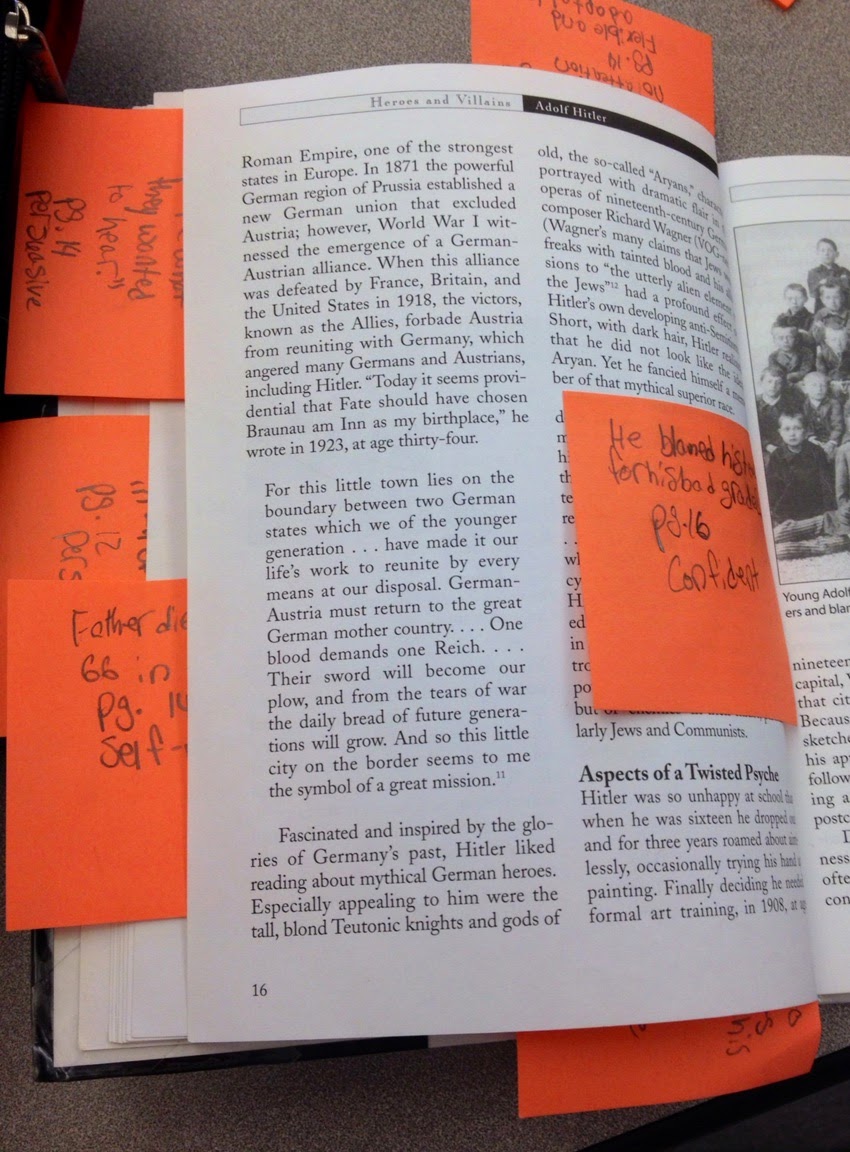
Sticky notes by an average student
We really couldn't get the kiddos into their books fast enough.  Some of them had already gotten through half of their books because they'd been reading outside of school, and we wanted to arm them with some hard-core purposes before they got any further.  With sticky notes in hand, they attacked their books - looking for examples of the ten characteristics of influential people and answers to some of their preliminary questions.  At this point in the game, we didn't even really want them stopping to jot down notes other than on the sticky notes, and I have to say, it was an effective decision!  Some of them went sticky-note mad, marking spots on every page where they identified examples of how their person demonstrated confidence or public speaking, or the art of persuasion.

As you can see, the heavily-hit background information and purpose setting has made all the difference in the world to these kiddos.  And we still haven't told them what their final product will be!  Because the final product is not our real purpose, we didn't feel like we needed to focus too much on it, and honestly, we are having entirely too much fun to focus on ruining it with a final product.  We do have projects and rubrics ready to go, and the plan is to introduce them this week, but the kiddos are much more interested in the process than the product.  When more than half of them raised their hands when I asked who was enjoying their biographies - I knew we had them hooked.

Saturday, April 26, 2014

Background knowledge and purpose setting - without them you could face epic fail

This topic never gets old for me.  I think it is because I've walked into dozens of classrooms over the years and have heard students ask over and over and over again, "Why are we doing this?"  When those words come out of their mouths, immediately I understand that the relevance of the activity and information has left the building, and the kids are instantly disengaged.  Posting standards and target goals in one's classroom gives a purpose, but the relevance is still not there.  Thus, continued disengagement.  Well, the last two weeks I have been working with two educators who are always willing to step out on the highest cliff with me and peer over just to see what possibilities lie over the edge, and I have to say, its been so wildly successful that we have rallied two more teachers to join us on this adventure!

Its tough to let go of things we have loved from years past.  There is currently a joke running in our department about a dramatic version of The Diary of Anne Frank and how this has been one of the toughest pieces for some teachers to "let go".  My risky colleague is no different.  Last year she and I collaborated on her long-loved biography project.  It's one of those projects that she has been teaching for years, and we needed to revamp it to cover the correct standards.  I'm a firm believer that if you really love something that much, you'll teach it with passion, so I knew that we needed to fix it up and make it work for her.  

Well, she approached me again about this same unit three weeks ago, but this year we were both ready to amp it up.  In the past she has had students choose biographies, read them, and then do some sort of project on the person.  As with so many other long-standing projects across the curriculum, it was a basic research report where kids choose a topic and become the expert on this topic, and we pray that they have found enough relevance and interest in the topic to complete it. This year we wanted to tie in some argumentative tone to the project, so we met and decided to focus on the essential topic Most Influential People.  We decided that students would be required to research a person and then provide evidence that proves that the person is, indeed, one of the most influential people in their field.  

Our first meeting consisted of pinpointing standards that we wanted to be certain to cover in-depth and then outlining our expectations.  We knew we wanted to focus on the research process, and we knew that we wanted to leave the final project open to student choice. After that planning meeting, we met off and on to start the process of front-loading important information, and we decided that we needed to get everybody on the same page in terms of defining what an influential person was.  I was also able to interest my retired former-colleague (and Project CRISS partner in crime) Pam, who loves to come back and share her wealth of knowledge with middle schoolers.  

Because the project has turned out to be one of the most interesting collaborative adventures I have ever had, I wanted to outline, in depth, what we did - partly to share what we have done and partly to remember the beauty of how it all came together.

Our first few days with the students focused on the phrase influential person.  We did a few background knowledge activating activities which ended up being as telling for us as they were for our students.

  • We had students draw a target on a piece of poster paper and fill in people they considered to be influential in their families, school, neighborhood/city, state/nation, and the world.  This was an immediate bust.  It was clear, after only a few minutes, that some of our kiddos could identify the word influential, but few could apply it and identify people they would consider influential because their definitions of the word were so wishy washy.
  • We then went back and had students discuss, in groups, their definitions of the word before they looked it up in the dictionary to clarify their misconceptions.  A whole group discussion took place, and we pointed out misconceptions over several days.  My biggest fear is always that students will go back to their former thinking because its easier and has been ingrained in them for so long.
  • Finally, we had groups discuss and identify a list of ten characteristics they thought a person of influence might have.
Students took purposeful notes
I knew I wanted to hit this idea of influential people really hard, and I also knew that if we didn't clean up all misconceptions on the word that our project would fall apart during the early stages - an epic fail I was not willing to watch, considering we actually had the time to clear things up.  We decided to work this idea for a week.  My colleague and I googled "characteristics of influential people" for kicks, and we found some pretty amazing articles on the web that outlined what these organizations believed it meant to be influential.  We chose 4 different ones (two from Forbes  and the other two from different websites that focused on self-help).  One was so long that we split it into two.  From there we performed the same twisted jigsaw that I had done with a group of kids in science earlier in the year.  
Discussions began
  • Print enough articles for every student to have one (be sure to even out the articles so that each one is read by the same number of students).  Have students choose what article they want to read and get into groups after they've chosen.
  • Give students their purpose for reading the article.  Their purpose is to decide which of the characteristics they feel are most important and to be prepared to explain why by arguing the case for the chosen characteristics.
  • Once everybody in the group finishes, the group must somehow agree on the most important characteristics.  If one person feels strongly about their second choice, he must argue his case, but he cannot choose it unless the entire group agrees.  By the end of this group work, all students in each group should have identical lists of characteristics and be prepared to provide reasons why they were chosen.  Here is where it gets fun.
  • Count each group off again.  In one group, each person gets a different number.  Then put the new groups together by number.  Now each new group should have at least one person in it that has read a different article.  In a normal jigsaw, the job of the group would be to "teach" the information to the rest of the group, but not in this one!
  • Every student in the group will, undoubtedly, have come armed with three to five characteristics of an influential person - all from different perspectives.  The group's job is to whittle down those into a list of their top ten.  What our kiddos found was that one characteristic may have shown up several times, and all they had to do is put some of them together!  Some, however, had to be debated.
  • Their final list then got submitted to us before they left for their next class.
Once we got those lists, we took the time to cut them apart and put like-characteristics together until we came up with a long class list of every trait mentioned.  The next day, we made the class discuss and vote on the final top ten.  What we found beautiful is that six of the ten characteristics chosen for the top ten were the same in both classes!  I'd call that success!

Our kiddos were finally ready to move forward to previewing topics and choosing their biographies.  Reflectively speaking, a few beautiful things happened during this entire pre-learning stage.  
Final lists derived from jigsaw activity
  • In the time that it took us to complete this entire process (about a week), only one student got "schooly" on us and asked what the final project was going to have to be.
  • Misconceptions were cleared up, and we now had an easily accessible list of ten characteristics that students could use while they played detective in their reading of their biographies that they didn't even HAVE yet.
  • Interest was piqued.  I say this with hindsight because we are several days ahead as I write this, and the behavior of the students after they received their biographies blew us away.  More details to follow on this.
  • A good discussion was had in both classes about negative influences and how they would align to the top ten characteristics. Without even doing it, students had developed a top ten list that would easily include the negative influences as well as the positive.
The next steps in this process are just as exciting, but this is a great place for me to stop for now.  What I can say is that every day I cannot wait to step into this classroom to see what is going to happen next.  Even though our plans are secure, the implementation is entertaining.  Watching our students remain engaged excites me.  But what really is interesting is that they all know they will be expected to produce something at the end, but they're so involved in what they're doing right now that none of it seems to matter.  Next weekend, I should be able to report to you the process of choosing topics and beginning the prep for research.  Stay tuned!

Friday, April 18, 2014

Feeding curiosity and writing questions to guide research

I had the pleasure of working with eighth graders this week on an activity that had two clear and important goals.  When I met with my colleague several days before, she showed me examples of final products from years past and explained that she was trying to build much-needed background knowledge on the Holocaust and WWII before beginning a novel study unit on the Holocaust novel Night.  She also planned to hit target standards that focus on research skills.

My role as a reading specialist is generally one of reading support for struggling readers, but another part of my job is to support teachers with best practice instruction, support for implementation of the Common Core standards in English Language Arts, and to give our achieving readers strategies to become more independent learners.  Collaborating on this research project was an exciting prospect, and I couldn't wait to get started!

After establishing our goals, we decided that I would come in to do a mini lesson on creating good questions for research.  Research instruction has changed significantly over the years.  Because our kiddos are inundated with information from all angles, our job is to teach them how to retrieve the information and then process it.  When I was a kid, we researched one way - encyclopedias and books, card catalogs, and index cards.  Today we have brain research to thank for the dozens of organization and note taking techniques that we can teach along with millions of cyber-resources, making teaching research more challenging than it has ever been!  Stephanie Harvey discussed this same idea in March when I attended her session at the IRC Conference.  Kids think they can just hop onto Google and type in a question, click on the first link, and voila! Question answered!  Next!  To avoid this, teachers make lengthy lists of previewed websites so that students can use them like books - scanning the documents for information and reporting their findings.  Why are we not teaching them how to scan the web to find the information for themselves?  Time is always of the essence, and teaching web searches is a time-consuming process.

I opened my lesson with the Observe, Infer, Question activity that has had me smitten this last few months.  Clearly, students were engaged, as we saw them write and discuss, ultimately beginning the process of asking good questions.  We used the photograph to the left to get the students thinking about our topic for the day - Adolf Hitler.  Next, we moved into the real purpose for the day, which was to write research questions that would help us to understand Hitler - my colleague called it biographical information, which it is, but with a spin.  Gone should be the days of writing reports where we simply talk about something.  Hitler was born on April 20, 1889, in Austria might seem like important information if we were gathering biographical information on Hitler, but for this particular assignment there is no purpose for it.  Project CRISS would call these questions right there questions.  They're quick to ask and quick to answer, and they take about as much thought as 1+1.  We wanted to push our kiddos to do more "thinking and searching" in their research.

In order to do research like this, we had to look at the purpose.  My colleague's purpose for research was to build students' background knowledge on the Holocaust so that they can better pick apart the themes and literary elements of the novel Night.  That being said, the Holocaust is where we needed to head, so anything that she wanted students to research ultimately had to connect to that.  Once that was established, she asked the students how they could connect World War I with the Holocaust.  After some discussion, the class was able to come up with How did the events during and after World War I effect what later happened, causing World War II and the Holocaust?  This is exactly what we did with Hitler, then, the next day.

I posed the big question How did Hitler effect what happened during World War II and the Holocaust?  From that I demonstrated how I would write more questions that led us to a better and clearer understanding of Hitler and what his part was in the Holocaust.  I wrote questions like What was Hitler's path to power? What events in Hitler's life may have impacted his decisions while in power? and How did the citizens of Germany view Hitler and why?  We organized them in a two-column note and started reading the synopsis of the article on Adolf Hitler from biography.com.  Instead of skimming the article looking for the answer to the first question and then the second question and so on (which is so often what I see students doing), I encouraged students to just start reading, and what they found was that we could begin to answer three questions in the first paragraph, but those answers made us ask more questions, so we wrote the new ones as well!  In that short twenty minute period we had written eight pretty good research questions that would easily give us a handle on who Adolf Hitler was and what his role was during the Holocaust.

In hindsight there are a few things I would have done differently during this lesson, but I was pleased with much of what we had done.  A few things to consider when taking a stab at a research activity are below.

  • Be absolutely clear on what your purpose(s) is(are).  Be certain your final product will align with the purpose.  It is always refreshing when a teacher takes a look at his original vision of a final product and realizes he has made it way more complicated than it needs to be.  If the goal is the research process, why go on and waste time with publication?  If the goal is a final published work for some purpose, then, by all means forge ahead!  My colleague wanted the students to organize their notes in a booklet-form for easy reference and connection during the novel study, which was a meaningful and purposeful final product.  If you are a content area teacher, you will probably have a two-fold purpose - one skill-based purpose (ie. - asking good research questions) and one content-based (ie - What was Hitler's role in WWII?)
  • Once your purposes are clear, establish a "big question" that can be answered by all students.  I'm working with another colleague right now on a biography unit, and, after lengthy discussion, we  finally decided to ask students to prove that the person they chose to research was a major influence in whatever industry he/she was in.  This is a great way to introduce informative writing with the argumentative purpose.  Our big umbrella question was What makes people influential? So the big question became, for the students, What made so-and-so a major influence in the such-and-such industry?  Once the big question is established, everything leads back to that question.  It's like a foundation.
  • Require students to ask loads of questions before allowing them into the resources.  I make this mistake over and over and over again - I let my kiddos into the resources, and the first thing they do is abandon the questioning.  Then it's days of clean-up as I watch them start randomly writing down unimportant information, and the entire process crumbles before my eyes.  Once your kiddos stop asking questions, their purpose is blurred and they lose focus.  Make questions mandatory, and do not give up!  If these kiddos get into the habit of asking questions, their entire educational career becomes more focused.  Imagine if your students opened a science book to chapter 12 and started immediately asking questions before they began reading!  How much more focused their learning would be!
  • Teach note taking strategies and allow students to give input on strategies that have worked for them in the past.  Pick one.  Ask the teachers in grades below what they use and the grades above what they use, and build a bridge.  Wouldn't it be fabulous if a sixth grade student used one type of note taking for research in sixth grade and repeated it in seventh grade and then eighth grade? Or even better - what if sixth grade teachers taught multiple note-taking strategies and allowed students to choose which one fit their learning style better?  And then seventh grade teachers built on those same strategies, and then eighth grade teachers did the same??? Kids are adaptable, but jumping from strategy to strategy every year never allows them the spiral effect where they can build upon acquired skills.  
  • Pique curiosity.  Allow students to choose.  Appeal to their emotions.  Get visual.  Use their five senses.  Nobody dreads a research project more than a person who researches something that has no interest or connection to their lives whatsoever.  Brain research tells us negative feelings impede learning. Some of our kiddos go through their entire day with a negative outlook on school.  No wonder these kids make so little progress!
Really, I could go on and on about the research process, but I will quit now while I am ahead.  The chances of me discussing this same topic next week are pretty high, as I have begun an exciting research project with two seventh grade teachers and a retired library media specialist this week, and we are all pretty psyched so far with what we have done!  Research has never been more challenging for students, so our job as educators is to help them to use their current reading and writing skills to make the task easier.  This is a daunting challenge, but one that can be conquered with the proper planning.