Friday, March 14, 2014

IRC Presentation: Fighting Adolescent Apathy With Authentic Engagement by Jason Brogan & Mal Keenan

After our first inspiring session on Wednesday in the basement of the Conference Center, we headed outside into the 40+ degree, sunny morning, eyed the mile-long line at Starbucks longingly, and headed up the elevator to the top of the Hilton for our second session.  My colleague Karen and I were interested in catching a presentation that tackled the motivation piece of reading because we had prepared to make a presentation on the exact same topic later in the afternoon.  Secretly, I was praying that, although the topics were the same, the presentations would focus on completely different aspects of student motivation, and I am happy to say that this was, indeed, the case as we sat down to listen to what Jason Brogan and Mal Keenan had to say.

Brogan and Keenan started their session by describing what they call their Triple A students: apathetic alliterate adolescents, and the first point Brogan made was that these students needed an environment of trust.  I immediately connected to our presentation that was planned for later in the day.  Part of what we had planned to deliver focused on this idea of connection, which feeds right into the student's need for a trusting environment.  I liked what I heard immediately, and I relaxed in my chair as I geared up to hear more.

The session was split into several large topics, each one designed to give the attendees a general idea to take back to their schools and implement.  Unlike most of the other sessions I attended in the two days, this one focused on big picture ideas rather than individual strategies, and I liked that because when you focus on the big picture, you usually have to make major pedagogical and philosophical decisions that impact a large number of people.  I'm all about making big changes and changing my philosophies based upon my clientele, so I maintained alertness as they presented.

One of the most interesting and useful ideas described during this session was Inquiry Circles.  Common Core Standards require students to seek information from multiple sources (ie - research), and the inquiry circle is a highly motivating way to introduce this.  Here's how I see it working.

  • Start with an essential question (there it is again!).
  • As an entire class, view a variety of graphics all related to the same general topic or big question.  Ask students to observe (or notice) details in the graphics.  Brogan suggested using upwards of forty photographs (if you use photos) and just allow students to write down what they see.  
  • As students are noticing or observing each picture, also have them write down some questions.  This activity is similar to the Observe, Infer, Question activity, if you're interested in reading about it.  The beauty of this is that students can't be wrong when they write their observations, and their questions will hopefully stir up some natural curiosity, which will keep them engaged.  You can always add the infer column in there if you want, as well.
  • Gather student questions, and group students according to the things about which they were most curious.  
  • Include the LMC director and other support staff (reading specialist, for example) and begin the research process, using the initial questions to guide the research.
  • During the research process, include mini-lessons on the content and research process.
  • After the initial information gathering, meet with groups and have them evaluate what information they still need to successfully move toward answering and supporting the essential question.  
  • Once the groups are satisfied that they have gathered enough information and put it together, they "go public" with it.  I loved this term.  Its a fresh way to have kids present, and who says they all have to present?  Maybe they go public a different way.
Why will this work?  The Triple A students are the ones who would be considered the least motivated.  We know from Dr. Ross Green's 2007 article, "Kids Do Well if they Can," that the reason these kids do not perform is because they lack something.  Many of them lack the academic self esteem or curiosity to become engaged, and our job is to create a safe environment where they feel comfortable enough to be curious and take some risks.  What a beautiful way to allow this to happen!  If we can just let go of the reins a little bit and allow our striving (love this word, by the way!) kiddos to explore topics and produce information the way they want (with guidance, of course), we might find these same students to be highly achieving.  You just never know!  

Brogan and Keenan had a wealth of information to share with their audience, but this idea of inquiry circles was, by far, one of my favorite of the eight sessions I attended at this conference.  Although I went into their session worried that they would bring the same information we had planned to share, I left wishing we could have teamed up with them for a half-day session!  I felt like so much of what they had to say complimented what we brought, and I left feeling a little wiser on the topic of fighting adolescent apathy.  

IRC presentation: Essential Middle School Strategies for English Language Learners (ELLs) in the Content Areas

Eight a.m. came pretty early this morning, but I started out my day with a Dr. Pepper Ten and a hope that I would increase my knowledge about reaching our high population of former-bilingual students.  Even though most of our kiddos receive no bilingual or ELL services, I knew that attending a session dedicated to ELLs would arm me with even more strategies and philosophies to take back to the staff and use immediately with our kiddos.  Boy, was I right!

We attended our first session by Amanda Schacht & Gabriela Carbajal from Crystal Lake School District 47.  The ladies started out their session by explaining that their strategies would be presented in three main categories, headed up with an essential question - which seems to be a hot topic the last few years in the education world.  Their three stages were the preview stage, focused literacy stage, and the application stage.  Unfortunately, most of the sessions here are sixty-minute sessions, so we ran out of time before we could go through each stage thoroughly, but the handouts contained explanations of every strategy.  This made it worth attending, in itself, because I could go back to my room and collect more information afterwards (which is what I am doing currently).

We spent most of our time on the preview stage, trying out out some of the strategies and learning about different language frames.  One point that these ladies made was that working with students who are still developing English language, the preview stage should probably be done orally rather than weighing down activities with written language.  The term language frames was new to me, but when I took a look in the packet, I realized that they were similar to Project CRISS's sentence frames.  Over the last few weeks I've been working in an eighth grade US History class.  While supporting students or delivering instruction, I try to interject sentence frames whenever I can.  We have so many students who still grapple with the English language, that sometimes they struggle with the act of even starting out sentences.  By giving students a frame into which to place ideas, they can use the English language properly and focus more in their ideas than formulating language.  Here's how it works.

When you are asking students who are still developing English language to perform a specific task that requires language (ie. answering a question or responding to media), supply them with several choices in language frames.  
  • To make a prediction, start out your sentences with phrases such as "I predict that . . . " "I bet that . . . " or "I wonder if . . . "
  • To ask a question, think about using starters such as "What would happen if . . . " "Why did . . . " or "Do you think that . . . "
  • To clarify something, supply your students with phrases such as "At first I thought _____, but now I think . . . " "Oh, I get it . . . " or "This part is really saying . . . "
  • To encourage students to make a connection, supply them with a things like "This reminds me of . . . " "This part is like . . . " or "This  makes me think of . . . "
  • If students are expected to answer a question, support them by giving them the beginning of what you would expect them to supply as the answer, and then let them continue on with their answer.
The above examples are just a small sampling of what Schacht and Carbajal included in their packet of resources, but I'm guessing you get the idea.  One question that a colleague asked me just today was, "At what point do you stop supplying students with these frames?"  I had to really put some thought into that question because at first glance, I can see how a student would use the frames as a crutch, but then I went back to the presentation that I gave later in the day today.  If our kiddos are armed with one hundred percent of the tools they need to perform a task, they will.  If they rely on what we give them as a crutch, there are still skills that they lack.  It is our job to figure out what those skills are, and one of them may very well be dealing with the fear of failure - a skill that many of our reluctant learners have (making them look unmotivated because they refuse to even try).  Perhaps if we made our efforts two-fold and provided students with academic as well as social-emotional support, we might find them moving forward at a much quicker pace and we might see them taking healthy academic risks more often.

The remainder of the presentation included a whole slew of preview, focused literacy, and application strategies such as Word Sorts, Think-Pair-Share (which they termed Think-Partner-Share), TPR (Total Physical Response), Video Jigsaw (see graphic to the right), Pane It / Retain It, Connect 2, THIEVES, Anticipation Guides, Say Something /Write Something, Narrow Reading, Numbered Brains (like Numbered Heads), Jigsaw, Combination Notes, Question / It Says / I Say / And So, GIST, Magnet Summaries (another CRISS strategy), Sketch to Stretch, LEA (Language Experience Approach), Side-By-Side Translations, and Metalinguistic Focus. So you can see that they supplied their participants with a wide variety of strategies to take back to their buildings and use immediately.  

THIEVES example
Late in the presentation, Schacht and Carbajal discussed the THIEVES strategy, which is an in-depth previewing strategy.  During this part of the talk, the ladies showed us a beautiful bookmark that was color coded, and then they unfolded a color coded copy of a chapter from a text book to demonstrate to students which parts of the bookmark coincided with the parts of the chapter.  It was beautifully done, and I could see this being something that could be adapted to a content area to support our students who are still developing English or for any of our students struggling to grapple with the complicated text in their text books.  

All in all, this presentation was a great way to begin my conference, and I am thrilled to bring back some of this information to start using in supporting our content area teachers and students.  With over forty percent of our student population being native Spanish speakers, each content area classroom contains groups of students who might benefit from any number of the strategies presented today during this first session.  


Saturday, March 8, 2014

The four types of learners and what we can do for them

This week I am traveling to the Illinois Reading Council's annual conference in Springfield to learn and to teach.  My esteemed colleague Karen and I have put together a presentation that includes information on why motivation should be considered a  key component in reading instruction and what we can do to turn our unmotivated learners around.  So after completing the slides for the presentation, I was mortified to find that, after counting up the number of minutes we would likely spend on each slide, that we had about 140 minutes of material to pack into a sixty minute slot!  We then began whittling down the material, in hopes that we wouldn't leave out the really important points.

Late in our research, we came across an interesting bit of information taken from another presentation on a similar topic.  After digging around for a few days, we discovered that this piece of research was duplicated several times, including being detailed by Dr. Valerie Rice, a researcher at the US Army Research Laboratory, Human Research and Engineering Directorate.  This parallel research is best illustrated by the graphic shown to the right.  As you can see, Dr. Rice's theory is that there are four types of students: the failure accepters, failure avoiders, optimists, and over-strivers.  According to Dr. Rice, the optimists are those who worry little about failure and desire success.  Brain research tells us that heightened anxiety can impede learning, so if you put low fear of failure and high desire of success together, it appears as if the optimists will have the highest rate of successful skillbuilding and, ultimately, the highest views of self.

Over-strivers are more motivated by their fear of failure than the optimists.  To help these students continue to make progress, we can aid them in planning for times when they might fail and come up with strategies to help them cope and deal with failure if it does happen.  This will give those students more of a sense of control and will hopefully boost their concept of self.  Going back to what Dr. Ross Greene says in, "Kids to Well if They Can," cited in a previous blog on student motivation, giving these students the skills they need to move past their blocks will allow them to learn and gain more control, making them more teachable.

As a reading specialist, the failure avoiders are the most difficult to bring to light. They will often fly under the radar because they work so hard.  My job is to look at data first, then the individual, and sometimes the data that I see doesn't reflect what we see in school.  It is then my job to figure out why, and what I often find is that we have a lot of kids who struggle and never say anything or show that they are struggling until it is too late!  A common generic example of this is when I am looking at reading comprehension data for a student, and I mention a specific student to a group of eighth grade teachers or the Tier 3 team.  When they look at me like I'm crazy, I know what is coming next.  "But she's getting Bs and Cs!" is often what I hear.  I then reflect back on Rick Wormeli's talk last week where he discusses the long-standing grading system of points, percentages, and letter grades and the glaring absurdities with how it is being used.  

Just because a student "earns" an A in a class, doesn't mean he is not struggling with reading comprehension.  In fact, in a the book Student Motivation, Engagement, and Achievement (Irvin, et. al, 2007), teachers were found to, with good intention, support those who appeared to struggle by loading those students with information verbally or visually (Yay!  Trying other learning styles!) or sometimes even copying teacher-notes or giving "cloze notes" to students who struggle - even in language arts!  While this helps the student in the content area, it does nothing to help our kiddos build reading skills, and therefore they succeed, as evidenced by the letter grade achieved for the quarter in that content area.  The reason is two-fold: teachers find ways around their deficiencies, and those students fear failure so much that they work hard enough to pass with decent grades.  I also know that these kiddos tend to resist interventions because they feel like if the grades show success, why would they need help.  

Most often, it is my latino students who struggle with this the most, as cited in Bridging Cultures Between Home and School: a Guide for Teachers (Trumball, et. al, 2001).  Many of them come from a more collectivist culture, where behavior and academics are often seen as reflective of each other.  As a reading specialist, part of my duty is to help parents accept reading intervention positively so that their children feel comfortable accepting it. It is also our job, as educators, to help these students put together some strategies to help them through failure so that they can face tasks with a mind that is more prepared to internalize instead of being in a constant state of fear.  Can we also plan ways to show these kiddos how they are making successes?  So often they don't see their successes because they are so worried that they will fail.  Just the idea that their hard work is paying off in their grades is one place to start, but giving them tasks where they can begin tracking smaller successes may give them the tools to feel more confident in their ability to grow and build a growth mindset.

Finally, our failure accepters.  We all know these students too well.  They are the ones who, after exhausting everything possible, we chalk up to a kid who is just "unmotivated".  A no-can-do in my book, and Dr. Ross Greene would agree with me.  There is something we are missing with these kiddos, and the graphic shows that first we need to give them tasks that make them feel competent and then provide feedback that is prescriptive and productive. Chances are, these kids have felt incompetent for so long, that they have forgotten the feeling of success.  Anything.  Even our relationships with these students could give them enough boost in confidence to give some of their school work a try.  Dr. Rice says it.  Rick Wormeli says it (see last week's blog on giving feedback after attending a Rick Wormeli seminar).  Dr. Greene says it.  This idea of feedback is such a powerful one, that it cannot be overlooked.

One thing that Karen and I wish we could have found was some sort of questionnaire or screening test that helped us to identify which of our students are which type of learner.  We searched and searched, but we were unable to locate one.  But as you are teaching this week, and as you interact with your students, contemplate which students might fall in which categories.  What would really be interesting is if all teachers of the same student were asked to place one student.  Would all of these teachers place the student into the same quadrant?  That, my friends, is something to ponder.


Friday, February 28, 2014

Feedback: Words are powerful

I had an opportunity to see Rick Wormeli today during our County-wide institute day.  Having never seen him present, I walked in with virtually no expectation except that I would be gathering some information on standards-based grading.  What he gave me was much more than that, and I walked out with a pocket full of ideas about instruction, intervention, grading, and working with students.

Since one of my pedagogical focuses has been student-motivation, I immediately grasped onto some of Wormeli's thoughts on ways to motivate students.  This year, one of my respected colleagues and I are planning to present at the Illinois Reading Council's spring conference.  Our presentation is entitled Motivation: the Overlooked 6th Component of Reading (shameless plug), so I make a point to note any new and innovative ways (or oldies but goodies) for motivating and engaging struggling readers.

Wormeli's session was six hours long, so really there were dozens of interesting points that he made.  Something that struck me, however, was his discussion on giving students feedback.  It brought me back to last summer when I was working on one of my last graduate classes on student motivation.  The book What Every Teacher Should Know About Student Motivation by Donna Walker Tileston (2010) was a quick and easy read, but it contained valuable information for any teacher looking to pad her philosophy with some ways to motivate and engage students.  Tileston quotes Marzano (1998) on several occasions in her book, saying, "Feedback that is consistent and specific has a strong effect on student success.  Just saying 'Good job' is not enough.  Feedback must be diagnostic and prescriptive, deserved, and given often - some researchers say every 30 minutes."  Wormeli's talk today reflected this exact point.

His point was that grades do not give accurate feedback, and then he illustrated this point over and over and over again throughout the day - oftentimes making his audience giggle with the illustrations that make our current grading system of letter grades and percentages appear absurd.  Since my focus was more on the struggling reader, and a large percentage of those students behave as if their grades are about as important as a wad of chewed gum, I paid particular attention to his idea of giving more specific, frequent, oral feedback - something that many researchers seem to agree is highly effective in getting positive responses from even the trickiest of adolescent personalities.

Here's how it works.  You are working on aerobic exercise in PE where your students are in the workout room using a variety of aerobic machines.  As you walk around, monitoring your students, you notice the posture, breathing, pace, and the way that students are using the equipment.  Each time you are in the workout room with these students, consider making a brief comment to ten students (or more, if possible), giving them specific feedback.

Use this format: "__________ (student name), I noticed that while you are _____________ (whatever it is that the student is doing), you ____________ (try for something positive so that you can start with an affirmation).  As a result, ________________ (then tell the student what it does for you).  I'm wondering if you will get better results by ____________ (and then give a suggestion to improve whatever it is and get closer to mastering the skill or technique).

Here is an example (Keep in mind that I am not a PE teacher, nor do I claim to have an expertise in the field, so use your imagination!).  "Giselle, I'm noticing that each day we are in here, while you're walking on the treadmill you keep the treadmill going for the entire thirty minute period.  As a result, I'm seeing that you are getting used to this type of exercise and might want to push yourself a little to get to that next level.  I'm wondering if you will get better results from the workout if you increase the incline (show her the button) or pick up the pace by maybe half a mile.  Can we give it a try?  I think you're ready."  Two minutes.  Tops.  She smiles or grumbles at you, but she does it, and you move on, vowing to check in on her tomorrow to see if she made the new changes permanent.

It works in any subject area and any level.  So simple, but it is specific, prescriptive, and effective.

This idea of noticing, observing, and being aware seems to be appearing more and more often in the world of education, from teaching students to notice or observe things and draw conclusions to asking teachers to reflect on things that they're noticing about themselves or their students.  This skill is deeply explored by another respected colleague of mine in his blog, if you're interested in learning how mindfulness can be used as both a classroom strategy and a strategy of self reflection.  I, myself, have blogged about this topic off and on since attending the 2013 IRC Conference, and am looking forward to going back to hear more about how I can use it more effectively with our students and staff.


Saturday, February 22, 2014

Building background knowledge to create a foundation before reading

One of the key Principles of Project CRISS is Background Knowledge - be it accessing it or building it.  It is not an original thought that if you have background knowledge on a topic, new information is more likely to stick.  We call this schema.  Students who struggle with information and reading in school suffer partly because, more likely than not, they lack background knowledge, or schema, (and this includes the basic vocabulary) on the academic subject.  As I perform reading inventories individually, part of the assessment is to determine the level of familiarity the student has with the text by asking basic questions about the main topic, vocabulary, or theme.  If a student scores less than fifty-percent on the pre-assessment, the passage is considered unfamiliar.  My problem is that no matter what passage I have pulled this year, all the way down to a grade three passage, very few of the passages had friendly text with which any one of my strugglers was familiar!  Imagine trying to read one hundred percent of your required material in school with little to no familiarity of the text.  What a daunting task, and one that would cause immediate stress and anxiety.

So in my last blog I mentioned that I would be working on a social studies activity this week in a U.S. History class.  It was wildly successful, in my opinion, so I thought I would share exactly what we did and give you some ideas as to how you can adapt this type of activity to your own curriculum.  

My lovely example of the organizer
We used the visuals from the text book in Chapter 16.1 to start.  I had the students create an adapted form of the organizer that a respected former-colleague showed me from the Library of Congress teacher-resources website.  I'm kicking myself now because I have a copy of the organizer that I created for them as a model, but I didn't take any pictures of completed student organizers!  So unlike me!  I'm of the mindset where the fewer organizers you give your students, the better prepared they will be.  Creating their own gives them a sense that they can do it on their own rather than waiting to be handed ways to think.  

In the organizer set up by the Library of Congress, students are asked to observe, reflect, and question.  I made mine a little  more user-friendly for our struggling readers, and we asked the kids to write "What I see (observations)", "What I think (inferences)", and "What I wonder (questions)".  I demonstrated using a map of Fort Sumter, talking my way through it and explaining how challenging it was for me because I generally skip the visuals in a select piece of text and dramatically overreacting when I found things I would have missed had I not looked at the visual.  I'm certain the kids think I'm crazy.  

One of the biggest struggles we have in this class is differentiation. We have a comparable population of gifted students and students with IEPs, and most of the rest of the class is composed of struggling readers.  Keeping the gifted students engaged is a tough line of business, and we were delighted to see that they maintained engagement through the entire activity!  When it was their turn to try their hand at the observation of the next visual (a color coded map of the United States during the Civil War), our strugglers took more time to read the visual.  We walked around, pointing out captions and helping them interpret what some of the images might be.  The gifted kids took the ram by the horns and wrote detailed descriptions. Inferences?  Even better!  We supported some of our struggling readers by giving them sentence starters if they needed them (This makes me think . . . ) while the gifted students and some others were able to infer more deeply and support those inferences with details.  Even the level of questioning varied, which was really fantastic!  My colleague and I agreed that we needed to do more activities like this one to keep all engaged (our strugglers were forced to participate because we put them into pre-determined groups where they were equally matched, skill-wise, so they couldn't really depend on their partners to do all the work).  Finally, after performing a third observation on a graph of the resources of the Union and the Confederacy during the Civil War, we asked students to write a prediction of what they would learn in the section.  This helped to bring the information together and set us up to read the summary the following day.

As a bell-ringer activity the next day, my colleague had her students read an adapted version of the section (two brief pages) with some directed reading questions thrown in for kicks.  Before they read it, I suggested that they circle or underline things that they remembered from the section preview the day before.  Words such as Fort Sumter, border states, and West Virginia were great reminders of the visuals we had seen in the section during the preview.  Students read the two pages, we went over some of the directed questions, and we were ready for their note-taking activity.  

After the two background knowledge builders, the actual note-taking went relatively quickly.  All students created another organizer and got right to work (we had them work in pre-determined groups again).  I also will point out that we did not ask students to read the entire selection of text, but we created a purpose for reading and took the five page section down to three for easier manageability.  All-in-all, I was very pleased with how things went this week, and I'm looking forward to more hands-on work in this class.  The idea of using visuals to preview the material made it easy to differentiate and allowed both our visual students and our students who were read/writers to use those skills.  It also allowed those of us with a weakness for visual learning to sharpen that skill.  

The skill of observation can be applied to just about anything:
  • artwork in history, geography, art, foreign language, language arts, or music classes
  • album covers in music, art, language arts, or history classes
  • photographs in any subject
  • 3 dimensional art in social studies, language arts, or art
  • science demonstration setup, art setup, or a demonstration itself in art, PE, science or technical studies
  • graphs, charts, or tables in science, math, social studies, PE, health etc.
  • equations in math or science
  • grammar in sentences in language arts
  • plants or animals in science, health, language arts, or social studies
  • rocks or fossils in science, language arts, or social studies
  • human beings in social studies, language arts, art, PE, health, etc.
The possibilities are so endless!  You could really require this type of studying of anything for a pre-determined purpose.  Take a look at a lesson for next week.  Can you take five minutes and ask students to notice something, write it down, and then make an inference (start out their thinking by saying, "What do you think about it?")?  The more practice our kiddos have in doing this type of exercise, the more observant they will learn to be.  By using this skill, our students are more likely to access or build their own background knowledge, which ultimately leads to more independent learners with a higher academic self-esteem.

Saturday, February 15, 2014

Strategies for visual learners

I had two things happen this week that made me think that I needed to revisit the topic of visual learners.  If you've read any of my previous blogs, you may have gotten the sense that I rely heavily on student strengths (learning styles and intelligences) as a reason for student success or (most often in the case of the students with whom I work) failures.  After reading Dr. Ross Greene's article on student motivation and blogging about it, what I should be saying is that student success or failure relies heavily on their instructors' inability to reach them and their inability to take in information the way it is presented.

If you have never taken a learning-styles assessment, stop right now and take one. Then take a multiple intelligences survey.  To clarify, the difference between the learning-style and the intelligence is that your learning-style is the way that you prefer to take in or produce information.  It may or may not be based upon your strengths (most often it is because we like to do things that are easier).  Your intelligences are your natural strengths.  They may cause you to prefer to take in and produce information a specific way.  Both are linked, and both cause a learner to face roadblocks in learning.

The results of your surveys may not be surprising, but before you continue to read, your next step should be to make a list of all of the things that you do in your classroom that align with your learning-style(s) or your strongest intelligences.  When I did this the first time, it was such an eye opening experience because I had never put emphasis on learning-styles or intelligences until I realized how my entire being reflects these things - even my personal relationships are impacted by the way I take in and produce information and my strengths.  I realized that if I wanted to reach all of my students, I needed to start making my instruction and communication more multi-modal.

One thing I am most definitely NOT is visual, and this is why, when I visited classrooms this week, I was reminded that one of my weaknesses is a strength of many of our students!  So this week's blog is in honor of my weakness and their strengths.  Take some time to read through some ideas for supporting those visual learners, as so many of them are sitting in your classrooms listening to you (aural) or reading your books and articles (read/write).

While visiting a seventh grade writing class, the teachers projected a photograph of a man with a dog (right) and gave the students a "Story Sparkers" (below left) sheet as a way to suggest details for the students' creative writing piece. Their teachers gave them time to study the image and think about the ideas before they began their writing.  So often, as a teacher of any subject, I have given students a prompt to begin their writing, and their job was to stay focused on the topic and write.  Our Common Assessments are the same way.  Standardized tests? More of the same.  What a disservice we are doing to an entire population of individuals who, as much as we think we are doing them a favor by giving them sixty seconds to think before they write, spend that sixty seconds trying to come up with details that aren't clear to them because they struggle to transform our prompt into a visual, see the details, and then transform those details back to writing!  It's like learning-style translation.  Then when we say "Go!" most of them write down the starter, fill in the blanks, and then stare at the page helplessly while we tell them to keep writing but give them little to no support in supplying details.  What better way to support this large group of visual learners than to supply them with a picture or (even better!) short video clip to get the visual images going!

It just so happened that I have been working in an eighth grade social studies class, and the same type of thing popped into my head last Thursday.  Looking at some of the visuals in the social studies text book, I was brought back to last year's IRC Conference presentations where the skill of observation was emphasized over and over and over again by multiple presenters.  Jeff Anderson, Anna Deese from Project CRISS, and Janet Allen all spoke on the idea that we need to teach students the art of observation because they overlook critical pieces of information when just casually looking.  It's like doing a close read, but on a piece of visual material.  Today we require students to think critically at a much younger age than ever before, and we need to start guiding students to developing their observation skills if they want to be prepared to compete for jobs in the workforce.  The skill of observation is even difficult for those who are visual because it requires stamina and a deeper understanding of what is being observed.  Now imagine how those of us who are NOT visual feel about it.  Ugh.

So on Tuesday this week my plan is to introduce chapter sixteen in a different way to the social studies class.  Both of the periods into which I am pushing consist of a high percentage of students with IEPs and struggling readers.  Expecting these students to tackle the highly complex text of their board-approved text book without frontloading and building background knowledge would be insane, so we are going to begin by an "I do", "we do", "you do" activity (gradual release of responsibility) to practice the art of observation.  I'll begin by asking the students to look in their text books at a map of Fort Sumter where the Civil War Began, and I will demonstrate my thinking on the screen for them by writing down some of my observations and my thoughts.  After this, I will direct their attention to the next map, where I will ask them to do as I did, but have them do it in pre-determined partners.  The idea here is to give them support in this new task, allow them some social learning, but guide them as well.  Finally, the graph on the next page shows the differences in the amount of resources between the north and the south.  This is the one I will ask them to do alone.

Once all is said and done, students will have engaged in reading (parts of the map), writing (their observations), and discussion (through partner work) on parts of the section and can probably make some predictions about what the section contains.  After the preview, students will read a two-page guided reading summary of the section, and then the following day will partner read selected sections of the real text with a very strict organizer to follow.  Students' purpose for reading will be to collect information on the strengths and weaknesses of the north and south during the Civil War.  This sounds vaguely familiar, as it was also a part of our old Level One CRISS training.

Project CRISS also has other ideas for using pictures and visuals for students who rely on their visual intelligence and learning-styles.  Below is a list of some of these easily-implemented ideas.
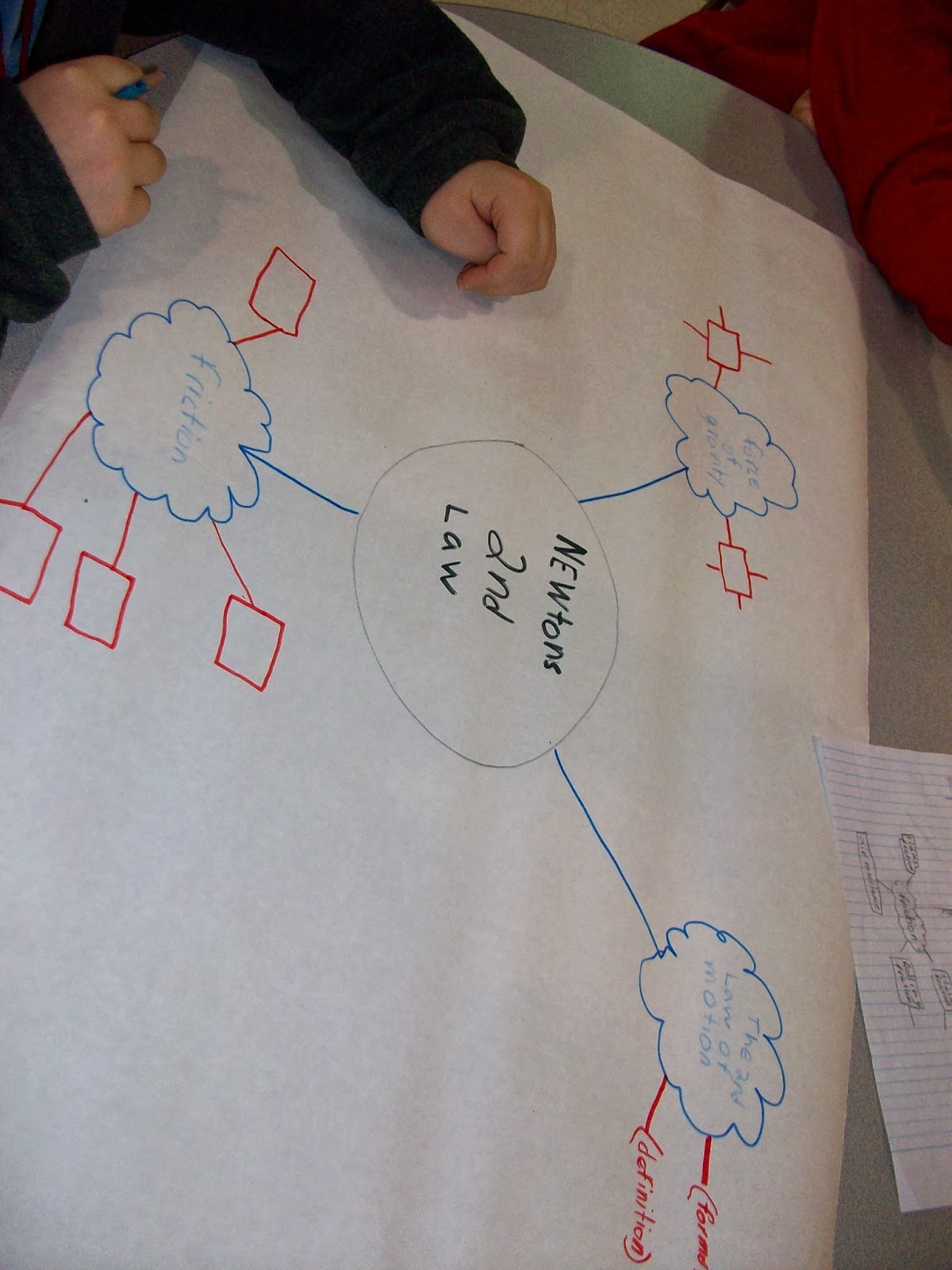
Concept map of Newton's Law

  • Main idea - Detail Organizers or concept maps (picture to the right)
  • Venn Diagrams
  • Sequence organizers (using pictures)
  • Using mental imagery (Ask students to close their eyes and imagine something while you tell them what they should be seeing.  Let them fill in details.  I used to do this when I taught sixth grade social studies.  I would play music of the time period softly, and then I would guide the students through a five minute "walk around the town" with their eyes closed.  They LOVED this exercise and were VERY excited to share what they saw.)
  • Picture notes (picture below left)
  • Creating cartoons (picture below right)
  • Using already-created cartoons and asking students to create captions or writing based upon them.
  • Problem-Solving organizers
  • Visual RAFTs (creating something from the perspective of someone or something other than a student)
  • Replacing words with pictures in ANY organizer
  • Timelines
Picture notes on Hurricanes

Newton's Law Cartoon
After you have completed a visual activity with your students and before shutting down the learning altogether, consider one last step: transformation of information.  Writing is a skill that our students will need, regardless of their learning-style or intelligences.  Once our eighth graders have completed their final organizer on the strengths and weaknesses of the north and the south during the Civil War, our last step will be to have our kiddos go BACK into their notes, summarize, and draw some conclusions.  I will, undoubtedly, have to model this for them, as drawing conclusions seems to be tricky business for even our gifted kids at times.  But the idea in this activity is to have them reread their notes and use their writing skills (however poor they may be) to put the information together into a complete thought.  This forces the visual students to practice expressing themselves with the aid of a strength (visuals) and it forces those of us who are read/write learners to use our words (strength) to support our visual learning (weaker).  I find that if I am forced to observe and write my observations that I am much more observant than if I am asked to just look.  It's a good lesson for me because if it happens to me, I know it is happening to my students.  

Saturday, February 8, 2014

My Vocabulary Hypothesis is Proving Itself Correct!

This winter testing season has been almost out of control.  Between the polar vortex days off and entering data in my office while wearing mittens and my coat, benchmarking and progress monitoring along a quarter-mile long school, it is now February 7, and I can officially say that today I gave my last AIMSWEB benchmark CBM of the season (except for one seventh grader who has been absent all week).  Good riddance!

Before I begin looking at individual students (we are already half way through third quarter, and I'm just NOW getting to this), I wanted to take a good look at our school-wide data and make some observations.  I'm meeting with our administrative team next Tuesday to go over it in depth, but my idea is that we need to take a look at the data and let it tell us what we need to know so we can make some building-wide decisions about what should happen next year.

This year I focused on the students who fell below the twenty-fifth percentile, which included most of our kiddos with IEPs.  In the two years previous to this, I focused on all students, and I think, now, that my data might have been a little skewed.  The bottom twenty-fifth percentile is really my main focus, and it is that population of kiddos who I wanted to gear most of my attention.  In all three grade levels, I found that the beginning of year (BOY) Performance Series test scores put a little more than twenty-five percent of them below the twenty-fifth percentile.  In both sixth and seventh grade, about twenty percent of those kiddos were students with IEPs and in eighth grade, a little under twelve percent had IEPs.

It was from these students that I took a look at gains (I used NPRs, lexile research scores, and AIMSWEB CBM words per minute) and created several graphs, hoping to prove that grouping our kiddos together, we could focus our Tier 1 instruction specifically for them and try to close that gap as a group.  No such luck.  As can be seen by the graph to the left, in all three grade levels, our kiddos who fell below the twenty-fifth percentile actually made higher lexile increases when placed in the regular ELA classrooms.  I was completely surprised by this and very frustrated.  This lack of gain could be explained a dozen different ways, none of which include lack of effort on the part of the educators.  Our intervention teachers work so hard at not only building reading and writing skills with this group of underachievers, but they get their hearts broken most often because it is also from this group of kiddos where much of our detentions and suspension come, not to mention the myriad of other social, emotional, and language issues.  And our intervention ELA teachers love their kids.  The end.

So after swallowing that piece of nasty data, I went on to my Tier 2 interventions - the SLC (Small Learning Community) intervention classes. SLC is a sixteen minute period before or after lunch.  Originally it was designed as a "middle school model" homeroom where different types of activities (including PBIS activities) could be quickly performed.  It has since morphed into the only time in the days of our students where I feel like I am not out of line by throwing in some interventions.  Soon after I took advantage of the SLC time, our gifted language arts and math teachers started using the time to enrich and support their gifted students as well, so the time (in my humble opinion) is utilized the best that it can be used.

Currently we have three types of interventions for reading being run through SLC.  At the beginning of the year we started with a seventh and and eighth grade SLC focused primarily on reading fluency.  Students whose CBM scores from the spring fell below the twenty-fifth percentile were placed into this SLC.  During this time, these groups use the 6 Minute Solution program to run reading fluency practice on a daily basis.  We have seen success with this program over the last five years, so we continue to use it.  In sixth grade we started the fluency SLC in October after our new sixth graders got used to us, and we could get a handle on their fluency scores.  Besides reading fluency in sixth grade, we also have one very small group of SLC students who, after screening, showed that they needed some support with learning their six syllable types so that they could more easily attack unfamiliar words.  This group runs fluency AND multisyllabic training during one sixteen minute class period.  This teacher is VERY talented!  Last year we had a music teacher who could run reading fluency and Otter Creek Math in sixteen minutes every day.  This was equally impressive to me!

So this year, in an effort to actually DO something about my hypothesis that most of our kiddos were tripping up because of vocabulary rather than fluency or phonics, I made the decision to design SLC classes so that students in these classes were being exposed to new words and studying them using a variety of research-proven strategies while reading interesting, short, non-fiction passages of current events.  Thus, the vocabulary SLC was born - one in seventh grade and two in eighth.  I chose students for these SLCs based upon the fact that the year before they had made little to no gains in fluency and/or their already-low reading lexile scores were not growing.  Most of the kiddos ended up being placed into these SLCs due to lack of comprehension progress.

Here's what we found out. The graph to the right shows that both the eighth graders AND the seventh graders in those vocabulary SLCs outscored their peers who were in fluency or regular SLCs.  For eighth grade, this is significant because the scores for the eighth graders who fell below the twenty-fifth percentile were really frustrating when we compared them by language arts class!  There is also a significant difference between students in the multisyllabic SLC (which does focus on vocabulary, just not in the same way as the seventh and eighth graders) and the fluency SLC.  I can't, however, explain the kiddos in the regular SLCs and why they scored higher, although I can tell you that this sweet group of sixth graders whose scores showed a need for multisyllabic training had lexile and fluency scores that were the lowest in the entire school.  I will be investigating the activities in the regular SLCs to see if I can come up with a reason.  My hope is that the teachers in the other SLCs require silent reading, as this would be a perfect plug for silent reading in SLC, but I don't know if this is the case.  Regardless, some positive information came from the SLC analysis.

But wait, there's more interesting information! The graph to the left shows the average words per minute (wpm) increase of students in the different SLCs.  Look at the seventh grade vocabulary SLC fluency scores compared to the fluency SLC!  Those vocabulary kiddos out-scored the fluency kids!  The eighth graders almost did as well!

The other interesting thing about the vocabulary SLCs is that we pre-and post assess the students for each unit, and their growth between these is not all that fantastic.  It's okay, at best, but we are using the Scholastic Reading Inventory to progress monitor their comprehension every six weeks, and after the first monitoring period, I was impressed with the results.  Some of these kiddos who have been sitting for a year and a half to two years with no gains are popping up all of a sudden!

So what are we doing that may be working?  At first glance, one would say that we are giving students direct instruction in vocabulary, which we are, in essence, but the units (here's an example) do more than just that.  The students get an opportunity to read and reread a short piece of text five, six, maybe seven times - each time the hope is that they absorb other vocabulary, aside from what is being specifically taught.  The activities allow them to pull definitions from context and make guesses on what the word might mean, use their kinesthetic intelligence and learning styles to manipulate things, categorize (which helps build the information into their schema), write (which helps to process), and make connections (again, another schema-building exercise).   Below is a long list of activities that have been built into these units.

  • Vocabulary Knowledge rater.  I use Socrative.com to create pre and post tests for each unit, and the pre-assessment always begins with a vocabulary knowledge rater to get students thinking about the words and to let me know their comfort level with the words.
  • Vocabulary matching manipulatives.  Using paper of three different colors, let students match words to their meanings and to an example or a sentence.  Let them work in partners to support social learning.
  • Repeated timed readings (where students track their progress each day)
  • Daily oral pronunciation of the words
  • Word combining (taking multiple words and putting them together to create one thought)
  • Using mentor sentences to write new sentences (Have students use the sentence in the article that contains the word being studied as a model for a sentence they will write with their own ideas.  Their sentence will have the same structure but use mostly different words.)
  • Round Robin Review (One student starts with reading a definition out loud.  Whoever has the word that goes with that definition then says the word and reads the new definition.  Another person in the room will have that word, and so on.  Time students to see how quickly they can go.  Then switch papers and race again.)
  • Interact with vocabulary (Students are asked to consider how the vocabulary applies to their own lives.)
  • Developing new words using prefixes and suffixes
  • Synonym cootie catcher
  • Writing sentences to go with pictures using the vocabulary words
  • Using quizlet.com 
  • Using the text to develop their own definitions of the words before being given the definition
  • Have students rewrite the sentences from the text but replace the vocabulary words with a synonym.
  • Mystery Word Bubbles 
  • BINGO
  • Questions, Reasons, Examples (Ask students a question that connects with their lives and has a vocabulary word in it, ask them to give a reason for something with the word in it, or ask for an example of the vocabulary word.)
  • Jeopardy
  • Crossword puzzles
  • A game of Memory using vocabulary matching cards
  • Vocabulary Four Square
  • Ask students to take the group of words from the article (I use ten words) and rewrite the article using the words without looking at the article.  This is similar to using mentor text and word combining.  
And that is it.  That's all we have used so far for this vocabulary adventure.  Each unit contains eight days - two of those days being pre and post assessment and six days of instruction.  We have three teachers currently using this program, and one who is about to begin using it for her kiddos at sixth grade.  I'm hoping, now that we see where our increases are, we can use what is working and plug that into what is not.  In the meantime, my next big job is to look at individual kiddos and note the big successes so that I don't get down on myself too badly.  I know there are kids who are responding to these interventions, and sometimes the big picture is too big.  I'm looking forward to digging into my list and beginning the process of planning for each one of these students.  I'm also hoping to start looking at places in our school day where I can work with small groups or individually.  Right now, the only time left is passing periods and student lunches, and the idea of me walking down the hallway with a student running fluency drills makes me giggle.  I may consider running some things with small groups during lunches, but again - its the only time in their day where they can relax and be themselves with their friends . . . and the problem-solving begins again.