Showing posts with label Anna Deese. Show all posts

Friday, April 4, 2014

IRC Conference: Scaffolding for mastery of the Common Core by Deb Franciosi of Project CRISS

It was my pleasure to connect with Deb Franciosi and Anna Deese of Project CRISS at the IRC Conference for dinner Thursday night.  I've been conducting trainings for and embracing the Principles and Philosophies of Project CRISS since 2005, and although the emphasis on CRISS at the middle level seems to have waned in my district, my faith in the philosophy has not.  

The next morning I had to choose between Anna and Deb's sessions because they both had presentations planned at the exact same time on Friday.  I had seen Anna present the year before, so she encouraged me to attend Deb's session this year, and I'm very glad I did!

Franciosi's session focused on the idea of scaffolding.  According to the Glossary of Educational Reform by the Great Schools Partnership, scaffolding is "a variety of instructional techniques used to move students progressively toward stronger understanding and, ultimately, greater independence in the learning process. The term itself offers the relevant descriptive metaphor: teachers provide successive levels of temporary support that help students reach higher levels of comprehension and skill acquisition that they would not be able to achieve without assistance."

To start out her session, Franciosi went through the CRISS frameworks for teaching and learning, which is really a fancy name for a plan for instruction.  She called the framework "PPER" (pronounced peeper).  The acronym stands for Plan, Prepare, Engage/Transform, and Reflect.  Nothing earth-shattering here, but the focus of the scaffolding happens during the planning and preparation stage.

One target of my coaching this year has been the area of planning.  I never begin a collaborative project without first discussing the goals of the project and what outcomes are expected.  It's a tricky situation when I begin work with a teacher, only to discover that he/she is unclear on the final assessment for the unit.  What scares me even more is when the final assessment is created by somebody else and the teacher with whom I'm working has never seen it.  To me, its not enough to know what the objectives are for the unit.  The assessment is written with the idea that the skills tested are expected to be mastered.  If the assessment is based upon anything other than those goals and the teacher hasn't seen the assessment, the students are immediately set up to fail.  Period.  Franciosi's first P in PPER is Plan.  Plan beginning with your goals, how you will assess, and what materials you will need to begin and engage your students.

Prepare is the second P in PPER.  To prepare oneself to engage students in content means to consider the learner and the content to be presented.  We have already determined the end-product and the goals of the lesson, but without properly assessing our learners, we cripple ourselves as educators.  What kind of background knowledge will our kiddos need for us to scaffold properly?  Who are our learners?  What are their strengths and learning preferences?  Are we standing in front of an entire class of struggling readers or a group of gifted kiddos?  Does our audience speak English?  All of them?  How much do they already know about the topic?  Do they know anything that I can easily connect to the topic?  What about the content?  What resources are readily available to me?  Are the resources easily accessible for my kiddos?  In other words, can they easily glean information from the resources or will they need support to do so?  Without asking every single one of the questions above, and possibly more, we leave out part of the preparation process and therefore risk losing our audience before we even begin.

Scaffolding happens as a result of preparation.  Once you know your learners and your content, you prepare to engage them, which may require some pre-teaching before actually teaching.  Earlier this year I worked with a science teacher on a close reading activity on global warming.  Although we chose to introduce the strategy and practice it with easily accessible text, in hindsight, we could have (and probably should have) used sections from the actual text book to work through the strategy.  

One idea that Cris Tovani describes in her book Do I Really Have to Teach Reading? is the idea of text-sets.  The reason we chose the easily accessible text was because we weren't certain students would have enough background knowledge to pull-off a good close read of the text book itself.  If we had considered the piece of text that we did use as more of a part of a text-set, we could have had the students read it first with the essential question in mind and then dive into the science text book to conduct a close read on sections of the text.  We could have given students time in class to explore several different texts, in fact, so that we could build up their current knowledge before we hit them with the really tough stuff.  This would have given the students an opportunity to build some background knowledge and maybe allow them to formulate some questions before tackling the more challenging text from the book.  It would have allowed them to feel challenged but successful.  Hindsight is always 20/20.

Another point that Franciosi made during her presentation was that the initial material that should be presented to students should not only be accessible but relevant.  In other words, find material that relates somehow to students' lives.  I read this recently, and I wish I could remember where . . . wherever it was, I recall the speaker adamantly telling the audience that no matter what the content, make it relevant!  Somehow find a way to connect it to students' lives.  If it is history, start with how the outcome impacts us today or parallel the situation with a current day situation.  Science? Health?  Music?  Get creative and make it fit.  Without relevance, you immediately lose a large percentage of your students without even beginning.  

The second part of Franciosi's session was filled with an example lesson, using the framework that she introduced at the beginning.  She went into much detail about all steps in the framework, but what I brought from the session was the emphasis on scaffolding, the research behind it, the implications for using it, and how it applies to good planning.  

Good, solid planning equals a well-managed classroom where students know the goals and the plan to get there.  Knowing your goals, your plan, your students, and your resources creates an environment where students may be less self-conscious about trying new things and stepping out of their comfort zone.  Once the ice is broken, students begin to feel more independent in their learning, and that is the whole premise of the Principles and Philosophy of Project CRISS.  CReating Independence through Student-owned Strategies.

Saturday, February 15, 2014

Strategies for visual learners

I had two things happen this week that made me think that I needed to revisit the topic of visual learners.  If you've read any of my previous blogs, you may have gotten the sense that I rely heavily on student strengths (learning styles and intelligences) as a reason for student success or (most often in the case of the students with whom I work) failures.  After reading Dr. Ross Greene's article on student motivation and blogging about it, what I should be saying is that student success or failure relies heavily on their instructors' inability to reach them and their inability to take in information the way it is presented.

If you have never taken a learning-styles assessment, stop right now and take one. Then take a multiple intelligences survey.  To clarify, the difference between the learning-style and the intelligence is that your learning-style is the way that you prefer to take in or produce information.  It may or may not be based upon your strengths (most often it is because we like to do things that are easier).  Your intelligences are your natural strengths.  They may cause you to prefer to take in and produce information a specific way.  Both are linked, and both cause a learner to face roadblocks in learning.

The results of your surveys may not be surprising, but before you continue to read, your next step should be to make a list of all of the things that you do in your classroom that align with your learning-style(s) or your strongest intelligences.  When I did this the first time, it was such an eye opening experience because I had never put emphasis on learning-styles or intelligences until I realized how my entire being reflects these things - even my personal relationships are impacted by the way I take in and produce information and my strengths.  I realized that if I wanted to reach all of my students, I needed to start making my instruction and communication more multi-modal.

One thing I am most definitely NOT is visual, and this is why, when I visited classrooms this week, I was reminded that one of my weaknesses is a strength of many of our students!  So this week's blog is in honor of my weakness and their strengths.  Take some time to read through some ideas for supporting those visual learners, as so many of them are sitting in your classrooms listening to you (aural) or reading your books and articles (read/write).

While visiting a seventh grade writing class, the teachers projected a photograph of a man with a dog (right) and gave the students a "Story Sparkers" (below left) sheet as a way to suggest details for the students' creative writing piece. Their teachers gave them time to study the image and think about the ideas before they began their writing.  So often, as a teacher of any subject, I have given students a prompt to begin their writing, and their job was to stay focused on the topic and write.  Our Common Assessments are the same way.  Standardized tests? More of the same.  What a disservice we are doing to an entire population of individuals who, as much as we think we are doing them a favor by giving them sixty seconds to think before they write, spend that sixty seconds trying to come up with details that aren't clear to them because they struggle to transform our prompt into a visual, see the details, and then transform those details back to writing!  It's like learning-style translation.  Then when we say "Go!" most of them write down the starter, fill in the blanks, and then stare at the page helplessly while we tell them to keep writing but give them little to no support in supplying details.  What better way to support this large group of visual learners than to supply them with a picture or (even better!) short video clip to get the visual images going!

It just so happened that I have been working in an eighth grade social studies class, and the same type of thing popped into my head last Thursday.  Looking at some of the visuals in the social studies text book, I was brought back to last year's IRC Conference presentations where the skill of observation was emphasized over and over and over again by multiple presenters.  Jeff Anderson, Anna Deese from Project CRISS, and Janet Allen all spoke on the idea that we need to teach students the art of observation because they overlook critical pieces of information when just casually looking.  It's like doing a close read, but on a piece of visual material.  Today we require students to think critically at a much younger age than ever before, and we need to start guiding students to developing their observation skills if they want to be prepared to compete for jobs in the workforce.  The skill of observation is even difficult for those who are visual because it requires stamina and a deeper understanding of what is being observed.  Now imagine how those of us who are NOT visual feel about it.  Ugh.

So on Tuesday this week my plan is to introduce chapter sixteen in a different way to the social studies class.  Both of the periods into which I am pushing consist of a high percentage of students with IEPs and struggling readers.  Expecting these students to tackle the highly complex text of their board-approved text book without frontloading and building background knowledge would be insane, so we are going to begin by an "I do", "we do", "you do" activity (gradual release of responsibility) to practice the art of observation.  I'll begin by asking the students to look in their text books at a map of Fort Sumter where the Civil War Began, and I will demonstrate my thinking on the screen for them by writing down some of my observations and my thoughts.  After this, I will direct their attention to the next map, where I will ask them to do as I did, but have them do it in pre-determined partners.  The idea here is to give them support in this new task, allow them some social learning, but guide them as well.  Finally, the graph on the next page shows the differences in the amount of resources between the north and the south.  This is the one I will ask them to do alone.

Once all is said and done, students will have engaged in reading (parts of the map), writing (their observations), and discussion (through partner work) on parts of the section and can probably make some predictions about what the section contains.  After the preview, students will read a two-page guided reading summary of the section, and then the following day will partner read selected sections of the real text with a very strict organizer to follow.  Students' purpose for reading will be to collect information on the strengths and weaknesses of the north and south during the Civil War.  This sounds vaguely familiar, as it was also a part of our old Level One CRISS training.

Project CRISS also has other ideas for using pictures and visuals for students who rely on their visual intelligence and learning-styles.  Below is a list of some of these easily-implemented ideas.
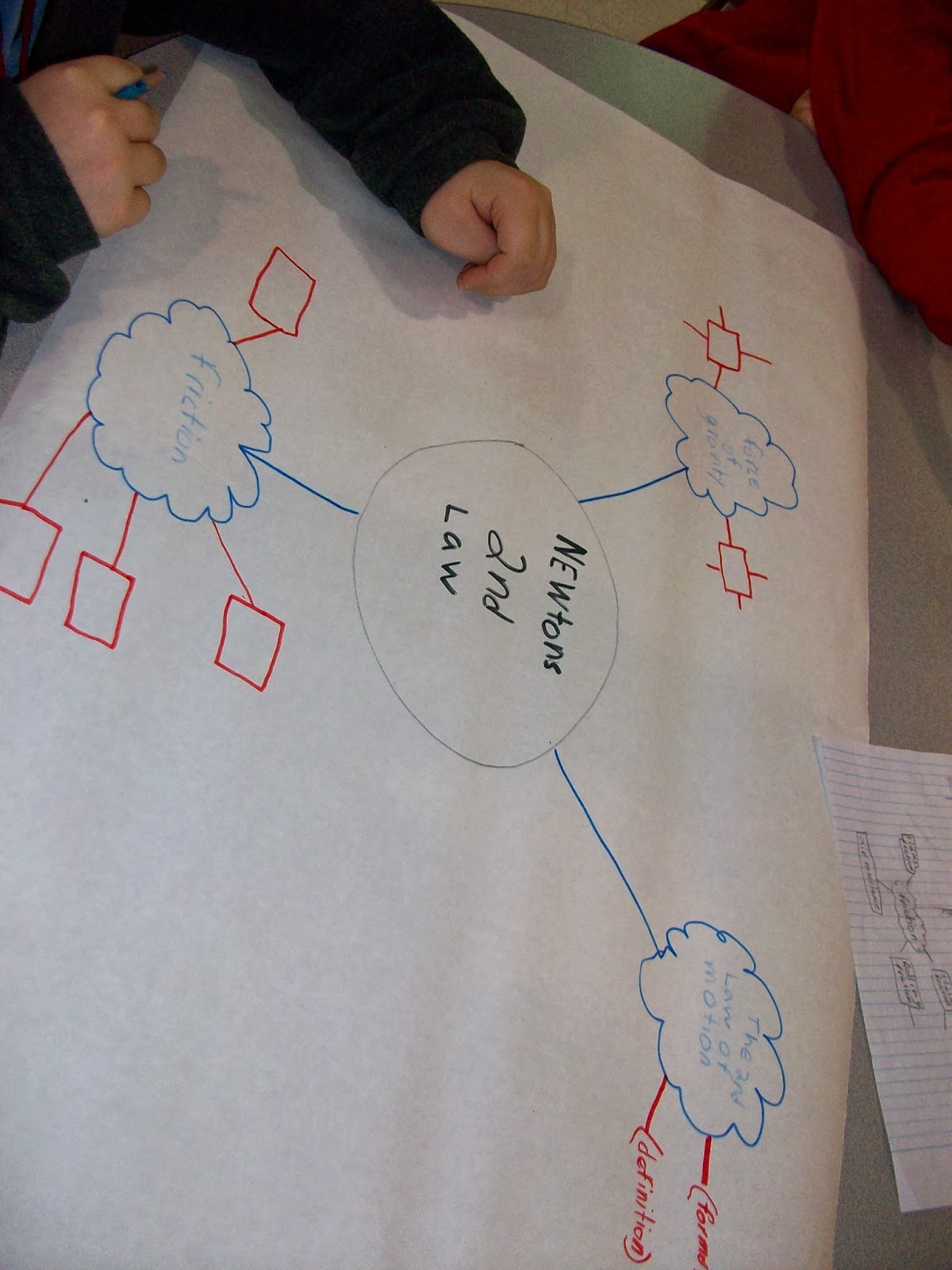
Concept map of Newton's Law

  • Main idea - Detail Organizers or concept maps (picture to the right)
  • Venn Diagrams
  • Sequence organizers (using pictures)
  • Using mental imagery (Ask students to close their eyes and imagine something while you tell them what they should be seeing.  Let them fill in details.  I used to do this when I taught sixth grade social studies.  I would play music of the time period softly, and then I would guide the students through a five minute "walk around the town" with their eyes closed.  They LOVED this exercise and were VERY excited to share what they saw.)
  • Picture notes (picture below left)
  • Creating cartoons (picture below right)
  • Using already-created cartoons and asking students to create captions or writing based upon them.
  • Problem-Solving organizers
  • Visual RAFTs (creating something from the perspective of someone or something other than a student)
  • Replacing words with pictures in ANY organizer
  • Timelines
Picture notes on Hurricanes

Newton's Law Cartoon
After you have completed a visual activity with your students and before shutting down the learning altogether, consider one last step: transformation of information.  Writing is a skill that our students will need, regardless of their learning-style or intelligences.  Once our eighth graders have completed their final organizer on the strengths and weaknesses of the north and the south during the Civil War, our last step will be to have our kiddos go BACK into their notes, summarize, and draw some conclusions.  I will, undoubtedly, have to model this for them, as drawing conclusions seems to be tricky business for even our gifted kids at times.  But the idea in this activity is to have them reread their notes and use their writing skills (however poor they may be) to put the information together into a complete thought.  This forces the visual students to practice expressing themselves with the aid of a strength (visuals) and it forces those of us who are read/write learners to use our words (strength) to support our visual learning (weaker).  I find that if I am forced to observe and write my observations that I am much more observant than if I am asked to just look.  It's a good lesson for me because if it happens to me, I know it is happening to my students.  

Thursday, March 28, 2013

IRC Conference, March 14-16, 2013, Kelly Gallagher

Write Like This: Teaching Real-World Writing through Modeling and Mentor Texts
Kelly Gallagher


I feel a little naïve in the area of reading/writing instruction sometimes.  I say this because I started my career out with full intention of acquiring a position as a US History teacher and staying there until I retired.  This didn't really work out the way I had planned.  In fact, it wasn't until I was 13 years into my teaching career that I was even offered my first job as a US History, and by this point I had given up and moved into reading.  Now don't get me wrong, by this point I had a deep understanding of how important reading was and I was excited with what I was doing.  It wasn't that reading was a second choice; its more like reading was the place I was meant to be, but I was distracted early in my career by the glory of social studies.  I truly believe that I am where I need to be right now.  It just took me over ten years to get there. 

I bring this up because I've never seen Kelly Gallagher speak until a few weeks ago at the IRC Convention.  It was embarrassing to admit this, as the girls with whom I was traveling had all seen him at least once.  My co-department chair actually paid to go see him next month because she wanted to hear him speak.  Gallagher is a contributing author to our newly purchased literature series.  So, after a crazy morning (I overslept by an hour and a half and still had to pack!), we managed to make it to breakfast without missing anything.  I have NO idea how this happened, but after hearing Gallagher speak, I'm glad that I didn't miss him.

The idea of mentor texts was also one that was new to me - again, I am admitting to this, knowing that I probably should have known this term.  After hearing Gallagher speak, I think I have used this strategy in one form or another, but I have never called it mentor texts.  The name makes sense to me, and the way that the idea is used is really brilliant. 

Gallagher began his session with a quick discussion about what today's students are facing in the next ten years.  Because he currently lives in California, he spoke of the California Highway Patrol assessment.  The examples that he showed his audience were clearly vocabulary-based.  Gallagher reports that the majority of this assessment is vocabulary and writing.  Prospective police officers are even required to write an essay!

One point Gallagher made in his presentation is the idea that our expectations for our students are getting lower and lower.  Gallagher stated that he felt like the expectations for our juniors and seniors are decreasing and yet the college expectations are not changing.  I hear this statement over and over again - the academic comparison of today's kids to kids of the past.  I was a kid a little over twenty years ago, and there is no comparison, in my opinion.  It's like the comparisons that are made country to country, state to state, or even district to district!  The number of variables that would have to be factored into the equations are so vast, it is impossible to make such a generalized statement, and yet educators of all walks do it. 

Sixteen years ago I saw my students' ability to absorb classroom content to be more than today's students.  But sixteen years ago I also communicated with their parents through phone calls and face-to-face discussion.  Today, I text or email parents.  I tweet, post and blog.  Input and output come in different formats for our students and for their parents, and this stimulates different parts of these kiddos' brains.  Sixteen years ago (my first year of teaching), my students were not inundated with digital media at every turn.  They were still reading paper books and researching using books and encyclopedias.  The internet was such a new tool back then, and youtube was nonexistent.  The term "just google it" had no premise, and AltaVista was my go-to search engine if I couldn't find the answer in the library.  These kids' brains were still tapped into things that could be touched.  Today's kids are not like this.  To me, this changes things.  We have added an entirely new type of literacy into the lives of our students - digital literacy, and yet we are expecting them to perform at the same capacity or higher, with all of our new research in higher order thinking, than we have in the past.  And we say our kids are not performing?  Of course they are not performing!  They're not meeting these expectations because we are moving at the speed of light and trying to keep up with the increasingly-complex technologies of tomorrow.  We are piling so much on our kids and then shaking our heads in puzzlement when they do not respond!  The bigger problem is that there are students who can achieve at such high rates, and this causes the chasm to spread between those whose brains have been able to adapt and those whose haven't.  Those whose parents read to them every night since before they were born and keep books in every room of their house.  They are the same who buy the latest technology at home who have a bigger advantage and will perform higher on every assessment than those who don't. 

What we expect of our students is in no way less than what we expected twenty or thirty years ago.  It is just different.  We have skipped over some key foundational concepts like basic mathematical computation, phonics, historical dates, and science definitions and moved into teaching application of difficult, complex concepts beginning at the age of six.  Gallagher even concedes that the math from yesterday is not the same as the math of today - word problems are more complex and requirements for computation and answering require reading and writing skills!  Although I can see where this allegation of educational negligence stems, I think the accusation should change to figuring out how we can equalize the opportunities for all of our students and meet the new technological needs of this new generation, all while meeting the higher expectations and blended literacies popping up all over in our standardized testing and real-world experiences. 

Gallagher sees writing as a key educational component, but no longer are we talking about the five paragraph essay.  Today's writing expectations are much more complex and include a wider range of English words than students from years past.  Each year, hundreds of new words are introduced to the English language, and one of our jobs, as educators, is to help our students keep up.  Again, we move to the idea of vocabulary

Kelly Gallagher's idea of using mentor texts is a neat concept - it's the idea that we use a piece of uniquely organized current writing, analyze the author's craft to identify what makes it unique, and then have our students use their own ideas to create a new piece based from the craft of the mentor text.  Gallagher went through a series of mentor texts during his talk.  These easily-utilized mentor texts are listed below:
  • 6 word memoirs - See the example lesson plan with videos from readwritethink.org on what they are.  My brief description will not do them justice.  They're six words long and can be used to say just about anything.  See?  Definitely not the detailed description that would be considered telling.
  • Twitter posts - If you haven't looked on twitter or used twitter, I'll tell you right now, I opened a twitter account a year ago and the combination of number signs, ampersands, slashes, dashes, and stars freaked me out so much I posted very little.  Just within the last month, I've made more of an effort to "get to know" twitter, and I'm really starting to get the hang of it!  The restriction with Twitter is that tweets can be only 140 characters (including spaces), so the composer has to either condense information into a sort of twitter code or tweet more than one tweet on the same topic.  This supports the idea of summarization, and would also pique the interest of the students composing the tweets on whatever topic they're writing.
  • Encyclopedia of an Ordinary Life - Definitely a book I will own.  This text is organized in alphabetical order and features words that are significant in the life of author Amy Rosenthal.   Andrea Reichenberger posted a flickr slideshow giving some examples of some great projects created by her students.  Gallagher suggested using this project to start the year.  I LOVE this idea and can't wait to share it with some of our ELA teachers. 
  • The "Unofficial and Unwritten Spokane Rules of Fisticuffs" from The Absolutely True Diary of a Part-Time Indian by Sherman Alexie.  Lisa Larsen,a teacher from Nevada, writes about this list of unofficial rules and how they can be used in the classroom in her book review.  Gallagher suggests using them in this way and then having students use Alexie's craft to craft their own unofficial rules.  A great way to cross writing with character education or PBIS!
  • This I believe . . . It's really unfortunate that I can't recall if this is the mentor text or not, but what a cool book!  I would use it.  There seems to be a lot out there on the web about writing "I believe" essays, but This I Believe: the Personal Philosophies of Remarkable Men and Women (Allison & Gediman, editors) seems to support Gallagher's objective.  Again, he suggests this could be a good first week (or first day) activity. So many of our kiddos are resistant to writing, but asking them to talk about themselves or what they believe usually sparks some motivation.  It also sets a premise for a writing class that we start the year writing - we will be writing all year.
  • "If you're looking for a way to  . . . " modeled from the ESPN article "If you're looking for a way to kill little league".  Read the article.  It's pretty awesome, and what a wonderful discussion on author's craft you and your students can have!
In each of the above examples, I am brought back to Jeff Anderson and Anna Deese where both presenters talked about the idea of observing or noticing.  Studying the craft of a writer or author requires this skill, and to use mentor texts like the ones above is a great way to practice this skill. The act of applying this craft then allows students to process what they've observed or noticed and morph it into their own writing.

I was thrilled to have taken so much from Kelly Gallagher's morning session at the IRC Convention, and I know that the ELA teachers with whom I work will embrace much of what I have brought back to share with them.  The fact that he contributed to our newly-adopted literature series gives this information even more meaning.  And . . . I also have a list of more books to go out and buy. 

    Tuesday, March 19, 2013

    IRC Conference, March 14-16, 2013, Inspiring Inquiry ThroughChallenging Texts

    Anna Deese
    Inspiring Inquiry Through Challenging Texts

    Last year I missed the Project CRISS ladies at the IRC Convention, and I was so disappointed, so this year I made it a priority, and boy, was I glad I did! Anna Deese taps onto students' intrinsic motivation using a simple, old technique masked by fancy words.  The old K-W-L got dressed up with two columns as seen here.  Instead of a K, we now see the word observations, and instead of the W, the words authentic questions appears.  Here's how it works.
    • Show the students a visual or two from the lesson - a map, a primary source photograph, a graph, etc.
    • Ask the students to make as many observations about the visual as they can.  Give some examples to get them started.
    • Then tell them to ask questions based from their observations.  Again, give an example to get them started.  (This may take some practice)
    • Categorize the independently-written questions into four different categories: easy resource / look up, inquiry, author and me (making connections with the author - ie.  Is this like . . . ?), and questions for the author (challenges what the author actually did.  ie - Why did the photographer choose this subject?)
    • Start with abstracts or summaries of selections before attacking the entire selection.  Read it to find answers.
    • Give students additional visuals from which to gather more information
    • Finally, give students an opportunity to find the answers for themselves (articles, sections of a text book, websites, etc.)
    I found this idea to be both engaging and extremely authentic, as students were really driving their own learning.  As they are compiling their list of questions, the teacher can always throw in a question that she feels might have been missed so that key targets are met as well.  This strategy can also be used across all content areas in a wide variety of situations. 

    Deese gives other examples of how this strategy can be used.  One example was with their own data collected from a science lab.   Better yet, she says, why not set up a lab with all of the materials and have students write down all of their observations and a prediction of what will happen that day.  She also suggests using advertisements with pieces missing and having students observe and use their background knowledge to try to fill in the missing pieces.  It was at this point that I was almost bouncing out of my chair in excitement because I couldn't wait to share what I had learned in Jeff Anderson's session the day before.  Anderson and Deese both discuss making observations.  Although Anderson calls it noticing, the concept is the same, and the process in the brain is the same.  The connection here was so strong that I couldn't help but share it.  I could tell she and I were on the same wavelength because after I shared that idea, she came up with the idea of observing a citation and commenting on the format.  Again, I loved this idea and hope to share it with my language arts department.

    The second part of Deese's presentation dealt with craft and structure of a selection.  The philosophy is that you can determine the author's purpose of a selection by taking a look at the author's craft and structure.  Handing us a copy of an article and a chapter of a book, Deese asked us to look at both the internal and external text features (see photo to the left) and makes notes about each.  Through discussion we discovered that both selections were written by the same author on the same topic, but the purpose of each was quite different!  The language used in one had a negative connotation, and the more we investigated it, the more we realized that the author's viewpoint was slanted in that particular piece.  Beautiful!  Difficult, but beautiful. 

    Deese's final activity was a listening activity.  She had all of her participants line up around the room with a piece of paper and a marker (this can be done individually, in pairs, and maybe in groups of 3).  We were directed to listen to the lab setup and draw what it looked like.  She read it to use three times slowly while we drew.  This activity was fun, made us laugh at the end, and gave us an idea as to what the lab might look like when set up.  I could see this done in quite a few settings - even in PE where students might be challenged to draw out a lineup of a team on the field or how the team might look on the gym floor just by listening or reading it from a piece of paper or index card!

    The hour I spent with Anna Deese during her presentation was an hour well spent.  Content area reading strategies are golden, in my book, and the ones that she presented here were ones so easily adapted to any content area.  I'm looking forward to sharing them with my staff.