Showing posts with label struggling readers. Show all posts

Saturday, February 15, 2014

Strategies for visual learners

I had two things happen this week that made me think that I needed to revisit the topic of visual learners.  If you've read any of my previous blogs, you may have gotten the sense that I rely heavily on student strengths (learning styles and intelligences) as a reason for student success or (most often in the case of the students with whom I work) failures.  After reading Dr. Ross Greene's article on student motivation and blogging about it, what I should be saying is that student success or failure relies heavily on their instructors' inability to reach them and their inability to take in information the way it is presented.

If you have never taken a learning-styles assessment, stop right now and take one. Then take a multiple intelligences survey.  To clarify, the difference between the learning-style and the intelligence is that your learning-style is the way that you prefer to take in or produce information.  It may or may not be based upon your strengths (most often it is because we like to do things that are easier).  Your intelligences are your natural strengths.  They may cause you to prefer to take in and produce information a specific way.  Both are linked, and both cause a learner to face roadblocks in learning.

The results of your surveys may not be surprising, but before you continue to read, your next step should be to make a list of all of the things that you do in your classroom that align with your learning-style(s) or your strongest intelligences.  When I did this the first time, it was such an eye opening experience because I had never put emphasis on learning-styles or intelligences until I realized how my entire being reflects these things - even my personal relationships are impacted by the way I take in and produce information and my strengths.  I realized that if I wanted to reach all of my students, I needed to start making my instruction and communication more multi-modal.

One thing I am most definitely NOT is visual, and this is why, when I visited classrooms this week, I was reminded that one of my weaknesses is a strength of many of our students!  So this week's blog is in honor of my weakness and their strengths.  Take some time to read through some ideas for supporting those visual learners, as so many of them are sitting in your classrooms listening to you (aural) or reading your books and articles (read/write).

While visiting a seventh grade writing class, the teachers projected a photograph of a man with a dog (right) and gave the students a "Story Sparkers" (below left) sheet as a way to suggest details for the students' creative writing piece. Their teachers gave them time to study the image and think about the ideas before they began their writing.  So often, as a teacher of any subject, I have given students a prompt to begin their writing, and their job was to stay focused on the topic and write.  Our Common Assessments are the same way.  Standardized tests? More of the same.  What a disservice we are doing to an entire population of individuals who, as much as we think we are doing them a favor by giving them sixty seconds to think before they write, spend that sixty seconds trying to come up with details that aren't clear to them because they struggle to transform our prompt into a visual, see the details, and then transform those details back to writing!  It's like learning-style translation.  Then when we say "Go!" most of them write down the starter, fill in the blanks, and then stare at the page helplessly while we tell them to keep writing but give them little to no support in supplying details.  What better way to support this large group of visual learners than to supply them with a picture or (even better!) short video clip to get the visual images going!

It just so happened that I have been working in an eighth grade social studies class, and the same type of thing popped into my head last Thursday.  Looking at some of the visuals in the social studies text book, I was brought back to last year's IRC Conference presentations where the skill of observation was emphasized over and over and over again by multiple presenters.  Jeff Anderson, Anna Deese from Project CRISS, and Janet Allen all spoke on the idea that we need to teach students the art of observation because they overlook critical pieces of information when just casually looking.  It's like doing a close read, but on a piece of visual material.  Today we require students to think critically at a much younger age than ever before, and we need to start guiding students to developing their observation skills if they want to be prepared to compete for jobs in the workforce.  The skill of observation is even difficult for those who are visual because it requires stamina and a deeper understanding of what is being observed.  Now imagine how those of us who are NOT visual feel about it.  Ugh.

So on Tuesday this week my plan is to introduce chapter sixteen in a different way to the social studies class.  Both of the periods into which I am pushing consist of a high percentage of students with IEPs and struggling readers.  Expecting these students to tackle the highly complex text of their board-approved text book without frontloading and building background knowledge would be insane, so we are going to begin by an "I do", "we do", "you do" activity (gradual release of responsibility) to practice the art of observation.  I'll begin by asking the students to look in their text books at a map of Fort Sumter where the Civil War Began, and I will demonstrate my thinking on the screen for them by writing down some of my observations and my thoughts.  After this, I will direct their attention to the next map, where I will ask them to do as I did, but have them do it in pre-determined partners.  The idea here is to give them support in this new task, allow them some social learning, but guide them as well.  Finally, the graph on the next page shows the differences in the amount of resources between the north and the south.  This is the one I will ask them to do alone.

Once all is said and done, students will have engaged in reading (parts of the map), writing (their observations), and discussion (through partner work) on parts of the section and can probably make some predictions about what the section contains.  After the preview, students will read a two-page guided reading summary of the section, and then the following day will partner read selected sections of the real text with a very strict organizer to follow.  Students' purpose for reading will be to collect information on the strengths and weaknesses of the north and south during the Civil War.  This sounds vaguely familiar, as it was also a part of our old Level One CRISS training.

Project CRISS also has other ideas for using pictures and visuals for students who rely on their visual intelligence and learning-styles.  Below is a list of some of these easily-implemented ideas.
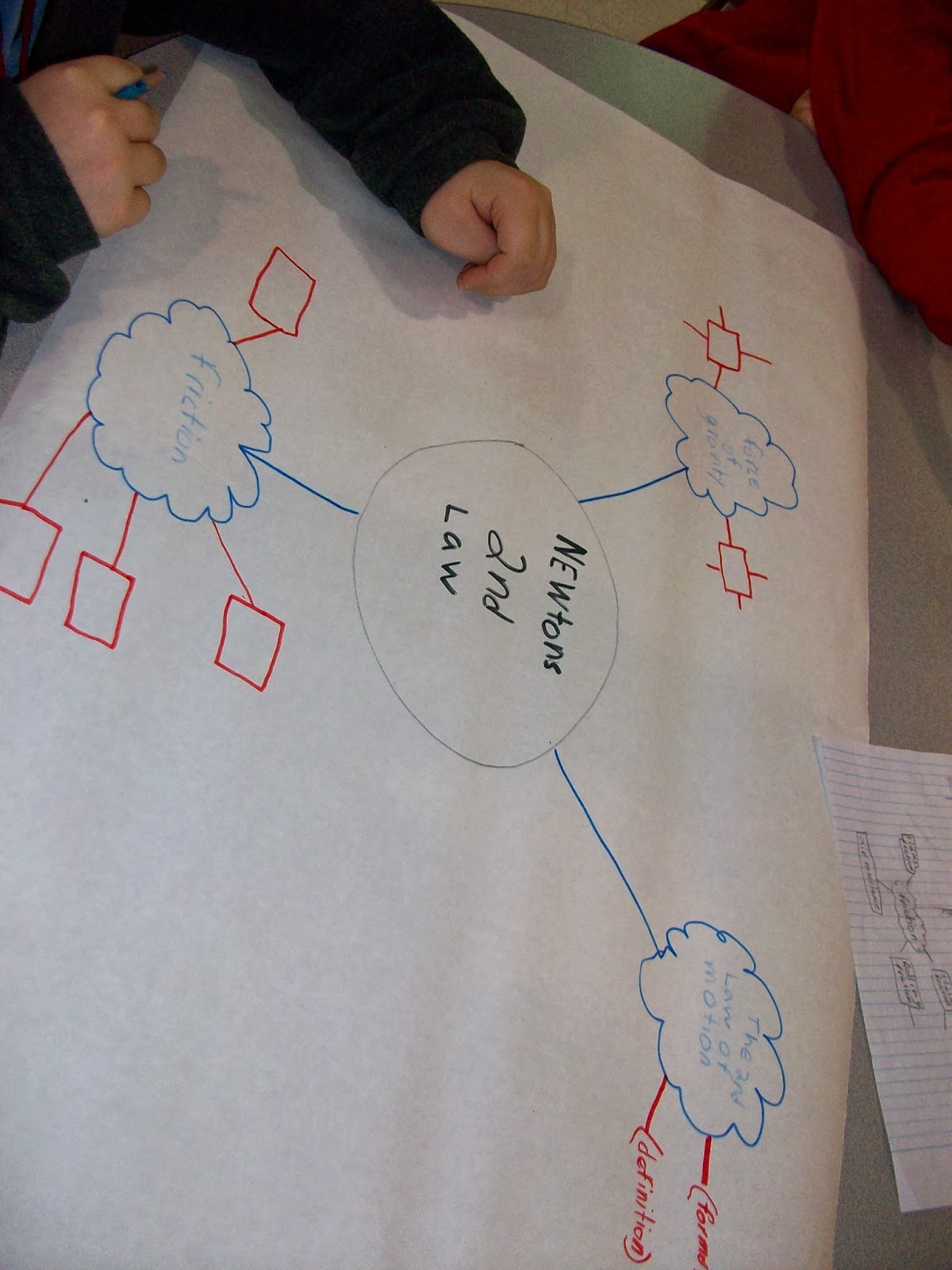
Concept map of Newton's Law

  • Main idea - Detail Organizers or concept maps (picture to the right)
  • Venn Diagrams
  • Sequence organizers (using pictures)
  • Using mental imagery (Ask students to close their eyes and imagine something while you tell them what they should be seeing.  Let them fill in details.  I used to do this when I taught sixth grade social studies.  I would play music of the time period softly, and then I would guide the students through a five minute "walk around the town" with their eyes closed.  They LOVED this exercise and were VERY excited to share what they saw.)
  • Picture notes (picture below left)
  • Creating cartoons (picture below right)
  • Using already-created cartoons and asking students to create captions or writing based upon them.
  • Problem-Solving organizers
  • Visual RAFTs (creating something from the perspective of someone or something other than a student)
  • Replacing words with pictures in ANY organizer
  • Timelines
Picture notes on Hurricanes

Newton's Law Cartoon
After you have completed a visual activity with your students and before shutting down the learning altogether, consider one last step: transformation of information.  Writing is a skill that our students will need, regardless of their learning-style or intelligences.  Once our eighth graders have completed their final organizer on the strengths and weaknesses of the north and the south during the Civil War, our last step will be to have our kiddos go BACK into their notes, summarize, and draw some conclusions.  I will, undoubtedly, have to model this for them, as drawing conclusions seems to be tricky business for even our gifted kids at times.  But the idea in this activity is to have them reread their notes and use their writing skills (however poor they may be) to put the information together into a complete thought.  This forces the visual students to practice expressing themselves with the aid of a strength (visuals) and it forces those of us who are read/write learners to use our words (strength) to support our visual learning (weaker).  I find that if I am forced to observe and write my observations that I am much more observant than if I am asked to just look.  It's a good lesson for me because if it happens to me, I know it is happening to my students.  

Monday, January 27, 2014

You say "tomato", I say "tomato": Word pronunciation, meaning, and spelling

I had an interesting (almost sweet for a story about an eighth grader) experience last week when I was working with a student (let's call him David) on a reading fluency exercise.  He is in his first year out of bilingual, and he struggles, to say the least.  This kid is a cool kid - well-liked, adorable, and goofy.  But he does everything in his power to avoid doing his academic work.  His teachers may complain that he is unmotivated and lacks focus, but I can hypothesize that what is really going on here is that David is trying to "save face" by deflecting any attention away from his lack of skill, which affects his academics.  The best way to do this?  Goof off in class.  You get your peers' attention, a few giggles, and inevitably you get adult attention also. 

So David and I were sitting in the hallway a few weeks ago running a fluency passage.  We use The Six-Minute Solution (Sopris, 2003) for quick and painless fluency training in our short amounts of intervention times that we have.  I cannot even remember the topic of the passage we were reading, but I will forever remember the conversation we had right before David began reading to me.  I always read the passage before the kids to model good fluency and to show them how even I can improve daily on my reading fluency when I practice.  After I read the passage, I looked at David, and he asked, "How do you pronounce that word?"  To me this was a big deal, because he usually doesn't ask - he just mispronounces words over and over again, and with his accent, sometimes it is difficult to determine what he is mispronouncing and what mispronunciations are dialectic.

The word was comfortable.  I pronounced it for him the way I pronounce it (COM-fer-ta-ble), and I could see him testing it out before he started reading.  During his read he stumbled on the word, but he did manage to pronounce it the way I had pronounced it.  I pondered this while I monitored his reading, and similar experiences with other ELLs popped into my head.  Ask a kid to pronounce that word.  I just asked my ten-year-old, and she looked at it, said it (com-FOR-ta-ble) twice, and then a light bulb went on in her head before she said, "COM-FTER-BUL!"  At that point I had to look the word up in the dictionary because I was curious how the dictionary said it should be pronounced, and what did I get?  Multiple pronunciations - both mine and theirs with an ADDITIONAL pronunciation (for kicks, I guess).  Fabulous. 

This situation brought me to the dozens of times when I have worked with students one-on-one or in small groups on reading and spelling.  Our big kids have been mispronouncing certain words for so long that, even when they DO know spelling rules, they misspell because they hear it and repeat it in their heads, naturally changing the pronunciation to how they think it is pronounced and have heard it pronounced over and over again by parents, siblings, and neighbors.  Part of our job is to help them understand that there are some words that may be pronounced differently, and explain how the spellings of those words may or may not follow spelling rules. 

I'm giggling now, because I am recalling a story a colleague shared with me about an issue where one student couldn't place a common phrase into context.  The student, who was writing a story in class, started the story with, "One supana time."  Clearly this student lacked the background knowledge in fairy tales to understand that the phrase was "Once upon a time."  There is nothing wrong with this, except that we assume that our kiddos will have knowledge to read, spell, and write, and some of them just don't.

Another example comes from a sixth grade classroom last year when I happened to be in a room where a teacher was asking students to give definitions or examples of words written on the board.  She asked one sixth grader, who I knew to have trouble with multisyllabic words larger than two syllables, about the meaning of a word (the specific word escapes me now, but it was a -tion word).  He stared at her, fear stricken, before he said he didn't know.  I  KNEW he knew the word, so I said, "I think you do know the word," and I pronounced it for him.  I am a believer in probing some kids until they see success, and I knew I could push him a bit.  The second he heard the word, he said, "Oh, THAT'S what that says?  I know that word!" And he went on to explain it to the class. Success.  I also knew that this student was a good reader as long as you kept his words to one and two-syllable words.  This particular word had three syllables.  That's how specific some of these reading deficits are!

My point here is that we take for granted that these kids can read or have the background knowledge to produce what we think they should.  They all can't - not yet, anyway, and they are brilliant at hiding that fact.  So how can we be absolutely certain we are covering our bases, as teachers of all content areas?  Here are some ideas.
  • No matter what content area you teach, pronounce any and all vocabulary words over and over and over and over again.
  • Require your entire class to pronounce them back.  Who cares of they think it is silly.  Just tell them that you want to be sure everybody has the correct pronunciation of all of the words.  If you're working with names in social studies, this is an easy justification because some names are just tough!  If they bawk at it, bawk back and make them say them in a British accent or like Dracula or something. 
  • If you're out of "bell ringer" exercises (or even if you are not), have students pronounce and spell vocabulary words back and forth to each other in partners.  Don't forget to pronounce them FIRST.  If you have two kids in a partnership and neither one of them knows how to pronounce one of the words, they will inevitably practice it wrong.  Throw in a few words that are not content area vocabulary words but are found in the text just for kicks! The kids will never know the difference!
  • Consider the fact that your students may run across other words in their reading that look unfamiliar.  If you know that you have struggling readers in your class (which you all do!), then reading a text book independently and silently is probably not the best way to expect your students to tackle the text.  Be sure to group (or preferably pair) students appropriately. 
  • Please do not put a gifted reader into a group of struggling readers or pair them up to support the struggler.  Space out those strugglers amongst your regular kiddos so that they can get some support and do the same with your gifted readers.  In my opinion, struggling readers and gifted readers can be grouped or paired together, but not for reading.  The gap is too wide.  I know you might be temped because you think it might give the struggler a good model, but there are plenty of good models amongst the average readers, and there is such a thing as looking at a gap and feeling like you'll never be able to jump it.  I imagine that is what it feels like to some of the struggling readers when they work with a gifted reader.  Plus, gifted kids are gifted and generally know it.  They're smart enough to know why they've been partnered up with certain people, and the minute the struggler opens her mouth, the gifted student will know.  There is no partnership at this point, and both students may feel like they can't wait for the activity to be over.   And to be honest, not all gifted readers feel like it is their calling to help those who struggle.
  • If your text books come with supported or modified text, use it, but use it with care. Don't just give it to kids who struggle with your content, use it with kids who struggle with reading and need reading support.
  • Look to your reading specialist, interventionist, data collection specialist, or special education staff to help you identify your strugglers.  There may be data in your school that you don't even know exists!  I hold all of our reading data, and I try to communicate it as much as possible, but with seven hundred kiddos and more than fifty people working in our building, not all information will get to everybody who needs it.  Sometimes you have to ask.  If you notice a student who is not meeting your expectations, look for answers and start with one of these people.

So the next time you notice a student who misspells words, ask the student to pronounce them for you.  Chances are, the problem may lie with the idea that he struggles with the pronunciation.   If you read my previous posts on students who lack vocabulary, you will understand that many of these kiddos are encountering some of these words for the first time and are building their oral vocabularies as fast as they can.  We need to continue to expose them, but we have to expose them properly and thoroughly.  Don't take for granted that they "should know", because some of them just don't.

Sunday, December 8, 2013

Why do many of our English Language Learners suffer in our system?

I'm wondering when my reading specialist colleagues are going to stop answering text messages and emails from me with the subject "vocabulary".  They have to be sick of my ranting by now because I've been beating that poor dead horse all year, and it seems that I'm only beating harder nowadays.  But this time I'm backing up my rants with some real data. 

For two years, I've suspected that vocabulary is at the root of our issues for many of our kiddos, but vocabulary is such a vast and general topic, and I'd never been satisfied with any assessment that I'd seen for vocabulary.  As it currently stands, there's the most commonly accepted Three-Tier Model for reading vocabulary: Tier 1 vocabulary (sight words), Tier 2 vocabulary (academic vocabulary), and Tier 3 vocabulary (content-area vocabulary).  Project CRISS's fourth edition manual now includes a Four-Level Model that, in no way, aligns with the Tiers, but the tiers would absolutely fit into the four levels (mostly academic and/or content-specific vocabulary).  Level 1 critical words are words that must be pre-taught before reading.  Level 2 words are important but do not require a lot of pre-teaching time.  The third level are words that are important, but they are clear in the text and do not require preteaching.  Finally, level 4 words are words that are not necessary to be taught to students before, during, or after.  As an educator, I make automatic assumptions that vocabulary-building means words that you read, right? Well, after this week I have begun to wonder if maybe I had it all wrong from the beginning.

With all of these categories and ways to approach vocabulary, why do we struggle so much once we hit this roadblock in reading?  We seem to have all of the answers for phonemic awareness, phonics, and fluency, but yet when it comes to vocabulary - the answers come in all shapes and sizes, and yet none seem to be fitting for so many of our middle schoolers.  Most of us skip considering vocabulary as a major issue because we assume that we are covering it when we teach content or literature-specific words, and when our kiddos test below level in comprehension, we push comprehension strategies, not vocabulary (in my case because I thought I had already covered it).  But what happens when you have a student who started life speaking a different language (in the case of most of our ELLs - Spanish)?  Maybe she began learning English at the age of six.  Imagine all of those important first-words that she missed and then had to learn!  How many years do you think it takes to catch up in a new language?  And how does that impact her at the age of thirteen?  Research tells us that each year our students absorb thousands of new words, but what if you don't start learning them until age six or seven?

So a few months back I remembered an assessment from my graduate work in reading that I wanted to try - one that targets oral vocabulary, specifically.  Although I was unable to get my hands on that specific assessment (the Peabody), our speech pathologist had something very similar for both receptive and expressive vocabulary.  I spent some time skimming through these two assessments and decided to give them a shot with one of our eighth graders (let's call him Tito) who has been through just about every Tier 2 intervention we offer.  At this point in the year, I begin to panic when nothing is working because I know that my time is limited with our almost-freshmen, and I need to act quickly to pinpoint a solution.

What I found did not surprise me one bit with this kiddo, and my former hypothesis that oral vocabulary is at the root of many of our English Language Learners' reading struggles sprung to life again with all sorts of questions attached to it.  Tito's scores on both the receptive and expressive vocabulary tests were in the very low average and below average range.  During the receptive vocabulary testing (where he had to identify pictures that best matched the words that I gave him), his responses came quickly.  However, the expressive vocabulary assessment was almost painful - he took so much time trying to formulate words for the pictures that at one point I wondered if he had forgotten that he was supposed to give an answer!  In several instances he finally gave up and said, "I don't really know."  Also, at times when the answers were incorrect, Tito's response was a short phrase description of the actual word.  It was obvious he was trying his best to express himself correctly every time.

I then started to formulate a list of questions that I will be pondering over the next few months:

  • What can I do, as a reading specialist, to help close the gap for these ELLs who fall under the RtI umbrella?  It is my responsibility to "catch them up" in reading, and yet I'm not trained to develop tens of thousands of missing pieces in oral vocabulary.  This is the most loaded question and very general, so then I started to get specific.
  • Will testing more of our ELLs produce the same information?
  • How do these gaps effect their performance in their content area classes?
  • What can I do to communicate this information to our staff?
  • How can I support our students who are lacking in oral and aural vocabulary so that they can be more successful?
  • What strategies work best for middle level students who have significant gaps in expressive and receptive vocabulary?
  • Within the confines of our current schedule, when can we work on these gaps?
  • How can my speech path (who is AWESOME, by the way) and I work together to make a plan, even though she is tied mostly to her students with IEPs?
  • Who else can help? (I have already talked to our speech pathologist who gave me some ideas, a bilingual reading specialist, and gotten an email from a former colleague who is hoping to help me use some resources to which she has access, and I'm super excited about all of it!)
  • At what point do I stop digging? Because I'm exhausted and exhilarated at the same time.  Although the screeners are just screeners, so are our comprehension, fluency, and phonics screeners - but you have to start somewhere, and the fact that both of Tito's tests came out just a few points from each other tells me that we do, indeed, have a problem.  
By next weekend, I hope to have a few more students assessed so I can report on how those went.  I have chosen three more students (three eighth graders and a repeat seventh grader) on which to complete testing. Once I get that done, my next step is to consult with our other reading specialists on this and formulate a plan of action after we put our resources together.

For now, friends, the next time you stand in front of your class and register that you have ten students who appear to have zoned off, take a moment to evaluate how you speak to your class.  The trick is to support them all without "dumbing it down".  The last thing we want to do is to stop exposing them to rich academic vocabulary, but know that if you do that without rephrasing and supporting, many of your kiddos may not have the skills to even understand the words that come out of your mouth.  A few years back I had this exact conversation with a respected social studies colleague who admitted that she hadn't considered that her vocabulary choice when instructing her students would impact their performance in class.  Also, we often think that if we read the text to our kiddos it will make a difference (and it sometimes does!), but imagine trying to keep up with an instructor who spoke to you in words so difficult that you often couldn't understand him, no matter what strategies you used.  What would you do?  I know what I would do, and it certainly wouldn't be to pay more attention and take more notes.  And yet this is often the answer just about every student gives when we ask them what they think they can do to improve themselves - even those who struggle due to language . . .

Friday, April 19, 2013

Social Studies inquiry - April 19 Crumble

As our seventh graders continued work on their biography projects this week, and I have moved into the eighth grade social studies classes.  I touch base with our biography-readers, and I've even been able to talk one into using Haiku Deck for his presentation rather than Power Point.  Unfortunately, after I got him started, I realized he can only access it on an iPad, but the project looks great!  This would be a nice app to use on our iPad cart, and it started me thinking about the possibility of checking out iPads from the library here.  It would have been great to allow him to do that for this project!  He seems to be enjoying it - partly because its on iPad and partly because it's cool and different.  Once he is finished, I will blog it so you can see the ease of this app.

So I spent most of my week with eighth graders.  Eighth graders have been given the task of creating a social history scrapbook to hit research targets for CCSS.  The project, itself, is big, but the entire task is really colossal - not unmanageable for a two-week project - but a big shock to our eighth graders.  Again, I am seeing an interesting phenomenon - the same trend that I saw with our seventh graders.  Give the kids a task (with good direction) and leave them alone.  They will do their best to complete the task. 

This is what has occured so far:
  • Students were given directive on the entire project, including being given a grading rubric that included specifics on the final project as well as specifics on the expectations on the process.  All targets were aligned with Common Core Standards and explained at length.  I will touch on this again below, so keep this bullet point in mind.
  • Students were also given direct instruction on citing sources by our Library Media Specialist.  She uses a spiral system where student expectations for citing increase sixth through eighth grade.  During this insruction each student (while working in pairs) also had an opportunity to try their hand at typing out a full citation in MLA style before being expected to write one on their own for the project. 
  • Students were then given instruction on how to use the Q-Chart.  This time, instead of having students write their questions on the chart, they wrote them in their three-column-note sheet before they began their research.  The Q-Chart was used, then, to keep track of what types of questions they were asking.  Students were directed to put a check mark on the chart and try to spread out their question types so that they use a variety of questions.
  • Finally, students were instructed to look for their topics and answers.
I am quite pleased with the process.  For three years we have been working on a functioning research technique, and we are getting to a point where we have one that we like.  As with everything, however, changes can be made to differentiate and make this an even more efficient procedure. 

I wish I had thought about conducting a mini-lesson on text features like I had done with the seventh grade biography-readers.  Not all of our students needed this, but a majority of them had trouble picking out main topics or even understanding that they should have main topics for their research.  They needed to have four influential people, four historical events, four science and technology breakthroughs, and four parts of daily life plus some other research.  Some students just started writing a bunch of questions about historical events, and their research was slim.  Once we sat with individual students and explained how to make their social studies text book work for them (use the timeline for important dates and the Important words and people at the beginning of each section to come up with influential people), some of them took off and never looked back!  I'm even wondering if perhaps I could have taken a group of the struggling readers off to a separate section of the library and worked with them on this task.  They were supposed to use their social studies text book to give them ideas for what to research in the era that they chose.  The picture below shows how some of the students organized their notes.  They were pretty extensive!

Another thing I wish I had done to differentiate for our students with higher skill level is to possibly pull them off and explain to them that the question-asking process might seem tedious to them because they sometimes skip that part and go right to finding answers.  Sometimes the answers come faster than the questions, so we were able to suggest to some of our kids that if they find information they want to include but have no question for it, include it and do a "jeopardy" - come up with the question afterwards. 

Something that our eight grade social studies teacher and I discussed a bit is the idea that when I am working with our struggling readers in small groups or one-on-one, they struggle so much with the texts we use for research - even when given a purpose for reading.  I found myself reading a paragraph out loud and stopping to paraphrase every few sentences (and looking up pictures online) because I would read and then ask if there were answers in what I read, and they would just stare at me with their eyes wide in the deer-in-headlights way.  One student, in particular, had self-awareness enough to be able to communicate that he had no idea what it was reading - even after chunking it into a few sentences at a time.  Why would this be?  Blam!  It hit me again.  I started breaking up sentences for them, and there were sometimes one out of every five words that I had to define!  Our kiddos need more words!

Some things that I am learning through this process:
  • Come up with some ways to communicate expectations over and over again.  Going over the packet at the beginning creates an overwhelming sensation with the kids that causes them to tune out and focus on one thing: when is it due?  I think that, if I can work on this project again next year, I might suggest creating a website with expectations laid out along with pictures of what pages should look like.  That way the teacher can direct students to the website and continue to emphasize how things should look.  Using a blog or Google sites would work just fine for this. 
  • Make a bigger effort to identify students who may struggle, and communicate better with the teacher so that we have a plan for these kiddos.  We had a surface plan early-on and identified the kids who would need help and modification, but I feel like I could have done a better job with support to them. 
  • Identify checkpoints in the project for those who struggle with organization and reading.  Stick with those checkpoints.
  • Know that I will be doing a lot of reading and paraphrasing to keep struggling readers on track with everybody else or modify the assignment even more than we had so that they can feel more independent with it.  By eighth grade I want them to feel a sense of accomplishment without having to have their hands held by anybody. 
  • Be prepared to spend some time after school and during lunch with those who are panicking.  We allowed the kids to come in during the second week, but I'm wondering if perhaps I should have insisted that the struggling readers come in both weeks.  I noticed that after working with some the first few days one-on-one, they were asking to come in during lunch, PE, music, and any other class to work on their project.  I'm guessing if I had set aside 3 mornings where the kids worked from 8:45 until lunch I would have had a few takers.  By the last day, they're all panicking - except those who asked to come in early-on.
This project has been a hard wake-up call for many of our eighth graders, but it is something they needed to experience as they prepare to become freshmen.  I'm praying that they all take it seriously over the weekend and finish it because it is out of our hands after today.  I have heard rumors of large quantities of students from our school descending upon public libraries this weekend to create and print.  I hope the library has stocked upon their paper!  But this project has also reminded me of my love for research, and it makes me want to get some projects going on an ongoing basis next year (partly because I don't want to have everybody doing their research in April next year and partly because I haven't had this much fun in a while!), so start thinking of some ideas and ways that I can be used to support you in your planning and execution of your research next year.