Showing posts with label purpose setting. Show all posts

Sunday, May 4, 2014

Background knowledge and purpose setting - Part 2

This blog is a continuation from last week's blog.  It is an ongoing narrative of a large project in which I am currently involved.  To get the scoop on what has happened previously, go back and read last week's blog.

On Friday I asked my colleague’s fourth period class for a show of hands of students who were more than half way through the biography that they had chosen last week.  Over half the class raised their hands, and some expressed that they had already finished!  Stepping out on a limb, I asked for a show of hands of students who are actually sort-of enjoying the biography (Never ask a middle schooler if they enjoy something about their education.  You’re likely to get crickets.).  What amazed me is the positive response we got when posing this question.  The room was filled with hands in the air.  They were admitting to enjoying  - not just reading – but reading a biography!  And, friends, I am not working with a class full of self-motivated or gifted students!  I’m working with a very diverse group of readers ranging from below average to above average in their reading levels. 

The big question from my former colleague (and tireless volunteer in this adventure) Pam is – WHY?  Why are these kiddos reading?  Why are they enjoying it?  What have we done that would cause a twelve or thirteen year old to find a biography on Helen Keller, Einstein, or Abraham Lincoln so satisfying that they’d want to finish it?  I’ll let you decide that answer for yourself after you read about the steps that we took  last week. 

We left off last blog with a final, class-derived list of the top ten characteristics that made a person highly influential.  Each class (fourth and sixth period) voted on the top ten, and, if you remember from last week, six of those ten characteristics were the same in both classes.  We felt like this was wildly successful.  If almost sixty students could conclude that the same six traits made a highly influential individual, then all sixty of those kiddos read, comprehended, and concluded at relatively the same level! 

Here they are.  The entire collection of pics just waiting to be picked.
The next step in this project was to have students choose their project topic.  Instead of giving the students a list of individuals from which to choose, Pam suggested going to the Library of Congress and printing photographs that represented the different choices we were offering.  She had even gone to the trouble of choosing only people who matched a biography of 100 or more pages in our library collection!  The pictures we printed and put into plastic sleeves before we laid out about 200 of them in the classroom.  The choosing process we conducted just like we normally do Steven Layne  Book Shopping activity (sadly, I can't find a good link for this activity).  With music playing softly in the background, we allowed students about twenty minutes to circulate the room and study the pictures.  Students carried sticky notes with their names on them so that they could mark their final choice when we gave the okay to do so.  Their instruction was to choose a picture that spoke to them.  What we didn't tell them was that the picture would be their choice for the biography project, and the next day we took a trip across the hall to the library where the students each checked out at least one biography that matched their picture from our collection.  Some students were intrigued by their choices, many knew at least the field form which their biography would likely come, and only a small number of students were outwardly upset by their choices.  We dealt with these students individually.
We couldn't get them out of their books!

What happened next was nothing short of miraculous for a group of seventh graders.  Our idea was to come back to the classroom the next day and have the students put themselves into groups according to field (artists, inventors, scientists, etc), which we did.  But we wanted the students to talk amongst their groups and share what spoke to them about the picture, why they chose it, and if they were surprised with the choice.  The picture to the left is what happened instead.  I walked into the classroom in the middle of the period to join the activity, and I was bowled over by what I saw!  These kids were READING.  Now, for those of you who know anything about most middle schoolers, its tough enough to get an entire class to sit still for independent reading when you ask them to, but to give them a social activity and have them choose to read (a biography) instead???  We couldn't believe it, and we finally gave up and let them read.

Working on the flip book
The following day we insisted on moving forward because we wanted our kiddos to read with a purpose before they got too far into their books, so we had the groups create flip books.  On each page of the book, they wrote one of the class-chosen characteristics of an influential person (ie. confident, good public speaker, etc.).  Then they had to go back and think about how that trait applied to their field.  We gave this question frame as an option if the group was struggling: What would it look like if a person in the field of _______________ was _____________?  So some students asked themselves something like What would it look like if an inventor was self-motivated?  They really struggled with this, and we found that, even though they could identify these characteristics as being important for a person of influence, they had a difficult time describing what the trait would actually look like.  This will be an ongoing vocabulary lesson with them as we move through the different stages of research, but there was no way we were going to be able to address all groups with all ten characteristics in one period.  The decision was made that we would clear up misconceptions on a small-group basis rather than with the whole group because each group had different needs.  The final product for this day was the flip book that we kept in a binder for future reference when it came to remembering the purpose for reading.

Pam's big job was to present the Question Formulation Technique (QFT) to the students.  We spent a day with the kids having them, as a group, write down all of their questions about their topic on a piece of poster paper.  Before they began, we reflected back on the essential question:  What makes (their topic) an influential person in (the field)? There were only four rules to the questioning activity:

  1. Ask as many questions as you can.
  2. Do not stop to discuss whether a question is good or bad.  Just write down every question.
  3. Write down questions exactly as they are stated.
  4. Change any statement into a question.

Once students spent time doing this, we then showed our kiddos how to change questions from In the Book questions (a Project CRISS QAR term) to Author and Me questions.  The idea was to show students that purpose changes when you change the questions.  We wanted students to think about questions before they really dove into their reading.  And that was that.  We let them read for two days.

Sticky notes by an average student
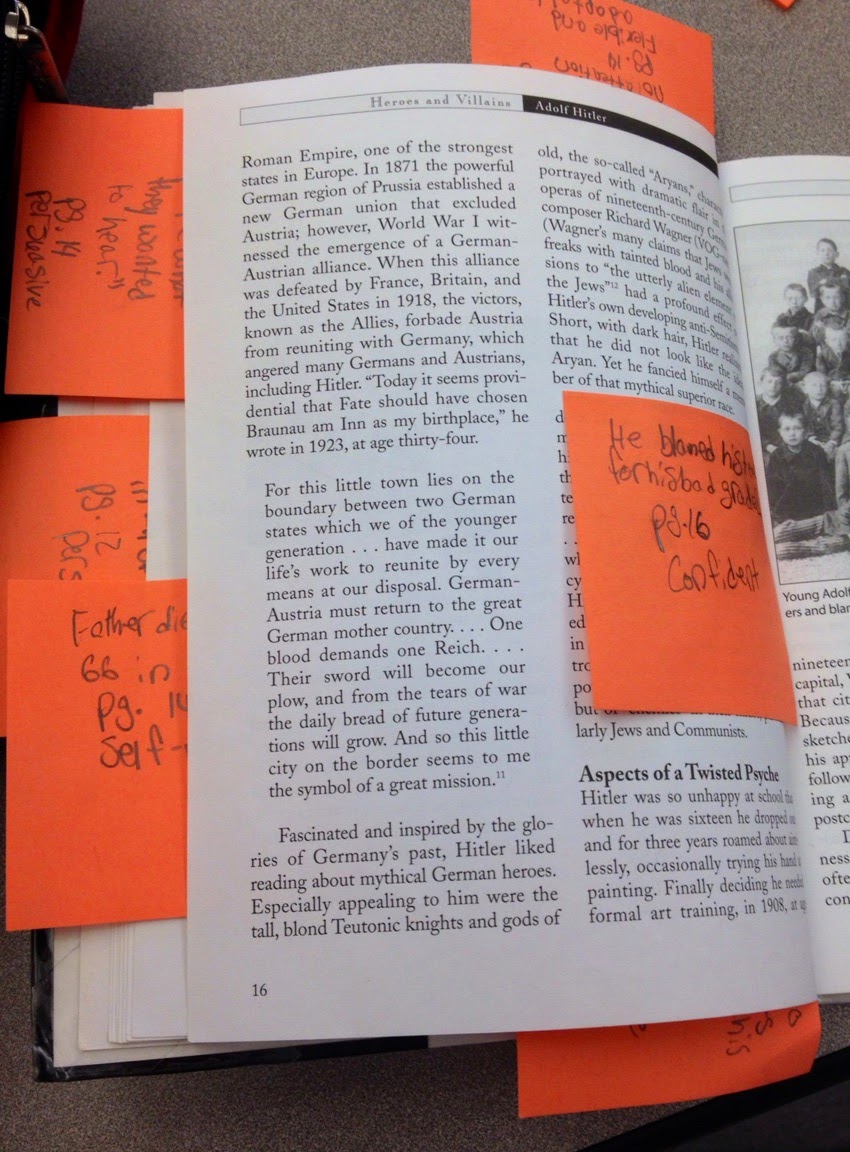
We really couldn't get the kiddos into their books fast enough.  Some of them had already gotten through half of their books because they'd been reading outside of school, and we wanted to arm them with some hard-core purposes before they got any further.  With sticky notes in hand, they attacked their books - looking for examples of the ten characteristics of influential people and answers to some of their preliminary questions.  At this point in the game, we didn't even really want them stopping to jot down notes other than on the sticky notes, and I have to say, it was an effective decision!  Some of them went sticky-note mad, marking spots on every page where they identified examples of how their person demonstrated confidence or public speaking, or the art of persuasion.

As you can see, the heavily-hit background information and purpose setting has made all the difference in the world to these kiddos.  And we still haven't told them what their final product will be!  Because the final product is not our real purpose, we didn't feel like we needed to focus too much on it, and honestly, we are having entirely too much fun to focus on ruining it with a final product.  We do have projects and rubrics ready to go, and the plan is to introduce them this week, but the kiddos are much more interested in the process than the product.  When more than half of them raised their hands when I asked who was enjoying their biographies - I knew we had them hooked.

Saturday, April 26, 2014

Background knowledge and purpose setting - without them you could face epic fail

This topic never gets old for me.  I think it is because I've walked into dozens of classrooms over the years and have heard students ask over and over and over again, "Why are we doing this?"  When those words come out of their mouths, immediately I understand that the relevance of the activity and information has left the building, and the kids are instantly disengaged.  Posting standards and target goals in one's classroom gives a purpose, but the relevance is still not there.  Thus, continued disengagement.  Well, the last two weeks I have been working with two educators who are always willing to step out on the highest cliff with me and peer over just to see what possibilities lie over the edge, and I have to say, its been so wildly successful that we have rallied two more teachers to join us on this adventure!

Its tough to let go of things we have loved from years past.  There is currently a joke running in our department about a dramatic version of The Diary of Anne Frank and how this has been one of the toughest pieces for some teachers to "let go".  My risky colleague is no different.  Last year she and I collaborated on her long-loved biography project.  It's one of those projects that she has been teaching for years, and we needed to revamp it to cover the correct standards.  I'm a firm believer that if you really love something that much, you'll teach it with passion, so I knew that we needed to fix it up and make it work for her.  

Well, she approached me again about this same unit three weeks ago, but this year we were both ready to amp it up.  In the past she has had students choose biographies, read them, and then do some sort of project on the person.  As with so many other long-standing projects across the curriculum, it was a basic research report where kids choose a topic and become the expert on this topic, and we pray that they have found enough relevance and interest in the topic to complete it. This year we wanted to tie in some argumentative tone to the project, so we met and decided to focus on the essential topic Most Influential People.  We decided that students would be required to research a person and then provide evidence that proves that the person is, indeed, one of the most influential people in their field.  

Our first meeting consisted of pinpointing standards that we wanted to be certain to cover in-depth and then outlining our expectations.  We knew we wanted to focus on the research process, and we knew that we wanted to leave the final project open to student choice. After that planning meeting, we met off and on to start the process of front-loading important information, and we decided that we needed to get everybody on the same page in terms of defining what an influential person was.  I was also able to interest my retired former-colleague (and Project CRISS partner in crime) Pam, who loves to come back and share her wealth of knowledge with middle schoolers.  

Because the project has turned out to be one of the most interesting collaborative adventures I have ever had, I wanted to outline, in depth, what we did - partly to share what we have done and partly to remember the beauty of how it all came together.

Our first few days with the students focused on the phrase influential person.  We did a few background knowledge activating activities which ended up being as telling for us as they were for our students.

  • We had students draw a target on a piece of poster paper and fill in people they considered to be influential in their families, school, neighborhood/city, state/nation, and the world.  This was an immediate bust.  It was clear, after only a few minutes, that some of our kiddos could identify the word influential, but few could apply it and identify people they would consider influential because their definitions of the word were so wishy washy.
  • We then went back and had students discuss, in groups, their definitions of the word before they looked it up in the dictionary to clarify their misconceptions.  A whole group discussion took place, and we pointed out misconceptions over several days.  My biggest fear is always that students will go back to their former thinking because its easier and has been ingrained in them for so long.
  • Finally, we had groups discuss and identify a list of ten characteristics they thought a person of influence might have.
Students took purposeful notes
I knew I wanted to hit this idea of influential people really hard, and I also knew that if we didn't clean up all misconceptions on the word that our project would fall apart during the early stages - an epic fail I was not willing to watch, considering we actually had the time to clear things up.  We decided to work this idea for a week.  My colleague and I googled "characteristics of influential people" for kicks, and we found some pretty amazing articles on the web that outlined what these organizations believed it meant to be influential.  We chose 4 different ones (two from Forbes  and the other two from different websites that focused on self-help).  One was so long that we split it into two.  From there we performed the same twisted jigsaw that I had done with a group of kids in science earlier in the year.  
Discussions began
  • Print enough articles for every student to have one (be sure to even out the articles so that each one is read by the same number of students).  Have students choose what article they want to read and get into groups after they've chosen.
  • Give students their purpose for reading the article.  Their purpose is to decide which of the characteristics they feel are most important and to be prepared to explain why by arguing the case for the chosen characteristics.
  • Once everybody in the group finishes, the group must somehow agree on the most important characteristics.  If one person feels strongly about their second choice, he must argue his case, but he cannot choose it unless the entire group agrees.  By the end of this group work, all students in each group should have identical lists of characteristics and be prepared to provide reasons why they were chosen.  Here is where it gets fun.
  • Count each group off again.  In one group, each person gets a different number.  Then put the new groups together by number.  Now each new group should have at least one person in it that has read a different article.  In a normal jigsaw, the job of the group would be to "teach" the information to the rest of the group, but not in this one!
  • Every student in the group will, undoubtedly, have come armed with three to five characteristics of an influential person - all from different perspectives.  The group's job is to whittle down those into a list of their top ten.  What our kiddos found was that one characteristic may have shown up several times, and all they had to do is put some of them together!  Some, however, had to be debated.
  • Their final list then got submitted to us before they left for their next class.
Once we got those lists, we took the time to cut them apart and put like-characteristics together until we came up with a long class list of every trait mentioned.  The next day, we made the class discuss and vote on the final top ten.  What we found beautiful is that six of the ten characteristics chosen for the top ten were the same in both classes!  I'd call that success!

Our kiddos were finally ready to move forward to previewing topics and choosing their biographies.  Reflectively speaking, a few beautiful things happened during this entire pre-learning stage.  
Final lists derived from jigsaw activity
  • In the time that it took us to complete this entire process (about a week), only one student got "schooly" on us and asked what the final project was going to have to be.
  • Misconceptions were cleared up, and we now had an easily accessible list of ten characteristics that students could use while they played detective in their reading of their biographies that they didn't even HAVE yet.
  • Interest was piqued.  I say this with hindsight because we are several days ahead as I write this, and the behavior of the students after they received their biographies blew us away.  More details to follow on this.
  • A good discussion was had in both classes about negative influences and how they would align to the top ten characteristics. Without even doing it, students had developed a top ten list that would easily include the negative influences as well as the positive.
The next steps in this process are just as exciting, but this is a great place for me to stop for now.  What I can say is that every day I cannot wait to step into this classroom to see what is going to happen next.  Even though our plans are secure, the implementation is entertaining.  Watching our students remain engaged excites me.  But what really is interesting is that they all know they will be expected to produce something at the end, but they're so involved in what they're doing right now that none of it seems to matter.  Next weekend, I should be able to report to you the process of choosing topics and beginning the prep for research.  Stay tuned!

Saturday, September 28, 2013

September 27 Crumble - Close Reading

The 2013 educational buzz word seems to be close reading, and, unless you're a language arts teacher, you may not completely understand this term.  In fact, some language arts teachers still struggle with it because it's complex and has no concrete rules.  I, myself, become impatient with the practice because I'm a slow reader, naturally, and close reading just makes me read more slowly.

So what is close reading, why should I care, and how could I use it?

Close reading is very much what the term says - it's a close reading of a piece of text for a particular purpose, looking for clues to help you determine what is important for your purpose.  It blends Project CRISS's purpose setting principle and the free-write into one strategy.  When you give your students an activity or a piece of writing, you do it because there is a standard or target that you're trying to hit.  Consider that target when you give your students the assignment, and either communicate it to them or allow them to identify that purpose on their own (checking to be certain they are on the right track). 


To illustrate, take a piece of reading from a book selection on climate change (one of my current collaborative projects).  Your objective may be that students identify causes of climate change.  You communicate that to students and give them the passage.  Modeling the close read is always important, so on the projector or on the board with colored markers (our low-budget interactive white board), show your students what you expect.  A close read is not simply highlighting the causes of climate change, however - but that's a good start.  It requires multiple read-throughs, stopping after EVERY sentence and processing what the sentence is really saying.  The picture to the left shows what this might look like on the white board (thanks to my most amazing colleague for takings pics during one of her lessons!  You can check out her super cute and informative blog right here!).  Notice that she color-coded the annotations here and even made a key. 

This next picture to the right shows how it might look without the color coding.  Notice that she labeled a lot of what she underlined.  The idea here is to have students converse with the author of the selection - to stimulate the internal conversation that is missing so often when students read.  Our kiddos are being asked to perform more and more complex tasks while learning and reading, and many of them become so overwhelmed with the daunting requests that they freeze and forget to be metacognitive while they read.  The close read requires metacognition because students must record their thoughts about the text as they read.  This ultimately gives them a closer understanding of what they are expected to read and allows them to process and ask for help with difficult text.

What can they highlight, underline, or annotate? you ask.  Below is a list of ideas that you can give your students as they practice their annotation and close reading.
  • Main characters or the "who" of the selection and evidence of traits of those characters (this can include the narrator).  Traits can be inferred, but the evidence to prove that inference should be marked and noted.
  • Setting or the time and place of the selection as it pertains to the purpose of the reading
  • Problems/Conflicts and solutions as they pertain to the purpose of the selection
  • Unknown vocabulary
  • Cause and effect relationships
  • Chronological events that pertain to the purpose of the reading and notes as to how they relate to each other
  • Questions that you have for the author (that may or may not be addressed later in the selection)
  • Answers to previous questions asked
  • Reactions to surprising points
  • Details that support a conclusion that you have drawn
  • Connections to previous learning or real-life situations
The options are really limitless, but remember - your students will get lost in the text if they don't have a focus.  To simply tell them to perform a close read will require them to set their own purpose, but unless you guide them, some of them will, undoubtedly, miss the entire point of the lesson and spend a lot more time processing useless facts than necessary. 

If you're interested in taking a stab at this truly valuable strategy, pick the brain of a language arts teacher this week!  All of our students should have been practicing their close reading the first part of quarter one, and some of them are ready to take their show on the road to other subject areas.

Friday, September 13, 2013

September 13 Crumble - Purpose Setting - the key to engaging our students

I have a ten-year-old who doesn't like to read.  But every once in a great while I can't get her head out of a book.  It's at those times when I look at her and ask myself, "What is different about this time, and why is she making the choice to read?"  In her case, eighty-percent of the time it is a non-fiction book that has captured her with a picture that made her go, "What's that!"  And at her age she knows that she will find the answer inside. 

So how can we transfer this type of behavior to our classrooms?  One of Project CRISS's Principles and Philosophies is Purpose Setting - but we're not just talking about telling kiddos why they're doing what they're doing.  Purpose setting comes in all sizes and shapes - including the "sneaky-teacher" ways of getting kids interested.  Here are some ideas to get your students motivated to read, learn, and participate.
  • Play a video related to your content (YouTube, United Streaming, DVD clip) that is not too long (6-8 minutes max) - something that is edgy or entertaining, and maybe evokes emotion.  After the video, ask students to write observations and reactions.  Give them a sentence frame if you think it will help.  Expect them to give details about their observations and reactions. Have students discuss and share their thoughts and then have them ask questions about it. You now have the beginnings of purpose (their questions).
  • Use music.  Kids love music.  Many of them write, and if you approach their lessons in a way that breaks down their own music or allows them to understand what goes INTO writing it, those with a musical inclination are more likely to participate.  Is there music that relates to the topic at hand?  I'm not talking a song about the scientific method or the fifty states, but music that somehow connects to the topic at hand.  You make the connections for them initially.  Have them observe and ask questions. 
  • Google Images is, hands down, one of the most fun places to go when you're curious about something.  Why not use it to gather some attention and show images that related to something in the lesson before giving the lesson and see if you can get kids to react to it.  So how does your topic of study connect to students' lives TODAY?  Find some images.  Have students write and discuss their observations and reactions and . . . you guessed it - ask questions!
In the three general ideas listed above, there are some commonalities that I'd like to point out, and then I'll let you take it from there. 
  • Get the kids thinking about the topic before they learn.
  • Engage them in something other than reading or talking (viewing, listening, or playing).
  • Require them to observe, write, and react.
  • From those observations, require them to ask thoughtful questions.  The questions asked can be used to drive your instruction or not - but a good educator can easily find the balance between what the kids want to know and the stuff that we're being told is important. 
It's not tough - in fact, I find that our purpose setting activities can be the most fun part of the lesson because it requires students to express themselves.  This is the beauty of middle school!  They're just learning to express themselves - their viewpoints and opinions, and yet we don't have to reel them in too much.  You can learn so much from just talking to your kiddos, and who knows?  Maybe what you learn from them is a new way to look at the topic!